1. Rationale for throwing off the jet
I began running the jet sweep six years ago as an addition to our offensive package. In those six seasons, I have used the sweep and its inside running complements more in some years and less in others. A few years our entire running game has been based on it. One constant I have found with the package is the advantages it gives in throwing the football. I have found that throwing the football off of jet sweep action gives the offense a number of advantages. First, the pressure the jet sweep puts on the perimeter will often force a defensive reaction. This allows the quarterback to know where defenders are going on the snap, which makes it easier to know where and when a route will be open. Second, the sweeper accounts for edge blitzes on the side he is sweeping. This gives the offense a seven man protection while still having four receivers out in routes. Third, jet motion allows for the quarterback to throw from multiple launch points while still having the advantages of a play action pass.
2. Protections and QB launch points
We throw three types of passes off of jet motion: drop-backs, quicks, and sprint- outs. We can throw quicks and drop-backs both to and away from the side in which we are motioning. In our system, plays run to the side we are motioning to are referred to as jeep plays, and plays that run away from motion are referred to as joker plays. Our drop-back passes are our 60-70 series, and our sprint-out passes are our 80-90 series. 60’s and 80’s go to the right, and 70’s and 90’s go to the left. Our quick passes are in our 60’s and 70’s series with the word QUICK tagged to them to let the quarterback and line know that the drop will be short. We also mirror all quick routes.
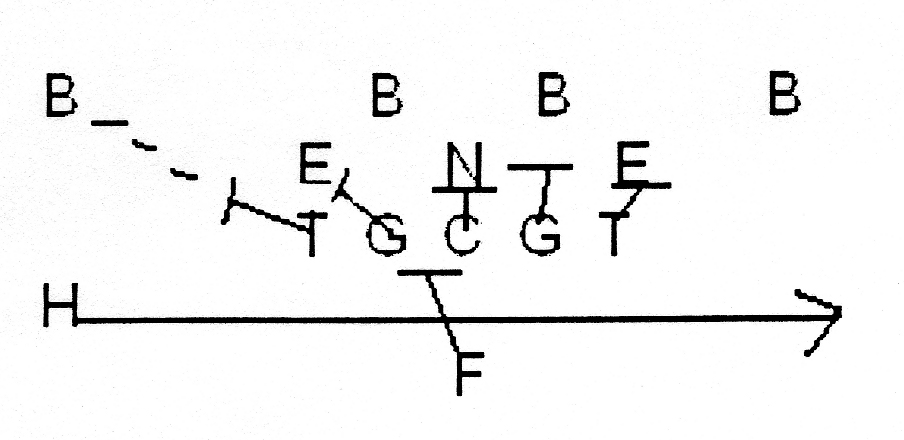
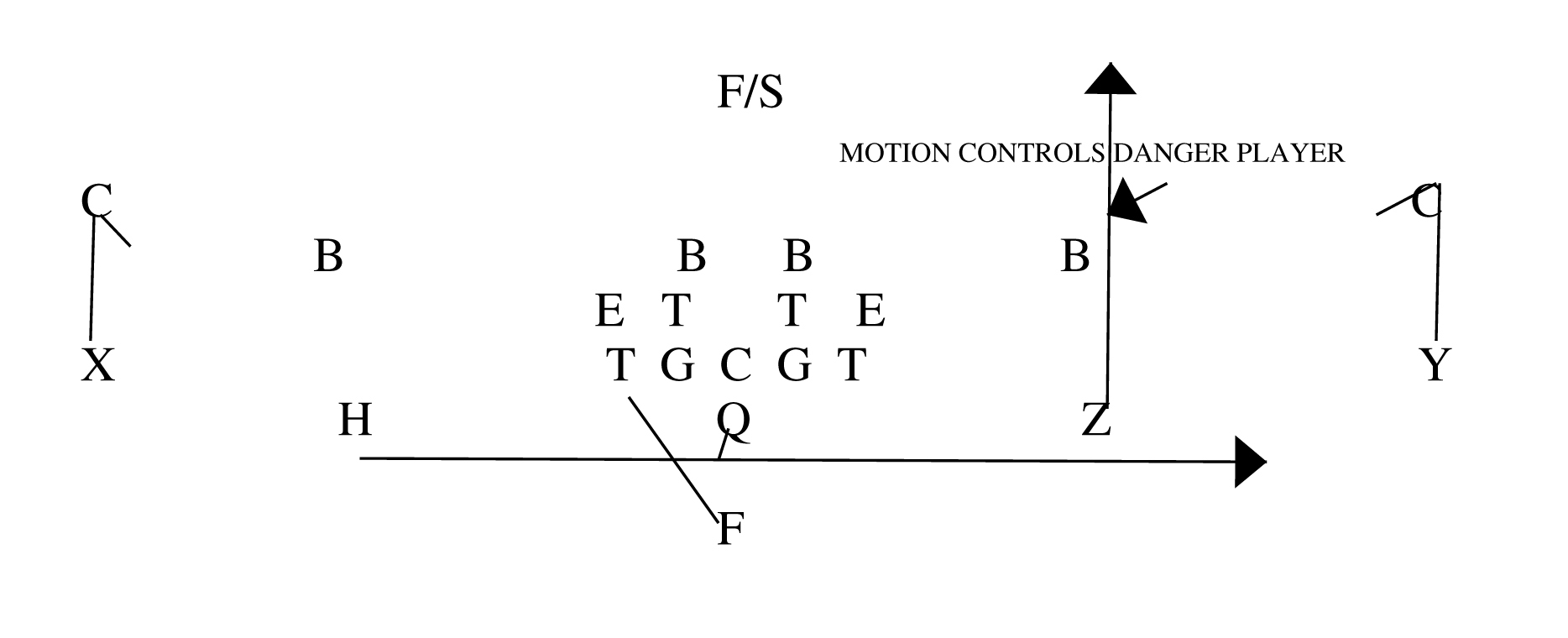
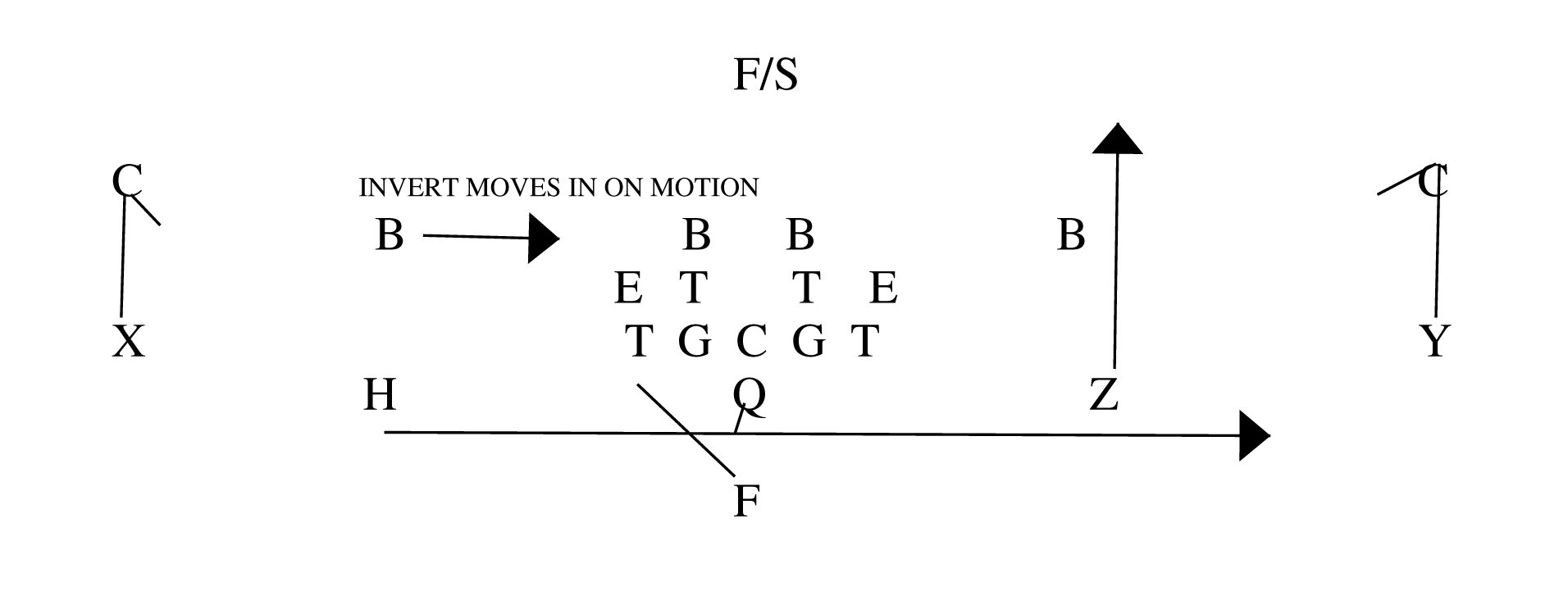
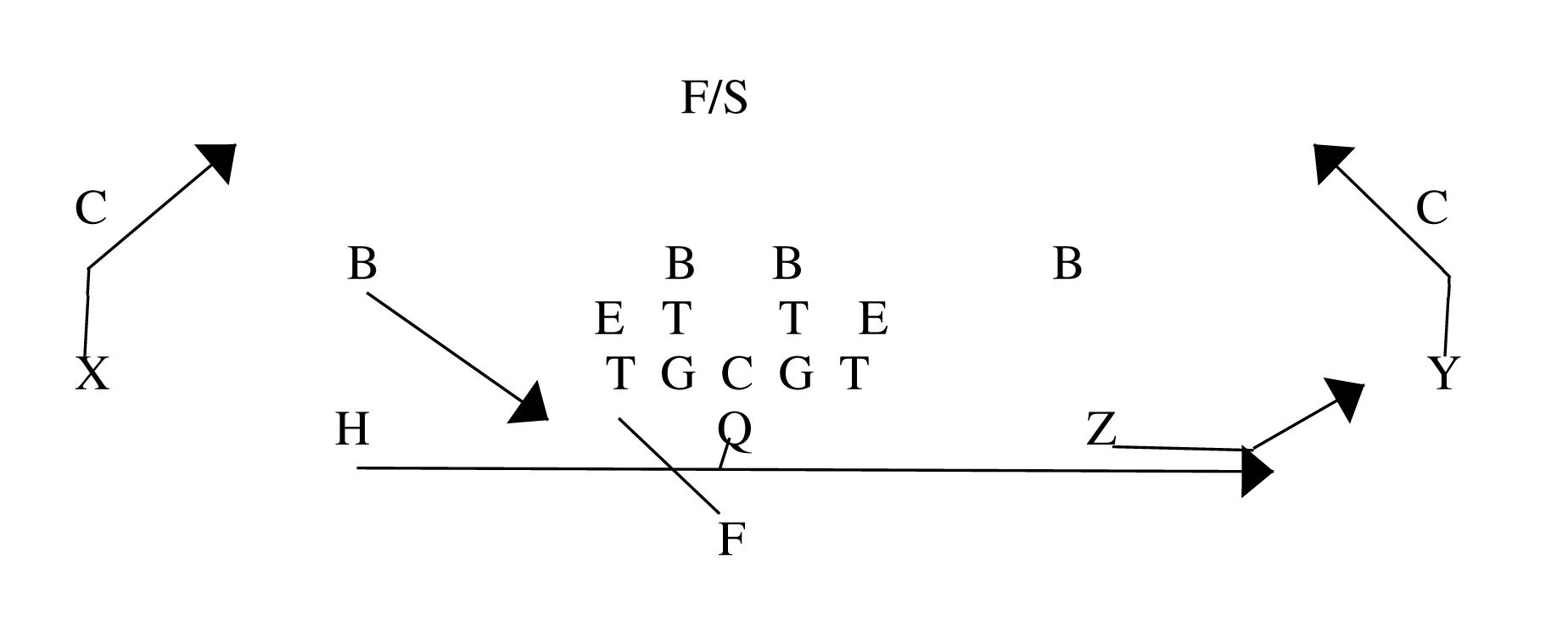
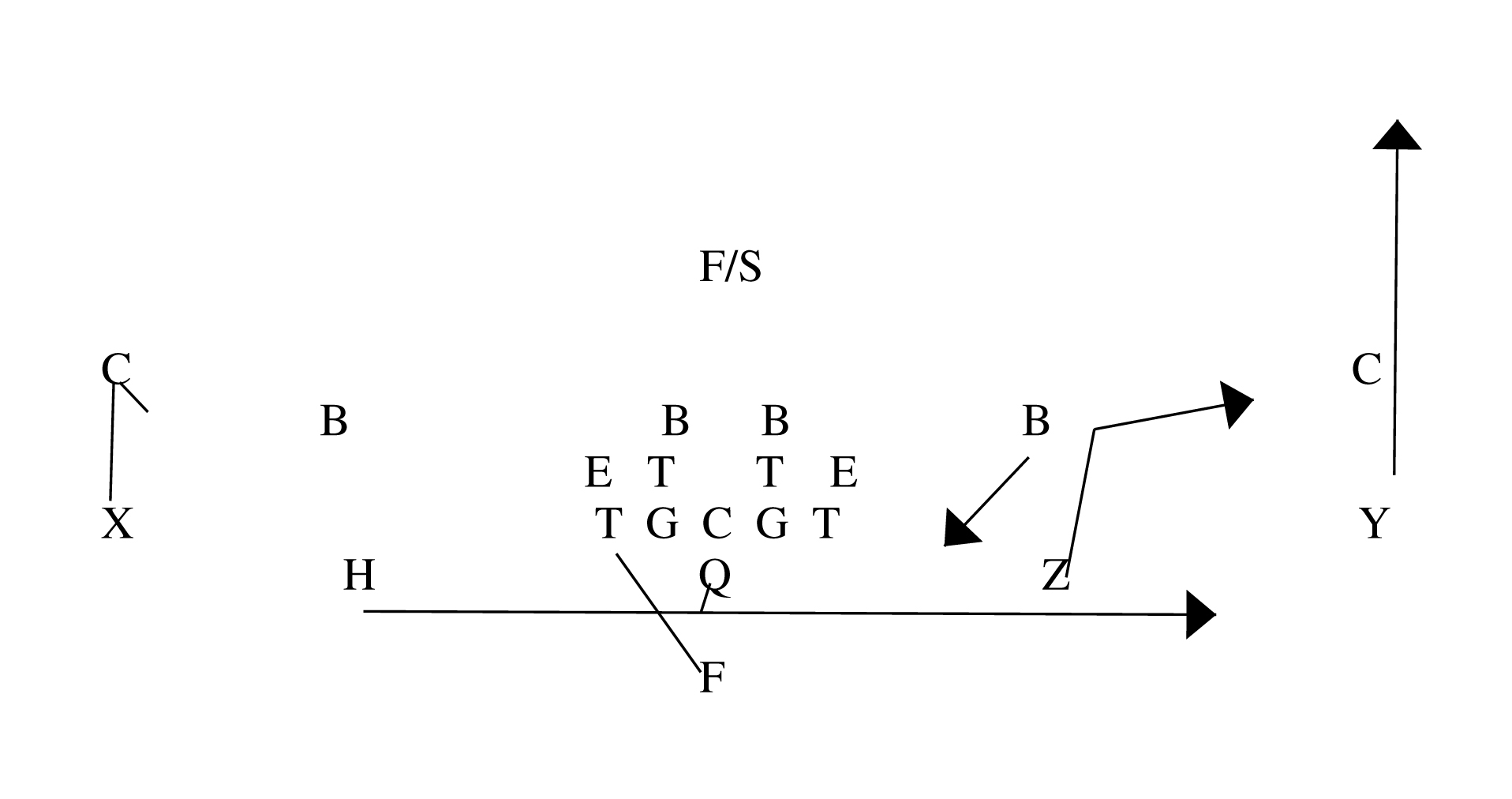
In our drop-back protection, we are in a big-on-big protection with the back helping inside-out on the backside. The center will work frontside if he is uncovered and eye the frontside inside linebacker. If the center is covered, the center and the uncovered guard will account for the frontside linebacker in a blitz pickup. Versus odd fronts, the guard and tackle on the backside will account for the man on the tackle and either the stacked linebacker or walked linebacker. The player running the jet fake accounts for any edge blitz to the side in which he is motioning. On joker plays, where the jet fake is going backside, the protection flips with the center now working backside and the back working frontside (See Diagrams 1-1 through 1-4).
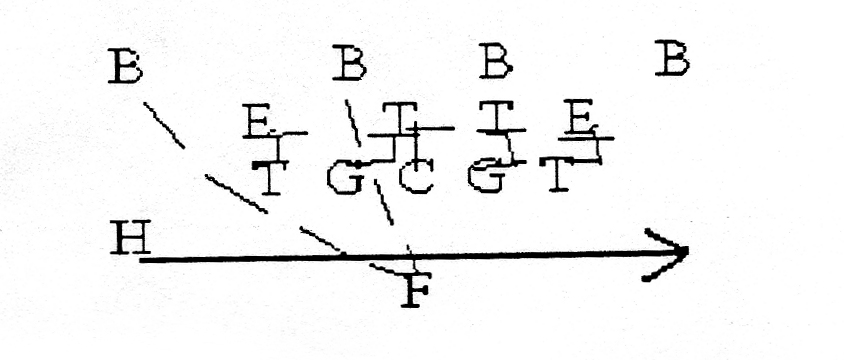
Our quick protection is exactly like our drop- back protection except for the fact that we are now aggressively attacking our protection responsibilities on the line of scrimmage.
In our sprint-out game we employ a reach-and-hinge protection with the back sealing on the frontside. Every covered lineman will work to reach the defender over him. Every uncovered lineman will take a lateral step to the frontside and punch to give the next playside lineman inside help. He will then check, in order, any blitzer coming over his position and any defender coming free in his backside gap, to any defender coming free from the backside edge. The back will aim for the outside leg of the tackle or tight end and seal to the inside.
The QB’s footwork on drop-back passes off of jet action is critical to the success of the play. If the motion is going to the right, the quarterback will call for the snap when the motion man gets to the left guard’s outside hip. He will step back with his left foot at 6 o’clock and give a hand fake with his left hand to the motion man. He will then step right, left, right, left, right, plant, and set up to throw. If the motion is going to the left, he will step straight back with his right foot at six o’clock, and give a hand fake to the motion man. He will then step left, right, left, right plant and set up to throw.
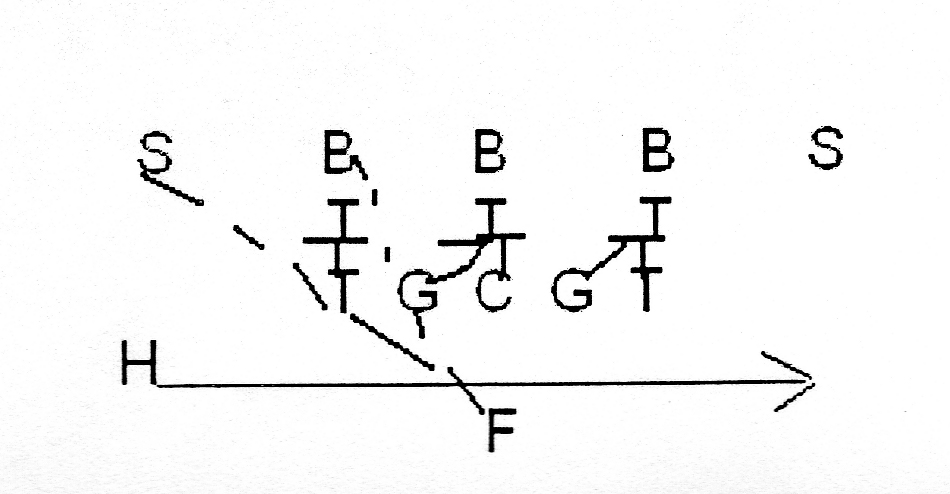
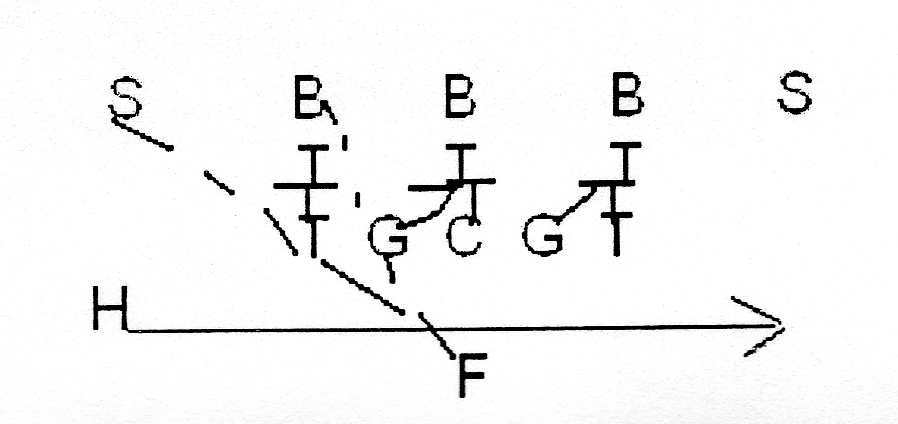
On quicks, the QB’s footwork is equally important. If he is throwing to the side motion is going to (Jeep Quicks), he will step back at 6 o’clock with his backside foot for as much depth as possible, then wheel completely around, getting his feet set to throw. He does not worry about making a hand fake. For example, on Jeep 61 quick (Diagram 2-1), the right is the front side. Therefore, the quarterback will step with his left foot first and wheel around to face the right side of the offense. If he is throwing to the side motion is coming from (Joker Quicks), he will step with his playside foot, then gather his feet and set to throw. For example, on Joker 71 Quick (Diagram 2-2), the left is the front side. Therefore, he will step back with his left foot first, gather with his right and face the left side of the offense. See Diagrams 2-3 and 2-4 as well for Joker 72 Quick and Jeep 63 Quick.
In our-sprint out game, we allow the motion man to get directly behind the quarterback before we snap the ball. This takes away some of the deception of the fake. However, we feel that the perimeter defenders who we are attacking in our sprint-out game have a hard time seeing where we are snapping the ball. In addition, we run our off-tackle belly play from this same snap point keeping the inside linebackers in conflict. On sprint-outs, the quarterback will step with his backside foot at six ‘clock, reversing out to the side we are throwing to. He will get depth as he rolls out and tries to come as close to the fullback as possible on his sprint out. It is important for him to get depth so he can get his shoulders pointed toward the direction of his throw on the perimeter.
3. Routes
In our drop-back series, we try to attack aggressive safeties. We only really see four coverages: either cover three with the free safety running the alleys, quarters coverage that rotates to cover three-on motion, quarters coverage in which an end or invert plays aggressively on the run in the flat, and cover two with the corner attacking the jet motion. We feel that with four route combinations, we can have a way of attacking deep against all of these looks. The four route combinations we have used are our Hawk Route, Eight Route, Wrap, and Cowboy. In our system we number receivers from outside in. Therefore, the widest receiver is #1, the next #2, and so on. We teach the routes as combinations.
Our Hawk Route is our four-verticals route (See Diagram 3-1).
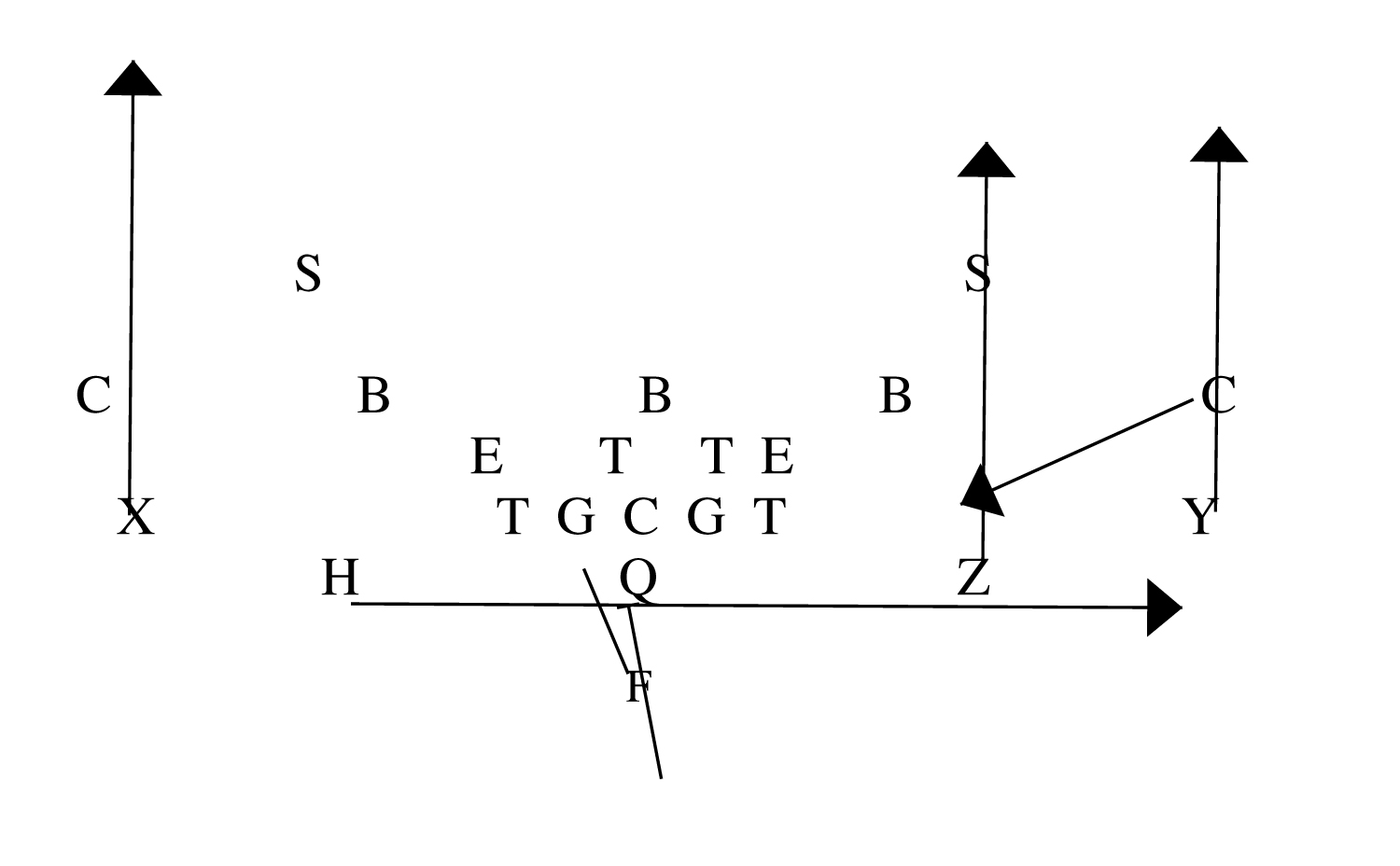
When we throw it with jet motion, it becomes three verticals. We tell the motion man to run a bubble route to the numbers, and sit there if no one is in the flat. If a defender covers him, he works for depth at the numbers and tries to uncover himself. He is an outlet receiver for us. We tell the motion runner on all 60’s and 70’s passes that if he sees an edge blitz coming, he should not try to avoid him, but instead collision him and become part of the protection. The outside receivers run down the numbers, and the inside receiver runs down the front side hash. We really only use this when we see a true cover 2 with the corner attacking the jet. In diagram 3-1, you can see how the vertical by Z holds the safety on the hash opening up the wide out on the outside. The QB reads it as a progression in this instance where he looks at playside #1, to playside #2, then to the bubble.
Both our Eight Route and Wrap Route (See Diagrams 3-2 and 3-3) are designed to attack quarters coverage.
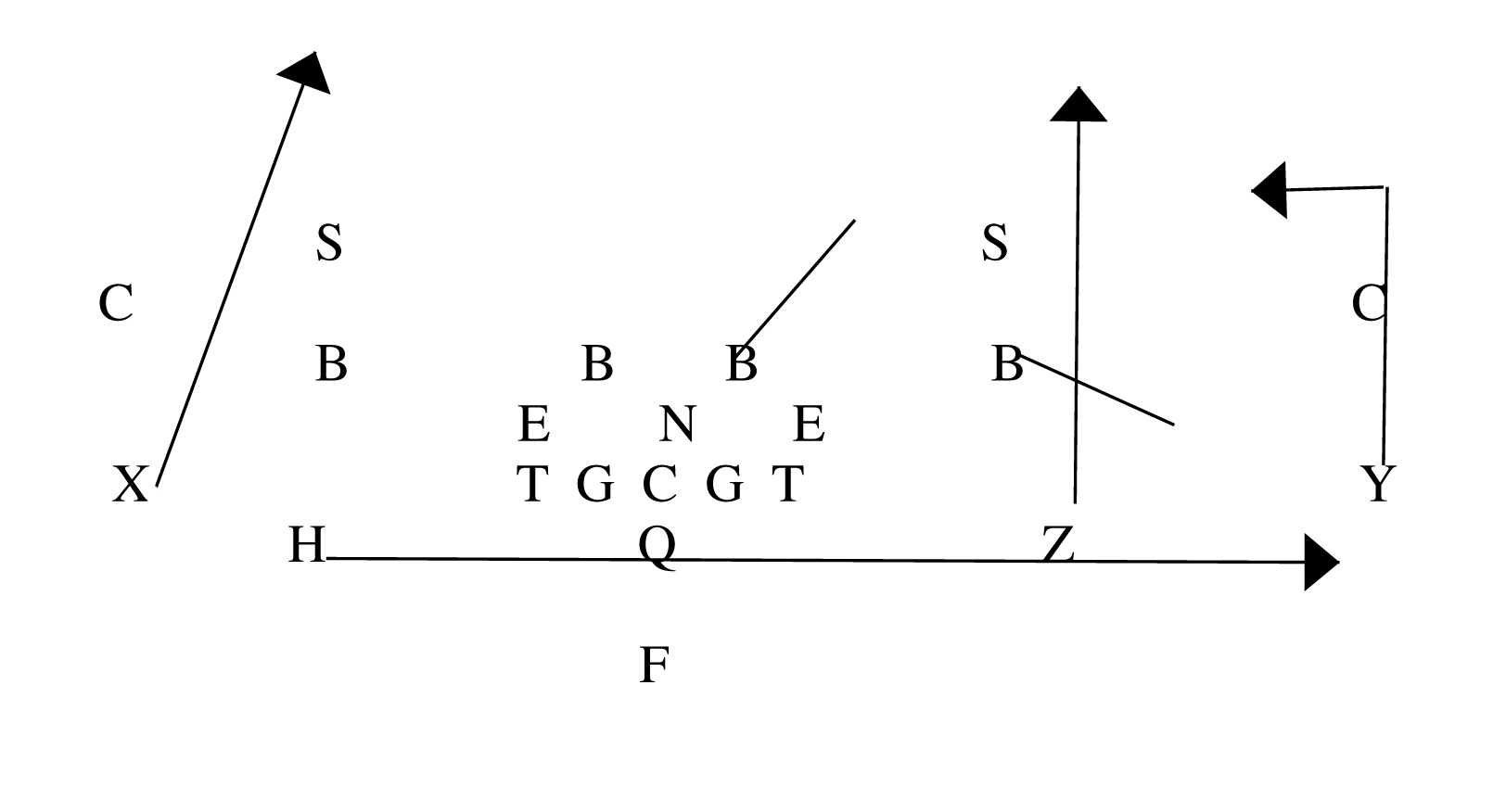
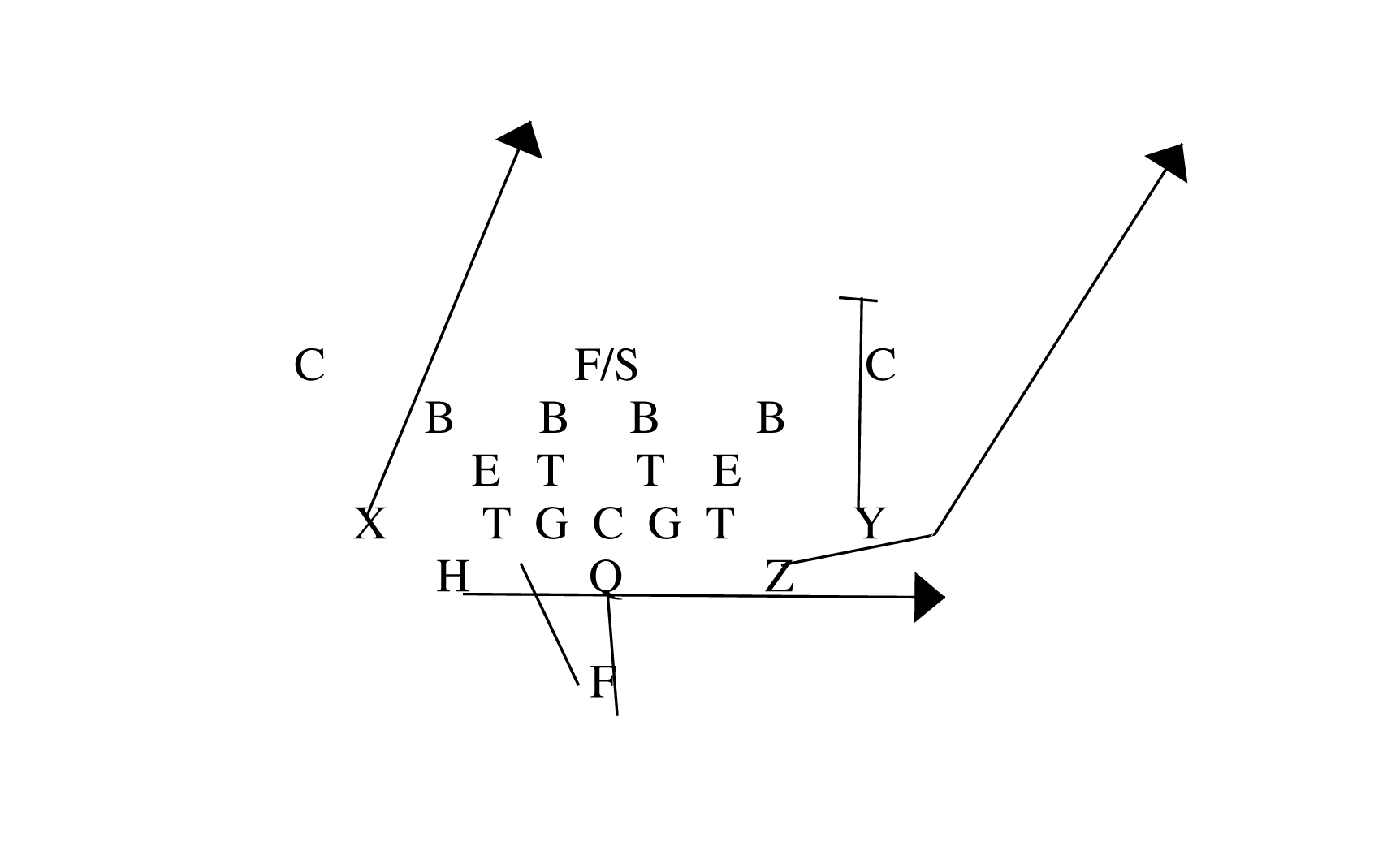
In the Eight Route, the inside receiver runs a go route and the outside receiver runs a 10- yard dig route. We tell the outside receiver to settle as soon as there is an open lane between him and the quarterback. The motion man always does the same thing, looking to run the bubble or attacking the edge blitz. On the backside of all drop-backs and sprint-outs, our generic rule for routes is for the #1 receiver to run a post, and the #2 receiver to run a drag working to a depth of five yards. However, we tell backside #1’s that if we have a route from the front side going into the deep middle part of the field, their route must not cross the hash on their side of the field. On the Eight Route, the quarterback will keep his eyes on the front side safety if he is flat footed or has come forward. We then want to throw the go by him. If the safety has gained depth, we look for the dig. If the dig is covered, we find the bubble.
Diagram 3-2 shows how we have created two stretches on the defense. First, we are high-low stretching the safety. If he sinks, he cannot defend the dig. If he comes up at all or sits flat footed, we feel we can hit the Z in the seam before the backside safety can come over to help. We widen our split with the playside slot at times to help facilitate this. If the safety is back, we essentially have a flat curl concept now underneath with the dig and the bubble. To keep the quarterback from being overloaded with two reads, we use our progression of the dig back to bubble once we recognize the safety getting depth.
Our Wrap Route attacks the same areas of the field. Now # 2 runs a 10-yard stop route. We tell him to work away from any inside linebacker that works to cover him. The #1 receiver runs a post over the top of # 2 with his post break coming at 10-yards. The motion man, again, looks to run the bubble. Our progression is exactly the same as for the Eight Route. As you can see in diagram 3-3, we have created the same stretches on the defense as in the Eight Route but with a different look.
Cowboy is a route we sprint to and also run as a drop-back play-action. We only run this route from a doubles formation with the receivers bunched tight on both sides. In our base two-by-two spread formation, we align as follows: # 1 will align on the numbers unless the ball is on the opposite hash when he will then align halfway between the numbers and the hash. # 2 splits the difference between him. Our flex formation moves everyone in with the wideouts aligning at four yards from the tackle and the slots aligning at two yards from the tackle. We use Cowboy with a drop back against cover 3 where the free safety is aggressively running the alleys. In our Cowboy route, the playside # 1 runs a 10-yard stop route, the #2 receiver runs a wheel fade working to 22 yards on the sideline. Our motion man again looks to run the bubble. We tag this play with the backside #1 receiver running a post directly over the football. We high-low read this with the quarterback looking at the stop route and the backside post. Because of the bunched alignment, the backside post has an easy time getting inside the corner, and we are able to attack the middle of the field quickly. The fullback’s role should also be noted. We run two inside run plays where the fullback will go to the side of the quarterback where the motion came from. One is an inside zone play, and one is the midline trap play. The fullback can help hold the linebackers if he will attack the line of scrimmage like he is getting the ball on one of those two plays.
In our quick game, we look to attack flat players who are either aggressively attacking the motion, blitzing on the backside of motion or falling inside to play the inside run game from the backside of motion. All quick routes are mirrored. We have three route combinations that we use with jet motion in our quick game. Our first route is a 5 step hitch by #1, and a seam by #2. Our second route is a 3 step slant by #1 with a bubble by #2. Our third route is a fade by #1, with 5-7 yard speed out by # 2.
We throw the first route both to and away from motion. When we throw it as a Jeep pass to the side, we are motioning so that it helps control the flat player by keeping him from expanding under the hitch (See Diagram 3-1) We will also tag it with the # 2 receiver running a hot route where he will sit down at 6 yards if we are getting a lot of blitzes from the flat player on the motioning side. When we throw it as a Joker pass, we are looking to isolate a receiver on a corner (See Diagram 3-2). This can occur with an invert player who is falling inside to play cut back on inside runs or with a two safety look where the safeties are rotating with motion. We also give the # 1 receiver the choice of converting the route to a fade if coverage is tight. Diagram 3-4 shows our 60 Cowboy X Post vs. a cover 3 defense.
We really only throw the second route as a single receiver route off of Joker motion. We like to run it when we are getting a lot of blitzes by the backside flat player. The third route is another way of attacking aggressive force players to the front side. We tell our quarterback to look at the flat and, if it is not open, take a shot down the sideline on the fade. In all of our quick routes, the motion man must be especially careful to not go up the field until he gets to the numbers.
In our Sprint-Out game with jet motion, we usually throw from compressed formations and use typical “bunch routes.” Our two main routes are our Mesh Route and Cowboy Route. In our formation system, our X and Y receivers are always on the line of scrimmage and our Z and H receivers are always off the line of scrimmage. In teaching our bunch routes, to keep things simple, we don’t teach the front side combinations in terms of a # 1, #2, and #3 receiver. Instead, the X or Y will always run a certain route, the Z or H on the front side will always run a certain route, and the motion man will always run a bubble.
In our Mesh combination (Diagram 4-1), the front side X or Y will run a flag route with the flag break coming at 8-10 yards. We tell the receiver to aim at a point 22 yards on the sideline. Our front side Z or H runs a whip route. He works to the first second-level defender inside of him, punches with his inside hand, and pivots to the outside until he has a lane between himself and the quarterback. The motion man runs a bubble again, either sitting at the numbers or working up the field if he is covered at the numbers. The backside X or Y runs a post directly over the ball.
In our Cowboy Route (Diagram 4-2), the front side X or Y will run a 10-yard stop route and begin to work away from the inside linebacker if he is covered. The front side Z or H runs a wheel, working to 22 yards on the sideline. The motion man runs the bubble. In both routes, the quarterback reads a progression as he is sprinting out. He looks for the bubble first, then the deep outside, then back to the whip or stop route. We really like the mesh route against two-safety defenses. We have found that we usually get the flag route behind the corner in those situations.
4. Conclusion
Over the past six years, I have had a number of different types of quarterbacks. Some have been good throwers and others have been more runners than passers. One thing that has remained consistent, though, is that all of them have been much better passers when they could predict pre-snap, with some certainty, what the defense was going to do. I have found nothing better than jet sweep action to bring about consistent responses from the defense.
About the author: Shannon Grimes has coached a total of 16 years, seven of them as a head coach both in Oklahoma and Kansas. He has coached six playoff teams with two of them reaching the Kansas state semi-finals. Grimes became the head coach at Watonga High School in 2005 and has lead led the team to its first two playoff appearances since the 2000 season. His overall career record is 52-27.