OUR PROGRAM had great success for several seasons using the Wing-T offense and variations of a Wing-T that utilized a one-back set with three and four receivers to spread the field and allowed us to vary our attacks. This type of attack enabled us to take advantage of our talent and we won two state championships.
In a subsequent season when we didn’t have the athletes that we had in the past, we decided to install a no-huddle offense, which we used about 30 percent of the time. After a 2-3 start, we began using our no-huddle offense more often. We won nine straight games and competed in our third state championship in a 6-year span.
Exploits Defensive Changes
Our no-huddle offense consists of four wide-outs and one running back. This package allows us to make coaching decisions that will exploit defensive adjustments. If the defense stacks up to stop the run, we throw the ball. If they set up strong against the pass, we run. If an opponent’s defense aligns to our formation, we’ll attack them where we think they’re most vulnerable.
It also allows us to make adjustments on the field during an offensive series. We’ll use this offense at any time in the game and at any place on the field. We don’t look at this as a hurry-up offense, but more as a move-the-chains offense. Every defense has weaker spots, depending on how it lines up against a certain formation. By using this package, a coach can exploit those weaknesses.
Our base offense is very simple to install, with only 10 plays. We have about 30 plays that we run out of our no-huddle set, but this article explains our base package.
No-Huddle Offense
Our no-huddle offense uses a combination of hand signals to the backs and receivers, and verbal acknowledgements from the QB to the offensive line. All of our plays are numbered and our formations have names. There are four parts to our no-huddle package.
- Calling the play.
- Reading defensive adjustments.
- Signaling the play in.
- QB relays play to OL.
Calling The Play
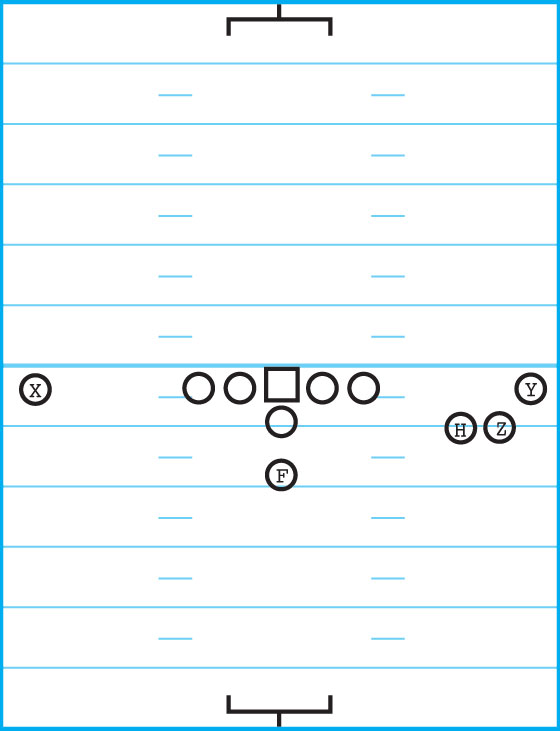
The coach calls out the formation. There are four basic formations:
DIAGRAM 1: Base. X and Y receivers always stay on the same position, while the Z is on the right and the H is on the left.
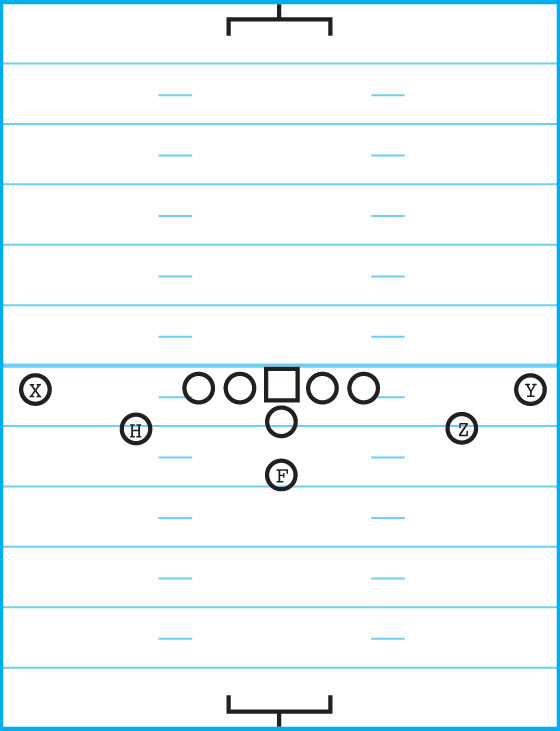
DIAGRAM 2: Trips Right Or Left. H is always the inside receiver on trips to either side while the Z is in the middle.
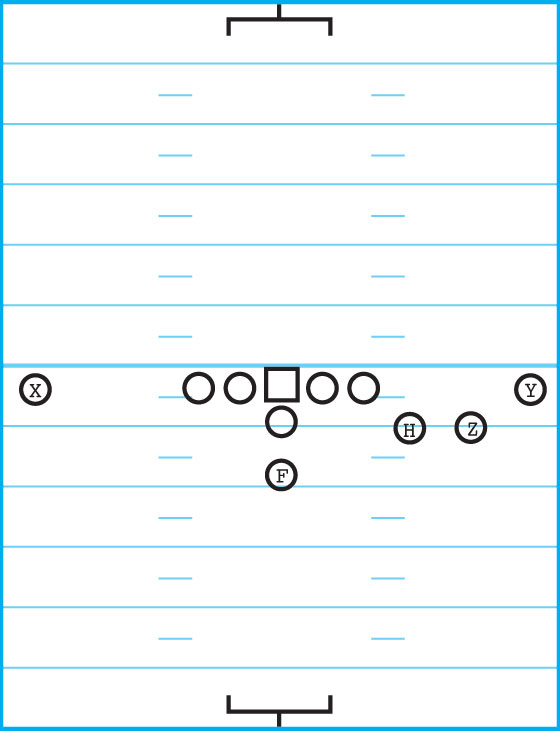
DIAGRAM 3: Trey Right Or Left (Bunch Formation). Our bunch formation is a tighter version of trips.
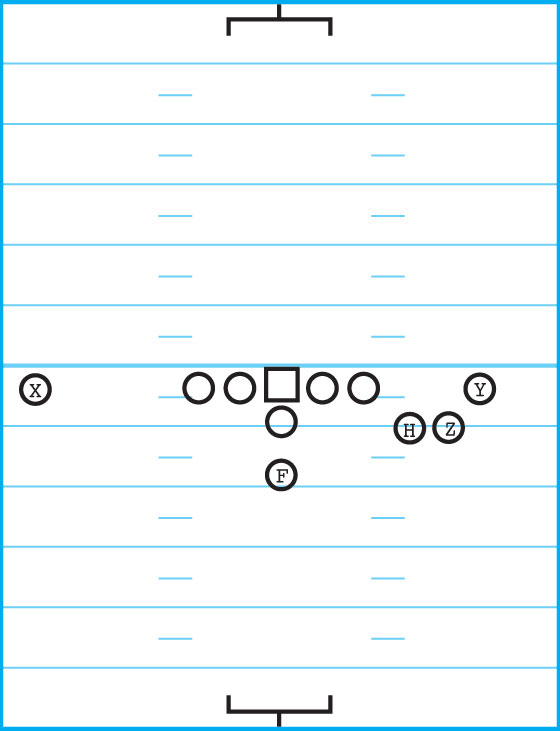
DIAGRAM 4: Triangle Right Or Triangle Left. The triangle is a very wide trips set.
Reading Defensive Adjustments
After the initial formation, the coach reads how the defense adjusts and then calls the play accordingly.
Check the number of defensive players in the box (tackle-to-tackle). If there are five in the box, we like to run the ball. If there are six or seven in the box, we’ll throw.
VS. 5 MEN IN THE BOX:
We have four basic running plays if there are five defenders in the box:
- Fullback Trap. We usually like to run a trips or triangle set to try and remove the extra linebacker. Then we trap the three technique or the four I side.
- Toss Sweep. Depending on the defense, we’ll either zone block, or pull one or both guards. We like to look for an overshift by the defense and attack the weak side.
- Zone Dive. We block for this play several ways, depending on the defense. Our two most-used blocking schemes are straight zone across the front, or we can gap down and pull the backside guard on the defensive end.
- Open Option. The open option is usually zone blocking to the play side with the exception of the play-side DE. The QB is responsible for the first person head up or outside the OT. He reads the option player and either keeps or pitches off.
VS 6 OR 7 MEN IN THE BOX:
We use six basic passing plays if the defense is loaded up in the box.
DIAGRAM 5: Smash Route. If we read that the corners are playing soft, we’ll opt to run the smash route. The outside receivers put their inside leg back and run a 4-step stop route. The inside receivers put their inside leg back and run a 2-step hot route. The QB takes a 3-step drop and delivers the football.
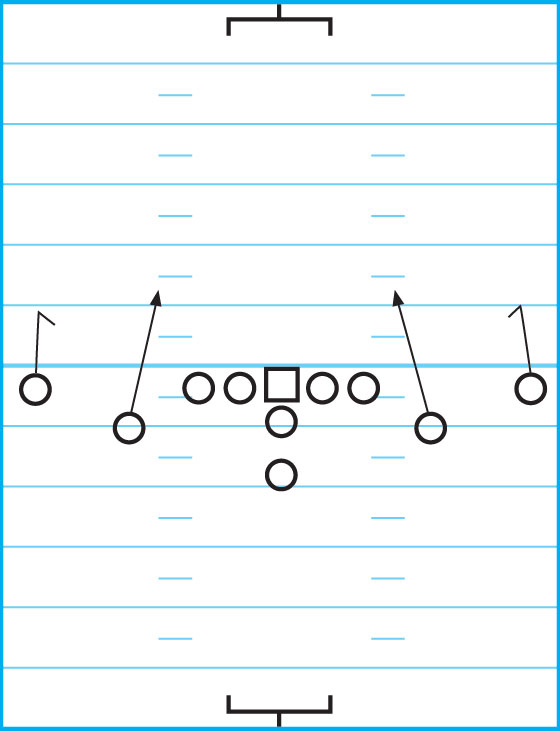
DIAGRAM 6: Fade and Flats. If we read that the corners are playing hard, we’ll attack with an outside fade and a flat route by the inside receiver. The inside receivers put their outside leg back and run a 4-step flat route, while the outside receivers put their outside leg back and run a 4-step fade route to the sideline. The QB takes a 3-step drop and delivers the football.
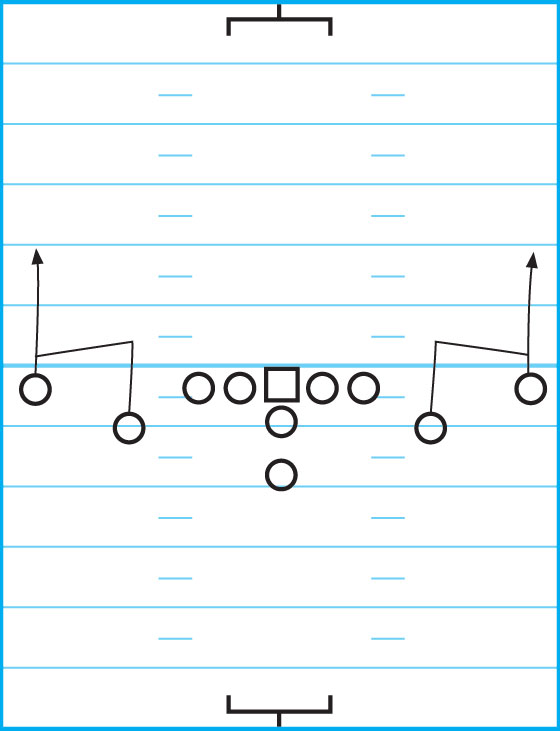
DIAGRAM 7: Bubble Screen. If the defense is in zone coverage or the OLB is covering the flats and taking away the smash, we’ll throw the bubble screen. The inside receiver puts his outside leg back, takes two steps straight back and then gets into the bubble attacking the sideline. The outside receiver blocks the most immediate danger to the screen. The QB takes a 1-step drop and throws the screen to the screen receiver.
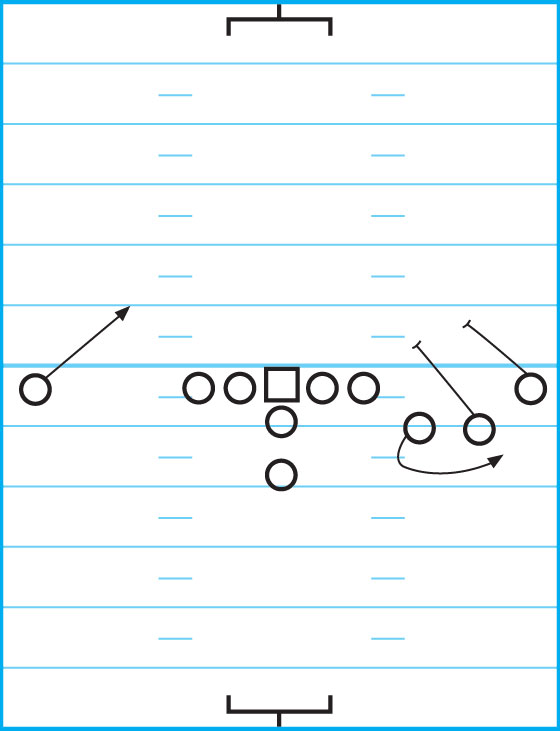
DIAGRAM 8: Hot Route. This route is going to be run to an uncovered receiver or to a receiver when we’re expecting a blitz to come from his defender. It’s usually run out of our trips formation. The outside receivers run fade routes. The inside receivers put their inside leg back and take two steps to cut in front of the defender. The QB takes a 1-step drop and hits the uncovered receiver.
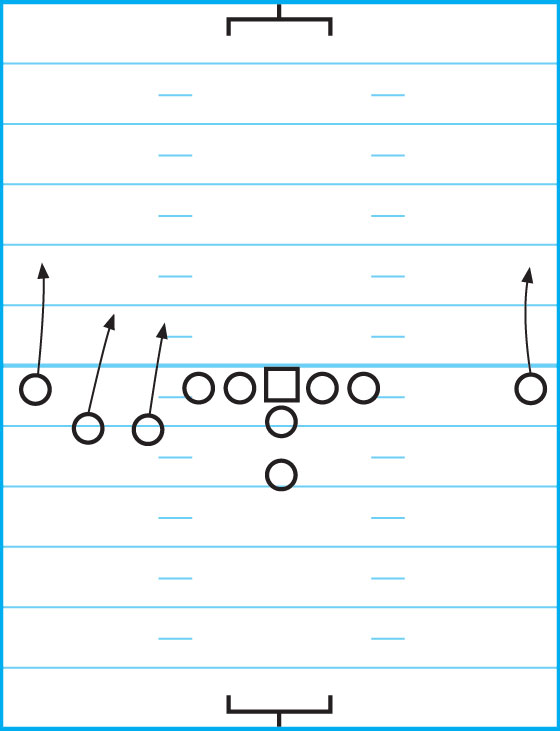
DIAGRAM 9: Slip Screen. The slip screen is best used against a heavy pass rush. The outside receiver in trips puts his inside leg back, takes two quick steps upfield and comes behind the line of scrimmage a yard back toward the offensive line. The slot receivers block out on the next receiver’s man while the OL blocks for 2 seconds, then release upfield on LB’s and DB’s. The QB takes a 5-step drop then drifts back, brings the defense to him, and dumps the ball off to the screen receiver.
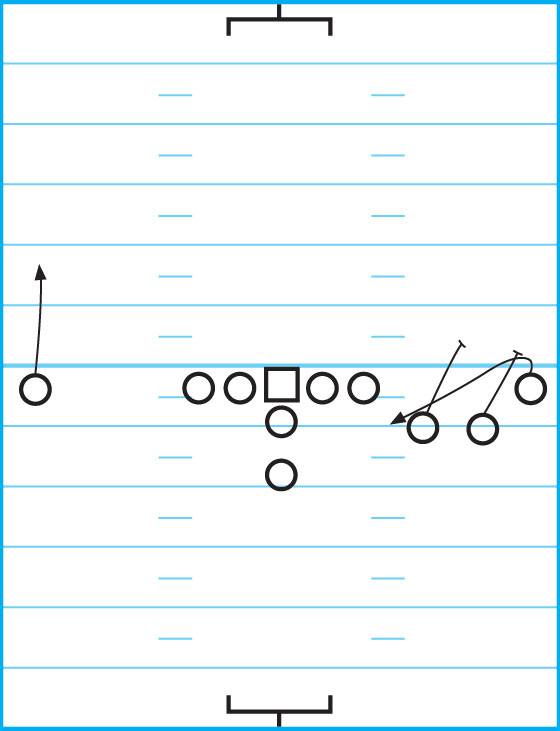
DIAGRAM 10: Sprint-Out Patterns. The QB sprints out to trips side and reads the defense. The outside receiver puts his inside leg back and runs an 8-step stop pattern. The middle receiver puts his outside leg back and runs an 8-step corner pattern (12 yard corner). The inside receiver puts outside leg back and runs a 4-step flat pattern (5-yard flat).
Coaching Note: All of our patterns are timing routes. That’s why we set our receivers up with either their inside or outside leg back and break their pattern off on a certain number of steps. For all inside patterns we have our inside leg back and on the outside patterns we put our outside leg back. This helps with the QB and WR’s timing on all of our patterns, eliminating a lot of guesswork.
Signaling The Play In
The coach signals the play to the backs and receivers. We have an indicator before each play is signaled.
Number System:
0 = Make an 0 with both hands.
1 = Top of head.
2 = Ears.
3 = Chest.
4 = Golf swing.
5 = Five fingers in the air.
6 = Six shooter from hip.
7 = Drink a 7-UP.
8 = Make an eight with both hands.
9 = Guns in the air.
Example Of A Play Call From Coach: Wrist is the indicator and he signals in order “Chest—Head—Wrist—7-UP—Head—Ears.”
The play signaled in was 71 bubble screen.
QB Relays
Play to OL
The QB then calls out the play to the OL along with the blocking assignment.
- The QB uses any color before the play and blocking technique is called.
- He then calls the play number to both sides of the OL with a dummy number after it.
- His third command is the blocking assignment or pass blocking assignment. He’ll use the words “Ray” and “Luke” to tell the OL which way to slide protect (The FB blocks the DE on the opposite side) and “Big” tells the OL to fan protect a 5-man front man-on-man.
Example Of A QB Call For The Bubble Screen: “Gold 71-23, Gold 71-23, Ray, Ray, Set Go.”