The punt: the most important play in football. At Monmouth College, we believe sound execution, communication, and efficiency in the kicking game are the cornerstones for success. Special teams demand a great deal of preparation, organization and attention to detail. In order to be a successful punt unit, we believe we must use the best players available, utilize meeting and practice time efficiently, teach and drill fundamentals, sell and motivate our players on the importance of special teams, and identify players with special talents.
Philosophy
At Monmouth College, we utilize the tight punt scheme. We break down our punt unit using the part and whole teaching method. We demonstrate the whole scheme then break down into individual positions to teach specific skills and techniques. Finally, we put the whole thing together and run the scheme. Our punt team concept is very simple, traditional and “old school”. We want to be able to teach it, have the athletes learn it, execute it and replicate it with a high level of confidence and success. We have gone back and forth over the last decade about using different concepts, schemes etc. (spread, rugby, shield), but it always comes back to the simple idea of what can we teach and execute in a timely and consistent manner that will be good against multiple fronts and stunts.
Organization
Our number one goal for the punt unit is to get every kick off. In 11 years at MC, we have had only four punts blocked. We stress protection over coverage. Goal number two is to have a net punt of 37.5 yards. The third goal is to hold the opponents return average to 1.0 yards or less. Our punters averaged 43.5 yards per kick and 42.6 yards net punting, respectively, this year.
Daily practice consists of a ten minute pre-practice session for long snappers, punters and returners. Kickers punt from both hash marks, the middle of the field, and into and out of the end zone. Individual protection and coverage drills and skills are done in pre-practice as well.
The full punt unit comes together at the following intervals:
Tuesday - 10 minute session
Wednesday - 5 minute session
Thursday – 10 minute session
Friday - multiple punts in air
Drills and Skills
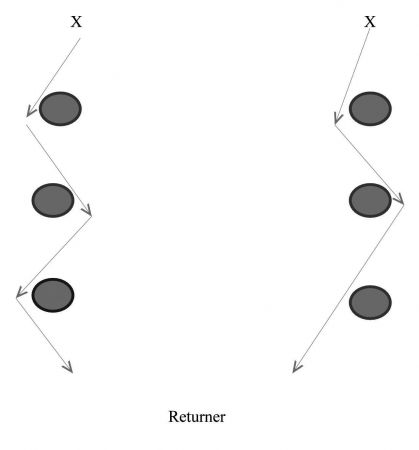
Diagram 1: Weave and Avoid Drill
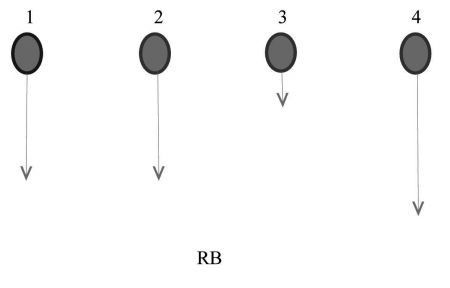
Diagram 2: Restrain Drill
Individual coverage drills and techniques include a Weave and Avoid Drill (diagram 1) and Restrain Drill (diagram 2).
• Weave and Avoid drill – the key points to remember are to rip close to the blocker, use the same arm and same leg on the rip and keep shoulders square to the returner.
• Restrain Drill – Remember to gain ground and keep shoulders square, squeeze to the ball, and keep the outside arm and leg free.
Individual protection drills include a punch drill, half line drill and whole line drill.
• Punch Drill: Guards, tackles and ends should assume an athletic two-point stance approximately 3 yards away from the 5-man sled (athletes are aligned with right or left shoulder 3 yards from the sled and are standing perpendicular to the sled). Step with outside foot, punch, and hold inside foot.
• Half Line Drill: Center, A gap player, guard, tackle and end assume positions. Splits are 1- yard apart. Block team aligns head up, in gaps or both. The snap punt unit executes blocks with no release. Punter punts the ball and returner fields the ball. Repeat on other side.
• Full Line Drill: Executed as above but with entire punt unit. No release or coverage for the punt unit which will ensure multiple repetitions in a timely manner. Progression will lead to full coverage by entire punt unit. Practice the following scenarios - punting out of end zone, punting into end zone, and punting from different hashes.
The actual punt alignment and scheme are shown in diagram 3.
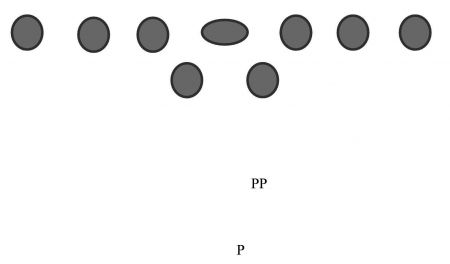
Diagram 3: Punt Alignment
Alignment splits are 3-feet apart for guards, tackles and ends. Gap players are 1 yard off the center’s near hip. The Personal Protector is aligned six yards back and the punter is 14 yards back from the line of scrimmage.
Blocking Assignments and Zone Principles
• Guards and tackles have anyone and everyone in their respective areas (from your nose to partner’s nose).
• A-gap players - Step up, get as big as possible, the landmark is outside number of returner.
• Center - Great snap, free release (no blocking responsibilities) nose up returner. Come to balance and tackle.
• Guards - Zone protect, step with outside foot, punch, and hold inside foot, and landmark is 4 yards inside hash.
• Tackles - Zone protect, step with outside foot, punch, and hold inside foot, landmark is 4 yards outside hash.
• Ends - One or two man rule - release for top of numbers, keep outside arm and leg free, inside shoulder force.
Conclusion
Statistics have shown that 60 % of all victories are a direct result of special teams play. One fifth of the downs in a game are special team’s downs. We utilize these facts to stress the importance of our special forces.
Offense wins the fan, defense wins the game and SPECIAL TEAMS win the Championship. By incorporating the aforementioned techniques, we have been very successful at Monmouth College, ranking at or near the top in the Midwest Conference and the NCAA Division III in kicking categories.
About the author: Dave Ragone recently completed his 12th season as both Special Teams Coordinator and Offensive Line Coach at Monmouth College (IL). A graduate of Ursinus College, he also coached at Delaware Valley College, Bemidji State University and Manchester College.