DIAGRAM 1: Right Flex, Lead Draw 6 (Vs. Under 4-3 Defense). Over the past four seasons, the “Lead Draw” series has become one of our most productive offensive series. Our running game has traditionally been set up by our successful passing attack. This play epitomizes that philosophy, as our assignments on the “Lead-Draw 6” play utilize the same action as in our most consistent passing play — the “Lead Draw Pass” (see Diagram 2). Even with 7 defenders in the box, we have success with this play, as we isolate the FB square on the weak-side LB. This play is run to the left when you have a right-handed QB.
The FB steps into a squared-up position on the Will LB and attacks him from the middle. This allows the ball carrier (TB) to read the block and cut accordingly. The QB takes a big 3-step drop, influences the “Sam” LB by looking as if to throw and fakes a pass after the mesh with the TB. The TB takes a slide step to the backside to square up the Sam LB, bends the path from the mesh point off the third step, receives the handoff and tracks the outside hip of the FB.
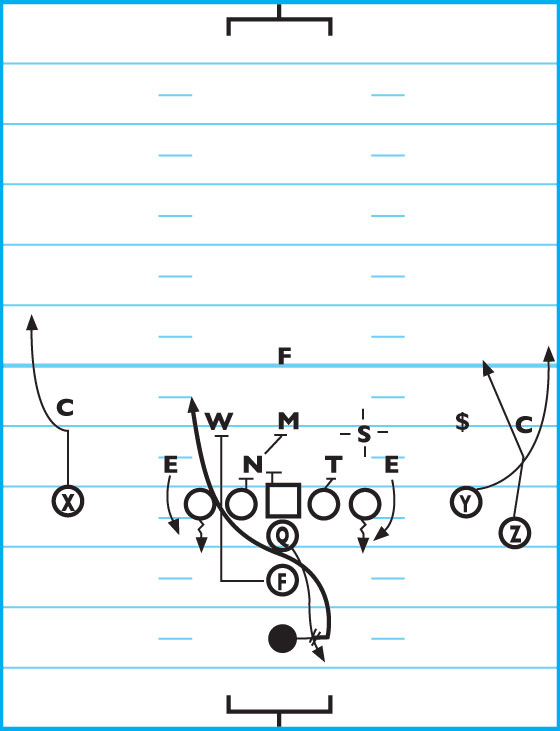
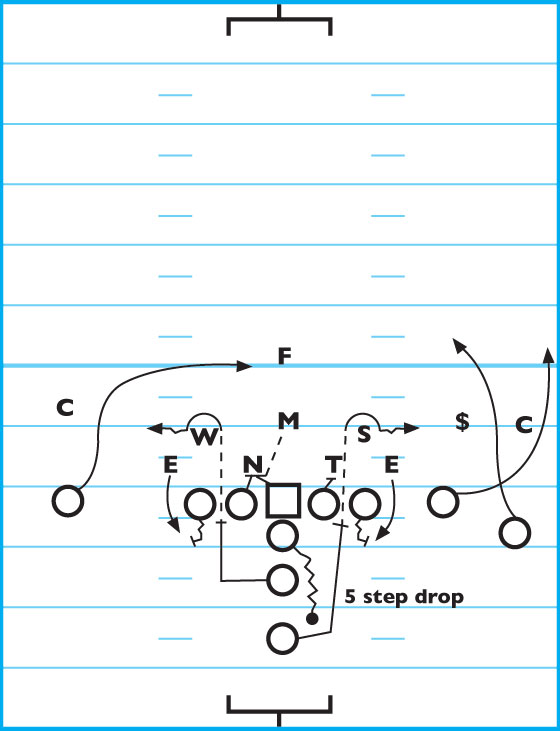
DIAGRAM 2: Lead Draw Pass (Vs. 3-Deep Secondary). Since we’re a passing team, utilizing the I-formation has become more of a passing-game motivation for us than a tool of the running game. When we draw 7 defenders on the LOS or in the box, we feel we have a great chance to successfully execute this pass play. The 5 down linemen must secure the LOS and the middle LB. The RBs run a “check-flat/hook” on the “Sam” and “Will” LBs.
The FB slide steps square to the Will LB. If the Will LB comes, then the FB must block him. If the Will LB drops into coverage, then the FB executes a 5 to 6 yard check-hook route. The TB slide steps square to the Sam LB. If the Sam LB comes, then the TB must block him. If the Sam LB drops into coverage, then the TB executes a check-hook at 5 to 6 yards.
Receiver X runs a double-break dig route at 10 to 12 yards. This route should break underneath the Safety.
Receiver Y runs a wheel route, gaining width in his release from the LOS. Receiver Z runs a post route with a break point at 8 to 10 yards. Z’s aiming point should be the near upright of the goal post.
The QB checks the FS just prior to the snap and takes a big 5-step drop. On the second or third step, the QB executes a fake to the TB and reads a progression based on two factors. If the FS retreats, then the QB’s progression is: 1) Dig route to X. 2) Hook route to the right. 3) Hook route to the left.
If the FS stays, the QB’s progression is: 1) Post to Z. 2) Wheel route to Y. 3) Hook route.
—Mike Mizer,
Quarterbacks Coach,
Columbia Central High School,
Columbia, Tenn.