IT’S NOTHING NEW to say that the kicking game is one-third of a football game. And, of course, all coaches know that, most of the big breaks in a game occur during special teams. However, we all seem to have a problem finding the time to work on the special teams skills we need to improve them. Few coaches have the luxury of spending one-third of a week’s practice time working on special teams.
Our program struggled for a way to find time to efficiently work on kicking-game skills. This struggle to get the biggest bang for each minute spent on special teams, led to the development of the Kicking-Game Circle Drill.
We were first exposed to the concept of the Kicking-Game Circle Drill about 20 years ago by Texas high school coach, Ross Rogers (who’s still coaching after 37 years). Time and necessity caused us to incorporate and “blend” Rogers’ drill concepts into our way of doing things.
“Breaking Down” On Coverage
The first skill we wanted to establish was “breaking down” in a coverage sprint so that our special teams coverage units could cover the entire field with players who are usually less talented than the opposing player who is returning kicks or punts, as well as dodging blocks along the way. Break-down technique is the single most critical aspect of special teams play.
“Breaking down,” to us, means that the coverage man must come to a stop or floating position with his knees bent and feet moving as soon as the return man gains possession of the ball. Many coaches use this term without fully explaining it to their players and often their aptitude for this technique is limited because of the lack of emphasis. The objective of all coverage players should be to force the returner to a lateral move, while cutting off the sideline. To achieve this goal, coverage players must:
1. Sprint downfield, as hard as possible, after the kick or punt and in a straight line or in his “lane.”
2. Come into “break-down” position as soon as the receiver catches the ball.
3. Keep outside leverage by the outside defender while the others protect against a cutback move.
Coverage players must also try to keep the distance between each other consistent and steady.
4. Try to let the kick returner “come to them” rather than making an overly aggressive forward thrust that opens a lane behind the tackler. Forward movements by the coverage players after the returner’s catch must be gradual and always done while maintaining proper leverage.
5. Make an open-field tackle. Your players can learn tackling fundamentals, but the only way to become skilled at open-field tackling is to practice — every day and while going full speed.
Kicking-Game Skill Development
Aside from learning proper break-down technique, there are other important special teams skills that must be worked on. The Kicking-Game Circle Drill emphasizes almost all the skills that your special teams players must learn. The following lists a particular aspect of special teams taught within this drill and then the techniques or practice tips to be emphasized within each skill.
- Deep Snapping.
• Two-handed and line-drive snapping.
• Shuffling directly back after the snap (as his head raises).
- Punting.
• Rocking back with non-kicking foot when receiving the long snap.
• Dropping the ball as flat as possible.
• Turning the toe down when punting and striking the ball with the upper foot (“where the shoestrings are tied”).
• Following through the punt with the head down.
• Having lots of footballs ready so the punter can practice as many kicks as possible in a short time-span.
- Kickoffs.
• Determine whether to use a soccer-style or straight-ahead kick. No matter the style, you must teach the kicker to kick with proper part of foot.
• Determine optimum position of football and target spot on football.
• Determine approach steps and standardize a way to measure the starting point.
• The kicker must be able to kick to any spot in the opponent’s receiving area.
• Following through on kicks with head down.
• Having lots of footballs for lots of kicks.
- Extra-Point Kicking & Holding.
• Determine kicking style (soccer or straight ahead).
• Determine approach steps and standard starting point.
• Keeping the eyes on the holder’s spot and starting the approach when ball “flashes” into kicking position.
• Holder’s position — with emphasis on allowing no exposure of his forward leg to blockers.
• Holder’s target for deep snapper and spot for placement.
• The long snapper’s snapping and resetting techniques.
- Catching & Returning Punts, Kickoffs.
• Sprinting to the receiving spot and setting up with the shoulders square and facing the goal line
• Looking the ball into the hands.
• Elbows-in positioning and “giving” as the catch is made.
• Moving after catching to avoid the opposing team’s “bullet man.”
• Avoiding lateral movements unless absolutely necessary.
- Protecting The Punter.
• Protection techniques may vary, but we teach players to never back up while protecting the punter.
• Release on a predetermined count or “thud” of kick.
- Blocking Kicks & Punts.
• Measure the exact starting points for blockers to the ball.
• Position a gym mat on the field so that players can practice diving and “laying out” to block kicks.
• During this phase of the drill, you must use a deep snapper, so that your players can develop a feel for the required punt- and kick-block timing.
Gets Everyone Involved
The Kicking-Game Circle Drill accomplishes all of the previously stated goals in only 10 minutes per day and it gets all your special teams players working simultaneously!
This drill uses the entire football field (see Diagram 1). Each day, the players move in their circle to a new location and a new part of the game to be learned (see Diagram 2). It is a great start-up activity in practice but we have also used it effectively at the end of practice.
The surprise benefit the Kicking-Game Circle Drill is seeing the development of players you hadn’t pictured as contributors on special teams (because this drill uses all of your players). A minimum of two coaches are needed, but any number of them can participate. The more coaches used, the better the attention to detail becomes.
There are five locations set up in various areas of the field that serve as “skill-work stations” during the drill.
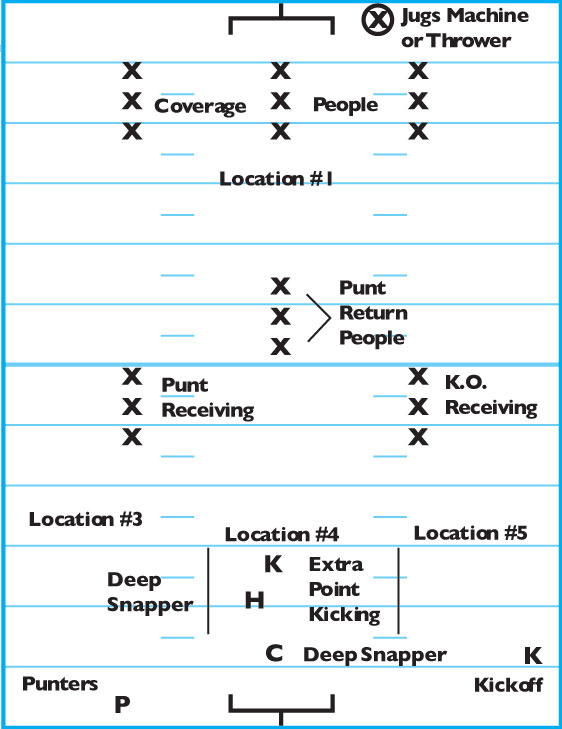
Location No. 1: Cover, “Break Down” and Return Station. Ideally, you would have a “Jugs-Gun” machine punting or kicking the ball from the end zone toward the middle of the field so that you would have fairly consistent height and distance to the kicks. If your program doesn’t have a “Jugs-Gun” machine, you can have a player or coach throw the ball to simulate a punt or kick.
We use three lines of coverage players to cover the field against the return man (use 1 line of returners).
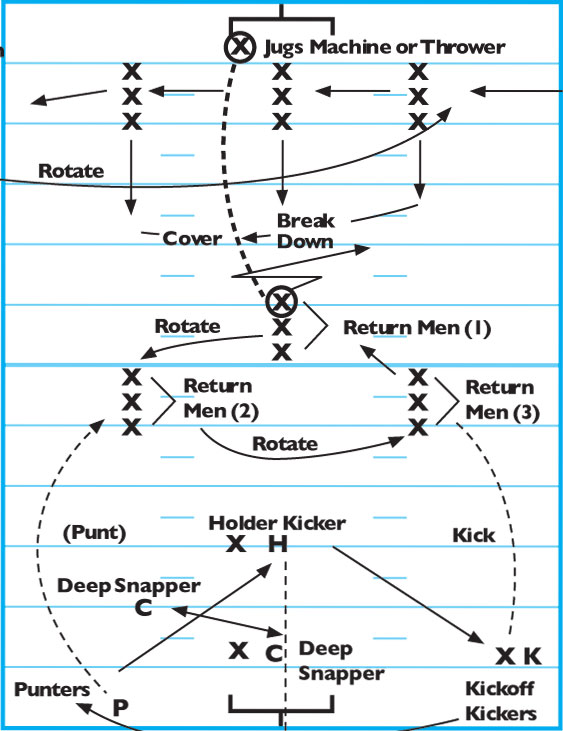
Location No. 2: Punt Protection (Set Up Your Way).
In this skill’s station, you set up your punt protection and teach your fundamentals for each position as they rotate-in from punt coverage.
Location No. 3: Deep Snap, Punt And Catch. In this skill’s station, the punt catchers only work on catching, not the return.
Location No. 4: Extra-Point Snap, Hold And Kick. Here, the balls are caught and returned by managers or injured players who aren’t participating in practice. All kickers and punters rotate to this spot regardless of ability. This is a great station to build depth in your kicking game.
Location No. 5: Kickoffs And Catch. At this station, all kicks are caught and balls are returned with a jog back to the kicker by the catcher.
We use this drill in spring training as well as the regular season. The result is a well-practiced and prepared special teams unit that uses up only a small amount of practice time. Players like it, the coaches like it and the action is continuous.
Players rotate within their specialty — with blockers and coverage people positioned at one end of the field; and kickers, punters, holders, and long snappers on the other. Return people are in the middle of the field.