Making head and neck training a priority is critical to the success of your strength program.
There have been a lot of questions about concussions. What are you doing to be proactive? What are you doing to help your athletes be better prepared for competition? What is the most important area of the body to train in preparation for contact sports?
For those of you who read the title and thought, “We do shrugs. We train the neck.” Read this, print this and share this with three of your coaches because we are not doing enough. Yes, coaches, strength coaches, athletic trainers, physical therapists, all need to learn more and do more.
Doctors take a “do no harm” oath, but they are taught to cut into the body. Athletic trainers and physical therapists are supposed to be proactive, but most react as first responders or are only involved in the rehabilitation process. Strength coaches will tell you they have an injury prevention program, but injury rates have only continued to rise. Coaches with no background in anatomy, physiology, biomechanics, kinesiology, etc. dictate what programs should be implemented with their team. If a “consultant” never played a sport, could they draw up the final play that dictates the season? We need to take an honest look at ourselves – a brutally honest look.
Do not overlook the benefits of training both the head and neck. Yes, the head, neck and upper back are all responsible for helping to reduce the sub-concussive forces that the brain may experience in athletics.
In order to prepare the body through a full body strength training program, the cylinder that supports the head has to become a priority. The muscles of the upper back, neck and head all play a role in dissipating forces.
Consider these head motions when developing your program: head nod (10 degrees of flexion), head tilt (25 degrees of extension), and head protrusion (Lie on your back. Drive your nose to the ceiling.)
Consider these neck motions when developing your program: cervical flexion, cervical extension, and cervical lateral flexion.
Consider these shoulder and upper back motions when developing your program: shrug, one arm shrug, one arm shoulder press, retraction (Kelso Shrug), and upright row.
It is always interesting to hear the reaction to this list. “Where am I going to put these into my program?” “When am I going to find time between all of the squats, cleans, and presses we have to get in?” These are common questions with simple answers. You find time for squats, lunges, step-ups, box jumps, glute extensions, hip flexion, leg curls, leg extension, calf raises, etc. Most programs will spend time doing multiple sets of each, anywhere from three to ten sets of each. That is just a basic approach to training the lower body.
One set of high-effort, disciplined reps, eliminating momentum during the full range of motion, is being studied to show that muscle growth and strength increases will occur for the muscles of the head and neck. Can you find time in your program for ten sets knowing that you are strengthening what many consider the most important area of the body to train? You should.
Make head and neck training a priority in your program. Make it the first thing your athletes do when they walk into the weight room. Thirteen minutes twice a week is all that is needed. If you don’t have access to a machine (and you should add a 4-way or 5-way neck machine to your “must have” list this season), begin implementing the exercises below at minimum into your program. Remember that you are evaluated by the quality of each repetition. Coach your athletes how to perform these exercises correctly. When you feel like your athletes are finally getting it, coach them again and again. Never stop emphasizing the importance of quality repetition replication.
The following manual resistance exercises can be performed at the beginning of a strength training or fitness session. These exercises will strengthen the flexors and extensors of the cervical spine.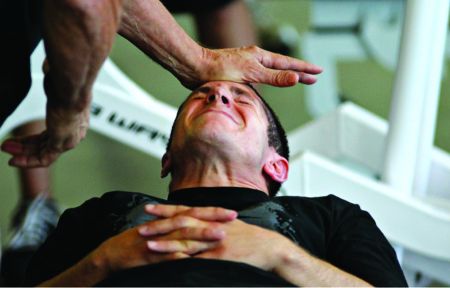
Neck Flexion (Target: Neck Flexors)
Starting Position:
1. Lie face up on a bench with your shoulders slightly over the edge of the bench. The top of the head should be parallel to the floor. At the beginning of each rep the neck muscles should be totally relaxed.
Movement:
2. Flexing only the neck muscles, raise the head forward and upward so that the chin is resting on the chest – pause momentarily and return to the starting position.
Spotting:
3. Place the dominant hand on the lifter’s forehead and your other hand on the lifter’s chin. Apply as much pressure as needed to accommodate for the strength curve of the neck flexors.
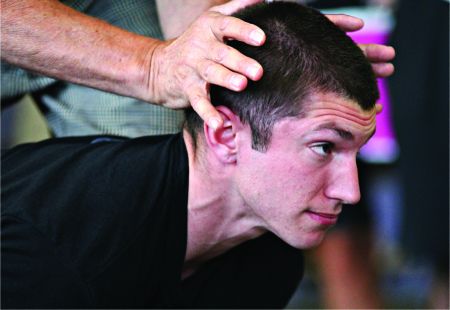
Neck Extension (Target: Neck Extensors)
Starting Position:
1. Lie face down on a flat bench with your head hanging over the edge of the bench. Neck should be totally relaxed with your chin touching your chest and hands resting under your hips.
Movement:
2. Raise your head upward and backwards until it is fully extended. Pause momentarily and return to the starting position.
Spotting:
3. Form a web with your hands and place them on the back of the lifter’s head. Begin the exercise with mild pressure and allow the lifter to raise his head in an arc that resembles a half moon. Adjust resistance according to the strength curve of the neck extensors. p
About the Author: Rob Taylor is the founder and owner of SMARTER Team Training. Over his career he has worked at the collegiate level, international level and with professional organizations such as the Anaheim Angels, Tampa Bay Buccaneers, Tampa Bay Mutiny, and San Antonio Silver Stars. You can follow Coach Taylor on Twitter @SMARTERTeam, email him at coachtaylor@smarterteamtraining.com or by visiting http://smarterteamtraining.com.