IT’S IMPORTANT TO get your players to buy into your punt-team philosophy. You need to instill a mindset that emphasizes how hugely important the punt team is. To help in this effort, our team decided to re-name our punt team the “pride team.”
We tell our pride team that there are five important points to remember about each punt.
1. A sizeable amount of yardage is exchanged on the change of possession.
2. It creates field position for your defense.
3. It’s an opportunity to gain momentum for your team with a big hit or a turnover.
4. It’s another opportunity to do something great on the field.
5. Field Position + Momentum = Points. Points = Victory.
Quality Practice Time
To have strong special teams, you must be dedicated to spending practice time to make your special teams units better. When we select our special teams units, I want guys on the pride team who weren’t necessarily on every special team’s unit. This allows me to meet with my pride team players every day. When we’re not on the field, we can get together in a meeting room, watch tape and prepare as a unit.
You especially want your personal protector (PP) to be a guy who will be in on all of your pride-team meetings. The PP should be a player who is on the same page as you and who knows about the kind of looks you can expect from your next opponent and the kinds of protections that you’re going to need. The PP should serve as a coach on the field and must know exactly what each player should be doing on any given punt.
We work with our gunners separately every Monday. We’ll work on the different looks they can expect to see, their release off the line of scrimmage and knowing their landmarks. We’ll also have them practice downing pooch kicks (great cover teams know how to kill the ball down inside the 10-yard line). We’ll often work on these gunner skills by using combination drills that also incorporate the long snapper, punter and punt-rush team into live-action drills.
Punters and long snappers can never get enough repetitions!
Pride Team Goals
Every time our pride team steps on the field to punt, the players must understand what’s at stake. Keep your pride team goals simple and attainable. We keep a pride team goal board posted in our locker room that has agreed-upon goals for the upcoming season.
You always want to attach a condition for success to your goals. This helps your players see how a goal can be achieved. Accompanying each goal must be the best way in which your pride team players can achieve that goal. Last season, our pride team goals were to:
O Play penalty free because of our great discipline and poise.
O Lead our conference in net average punt because of a long hang time of no less than 4.5 seconds and swarming coverage.
O Give up an average of 3 yards per punt return or less thanks to our relentless pursuit and tackling.
O Allow no touchdowns because everyone stays “inside” and “in-front” of the ball.
O Not have a punt blocked due to our discipline and physical protection.
Punt-Cover Philosophy
We are a spread, zone-protection team. The first day of practice we install the concept of gap protection and let everything else stem from that concept. Man protection techniques and schemes are then taught to handle unique defensive alignments. The PP makes the needed adjustments according to game plan and personnel. When evaluating tape of an opponent, we organize our game plan in terms of several factors.
- Alignment. Does the opposing punt-block or punt-return team cause any problems for our base alignment?
- Operation. This is more than just the target times of the snap, get-off time and hang time. It involves all phases of the punt — including techniques, footwork and huddles.
- Protection. This is obviously a huge part in the scheme of things. Individual techniques and overall schemes may need to be adjusted depending upon the looks that are given by the opponent.
- Release. Gunners must realize the defender has no rules and will hit, hold and do anything else to keep them from getting downfield.
- The Coverage “Net.” Next to the protection, we spend the largest part of our time coaching the coverage part of the punt. Pride team players must always be aware of their assignments and responsibilities.
- Making The Play. This comes from understanding the proper angles and body position for making a tackle in open space.
Zone, Spread Punt
Each spring we begin by teaching the zone punt and zone-punt concept. Each player on the pride team has a responsibility to protect an area. Man protection applies with the adjustments due to what the opponent gives you.
DIAGRAM 1: Basic Spread-Punt Formation.
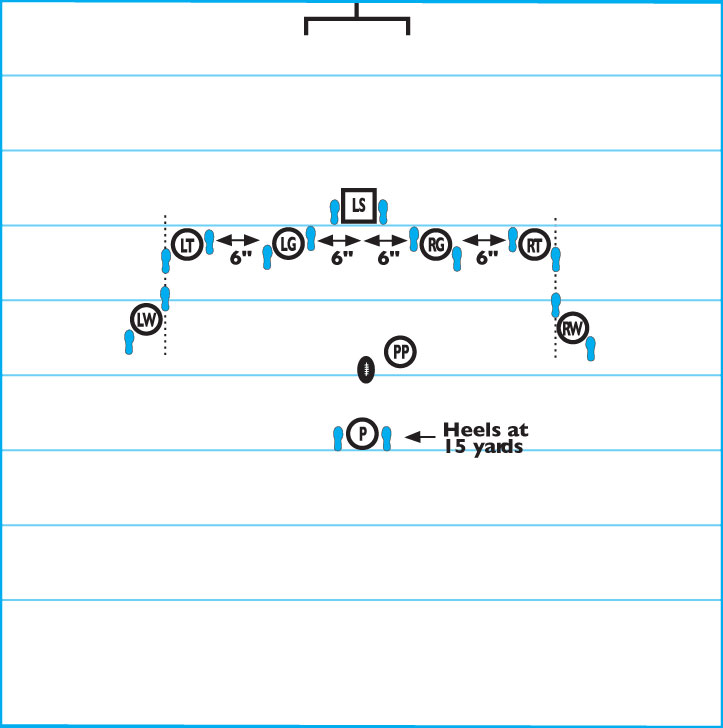
Our basic alignment is a spread punt. The interior “core” consists of two tackles (OT), two guards (OG), a long snapper (LS) and PP with two wings flanking the core on each side. The wings will be aligned in the backfield and place their inside foot a yard behind the outside foot of the tackle they flank. The wing must be able to touch the hip of the tackle in his stance. If he can’t touch the tackle, he is aligned too deep.
The gunners flank the ball on each side. When the ball is on the hash, the gunner to the open-field side is 3-yards outside the hash to the top of the field numbers and the gunner to the sideline is anywhere from the top of the field numbers to the bottom of the numbers. Both gunners are on the ball. The gunner’s splits will be determined by the location of the ball and game plan.
The OTs, OGs and LS align with a 6-inch splits. The stance of those in the core is the same from wing to wing. Their inside foot (post foot) is up and their outside foot (set foot or kick foot) is back. Their hands are placed at the top of the thigh pad with great bend in the knees and hips.
The OGs and OTs place their post foot as far from the ball as possible, bending at the hips and leaning toward the LOS so the top of their helmet breaks the plane of the snapper’s waist. The goal is to create as much separation from the LOS as possible and still be onside. The PP has a base alignment of heels at 5 yards behind one of the guards. The punter starts out with his heels at 15 yards and adjusts that alignment depending on his stride. It’s ideal for the punter to get the launch point just less than 10 yards.
Operation Time
The one thing that gets a punt blocked quicker than anything is a slow operation. We are constantly clocking our snappers and punters and charting all segments of a kick. Not only are we concerned with the speed and location of a snap but the ease in which the punter can receive the snap.
Your LS must deliver a catchable ball to the punter and execute his blocking assignment. We target the snap and the get off (the time between the ball hitting the punter’s hand and his foot), and then add the two times together to get a total operation time. The following are our targeted goals for operation.
1. Snap. 0.79 seconds or better.
2. Get Off. 1.2 seconds or better.
3. Total Operation. 1.99 seconds or better.
Protection Footwork
Depth off the LOS and staying in tandem with adjacent linemen are critical to the integrity of your protection. This depth is created with footwork.
DIAGRAM 2: Protection Footwork.
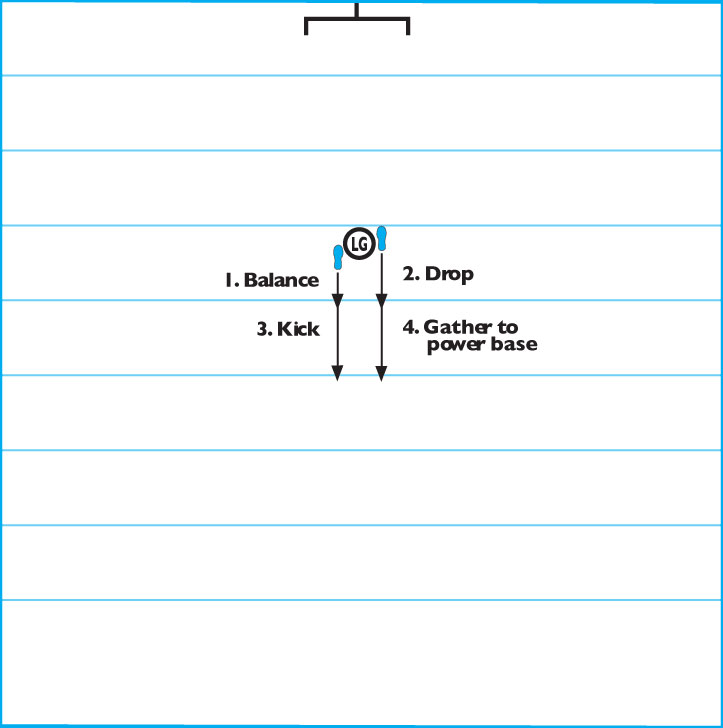
The initial step (balance step) is with the set foot. This movement is not a big step. It’s a short, balance step straight back to establish a true vertical position off the LOS.
The second step is with the post foot and it’s a drop step. This step is critical to getting distance from the LOS and maintaining square shoulders. It’s straight back on a true vertical set.
The third and fourth steps happen almost simultaneously. After the drop step with the post foot, the blocker gathers his base with a short kick and a gather of the feet to establish a good power base.
Once the power base has been established, a punch is delivered off the outside foot. We want to establish inside leverage on the defender, always keeping his body between him and the launch point. Once contact is made, our blocker drives into the defender, clearing the pocket and the launch point. We coach an aggressive release to maintain square shoulders from the punch through the release.
Pride Team Coverage
The key to great coverage is to play at full speed and through to the landmarks until the ball is located.
DIAGRAM 3: Standard Coverage.
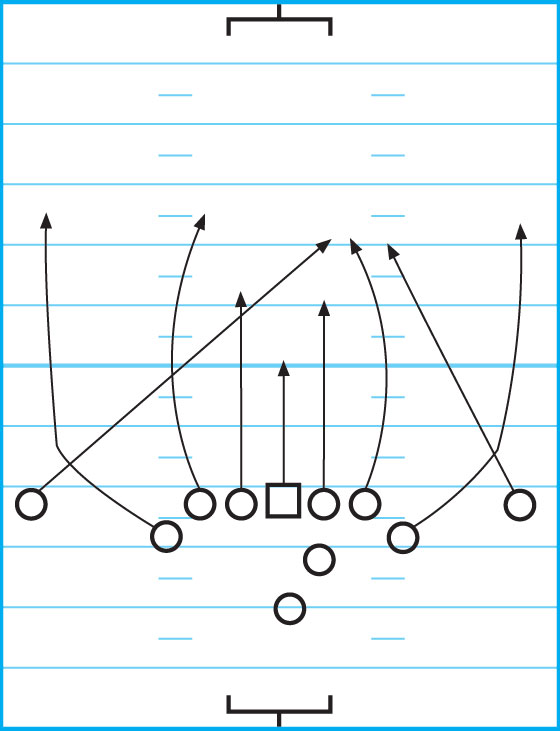
DIAGRAM 4: “Net” Fit Coverage (Left).
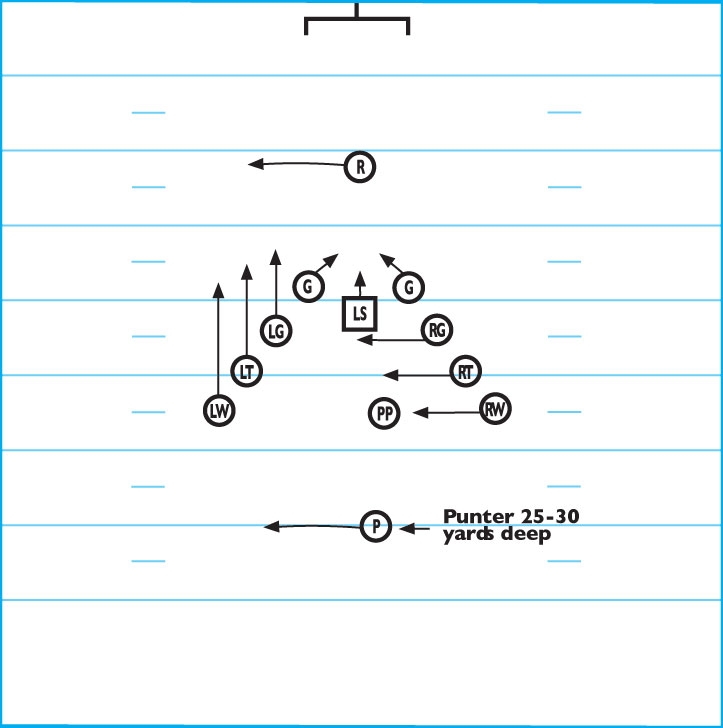
When the ball is in the middle of the field, the OGs cover through a landmark 10 yards downfield at the goal posts, the OTs cover to a landmark 10 yards downfield at the hash marks and the wings cover to a landmark 10 yards downfield at the top of the field numbers.
Once the ball is located, the principle of keeping the ball “inside and in-front” takes over. The initial landmarks of the six core players are distributed over two-thirds of the field.
The gunners, LS and PP are “head hunters.” Their fit is on the ball carrier. The fit of the OGs, OTs and wings are on leverage points to the ball carrier.
They must use distance and space to “choke” the ball carrier. They squeeze the noose around the returner in relation to the location of their teammates’ position. Coverage is all about relationships! Players must keep the ball in front of them at all times.