THE PLACEKICK IS crucial to your team’s success and often determines the final outcome of the game. We stress to our players about the importance of field goal and extra point (FG/PAT) units and that they should expect to score every time they take the field, but not to take it for granted.
A successful FG/PAT team must:
- Be disciplined in substitution.
- Be disciplined in alignment and technique.
- Have a great snap, hold and kick.
- Have confidence in their ability to execute the kick.
- Take pride in doing the job well.
The Huddle
The center sets the huddle 8 yards from the line of scrimmage with his back to the LOS. He always sets the huddle on the right hash mark unless the ball is on the right hash mark — in that case, he sets the huddle to the left of the ball.
In the huddle, the offensive linemen face the holder, standing tall. The wings and ends are in front with their hands on their knees, looking up. Everyone in the huddle must give their full attention to the holder. The kicker is not in the huddle — he is finding his spot.
The holder is the quarterback of this unit. It’s his huddle. He needs to control. His first responsibility is counting to make sure there are 10 men in the huddle and the kicker is on the field. His second responsibility is making all calls inside the huddle. He’ll tell the unit whether the kick is normal or a fake, giving the call twice.
Coming out of the huddle, the center approaches the ball and gets into his stance as quickly as possible. The other players find their alignments based on the center.
Offensive Guards. Assume a 3-point stance with their inside foot back and inside hand down. The OG to the center’s right is in a left-handed stance. The OG’s inside foot (the foot closest to the center) is directly behind the center’s foot. OG’s must be careful not to interlock with the center — that is a penalty. The toes on his outside foot should be perpendicular to the center’s foot. You want to create some vertical separation from the LOS. The OGs’ must see the ball from their peripheral line of vision.
Offensive Tackles. Base their alignments on the OGs’ alignment. OTs take no more than a 6-inch split from the OGs. Again, they use a 3-point stance with their inside foot back and inside hand down. The toes of the OT’s outside foot should be perpendicular to the OG’s foot. OT’s must see the ball from their peripheral line of vision.
Ends. Base their alignments off the OTs. The ends align in a 3-point stance with the inside foot back and inside hand down. The ends take no more than a 6-inch split from the OTs. The ends are different from the other interior linemen in that their outside feet are parallel to the OT’s outside feet. The ends should not create any more vertical separation from the LOS Each end’s helmet must break the beltline of the center. If it doesn’t break the beltline of the center, there will not be enough men on the LOS. Ends must also see the ball out of their peripheral line of vision.
DIAGRAM 1: Bow-At-The-LOS Alignment. If you look at the FG/PAT unit’s alignment from end to end, you should see a bow. The bow at the LOS widens the corners for the rush unit. If you line everyone up from end to end on the same plane, the rush unit has a better angle coming off the edges to block the kick.
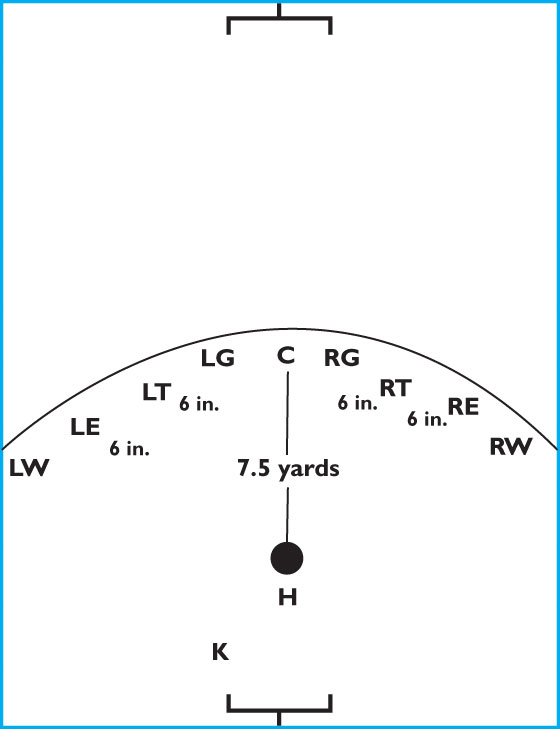
You must have 7 men on the LOS, so make sure that your front 7 are aligned so that their helmets break the beltline of the center.
Wings. Base their alignment on the ends. They use a 2-point stance with their hands on their knees with the butt down and eyes up. They align an arm’s length off the end with the inside foot just behind the groin of the end. The wings face out on a 45-degree angle.
Holder, Kicker. After breaking the huddle, the holder sets the spot for the kicker. The kicker should sets his spot approximately 7 to 7 1/2 yards from the LOS. After the holder places his hand on the spot, the kicker can mark off his steps.
Tackle-Over Alignment
If the ball is spotted at either hash mark, you can use a tackle-over alignment. On kicks from the hash mark, the flight of the ball often shortens the corner to the wide side of the field. In this formation, you’re putting the boundary side OT to the wide side of the field. You only want to do this if you’re kicking from the hash mark and are facing wide-side rushes from the defense.
DIAGRAM 2: Tackle -Over Alignment. If you’re kicking from the left hash mark, the wide side of the field is to the right. The left OT must now keep his outside foot parallel with the right OT’s outside foot. Again, his helmet should break the beltline of the center. If you’re kicking from the right hash mark, the right OT would go to the left side.
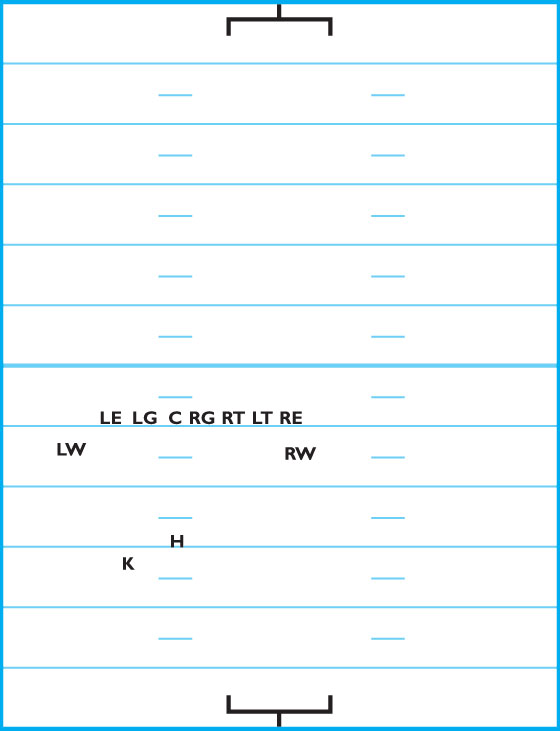
The left end slides down beside the left OG. He can get some vertical separation from the LOS by moving his outside foot back to be perpendicular with OG’s outside foot. The techniques and footwork remain the same.
By making these two simple personnel adjustments, you can take away the edge rushers’ angles.
Fire Calls
Unfortunately, kicking a FG or extra point isn’t automatic. Eventually the center is going to make a bad snap or the holder is going to mishandle a good one. In any case, having a “fire call” in your arsenal can get you out of tough situations. In the event of a bad snap or a snap that the holder can’t place on the spot in time for the kicker to kick the ball, the holder signals a fire call. The holder must repeat this call loudly several times.
DIAGRAM 3: Fire Call. When the holder signals for a fire call, the ends and wings run mirroring routes on both sides. The wings release and run into the flat about 3 yards deep. On an extra point, the wings must run their pattern into the end zone. On a FG, they want to get deep enough to ensure a first down if they are thrown the ball.
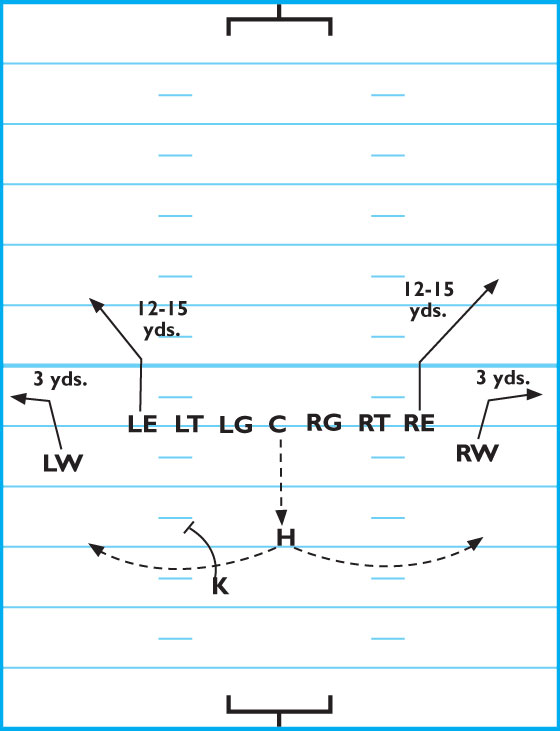
The ends run corner routes, aiming for the back pylon of the end zone on an extra point and for a spot on the sidelines 12 to 15 deep on a FG (or enough for first-down yardage).
The holder or kicker — whoever picks up the ball, tucks the ball away and sprints to the most convenient side. This is a run-first, pass-second option play. The ball carrier should be thinking about getting the first down or getting into the end zone. Everyone must be aware of the yardage needed for a first down. No one needs a holder throwing an incomplete pass to a covered end 15 yards downfield when the flat route is open 3 yards downfield.
When the holder signals a fire call, the offensive linemen can’t go downfield. They must stay on the LOS and pass-block any man in their zones. Furthermore, any player wearing an ineligible number cannot go downfield. If you have substituted extra offensive linemen at the end position, coach him not to release on a fire call.
We install a fire call early in preseason camp. Bad snaps and mishandled snaps are going to happen, so when they do occur, play them out as fire calls. We practice one or two fire calls every week during game preparation.
FG/PAT Drills
A good way to help your FG/PAT units develop cohesion is set up station drills. In these drills emphasize technique while detailing alignment and assignment. The following are two good drills we use for kick protection to help the linemen, TEs and wings.
While these protection drills are being done, the snapper, holder and kicker work on operational mechanics.
DIAGRAM 4: Interior-Protection Drill. Put a group of six defenders in as the rush unit. The defenders each rush a gap so the protection unit can work on technique.
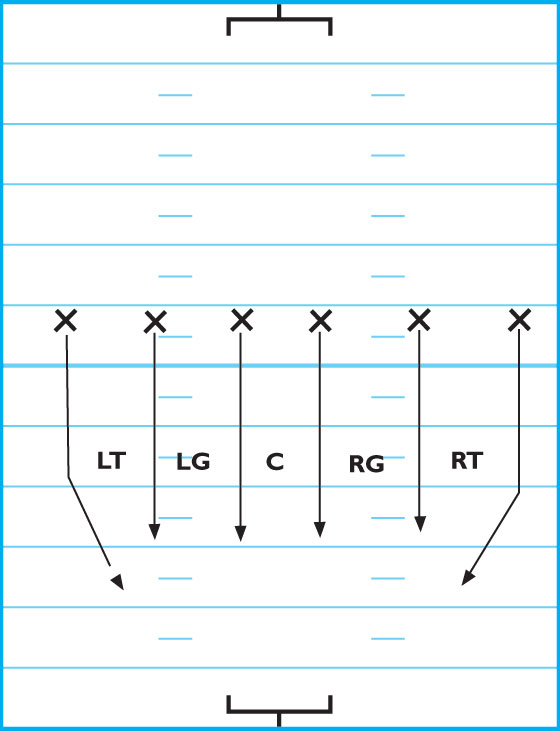
Emphasize footwork, hand placement and parallel shoulders.
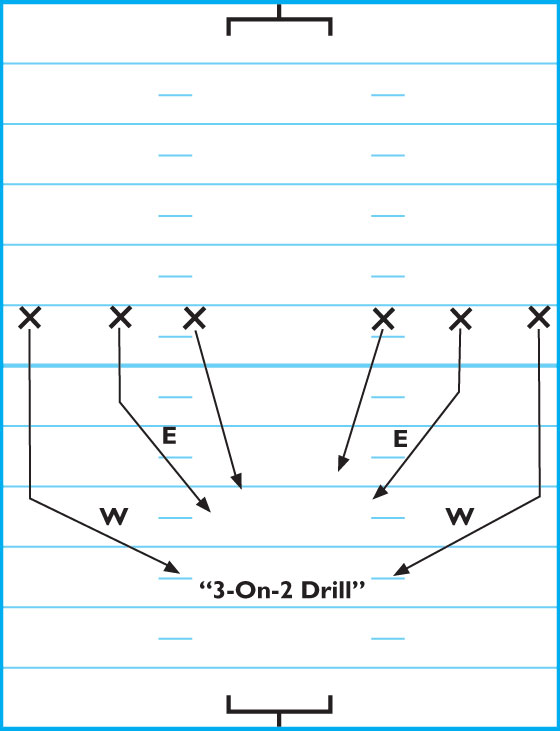
DIAGRAM 5: 3-On-2 Ends And Wings Drill. TEs and wings take on three defenders who rush the C-gap, D-gap and the edge. This drill, which can be run at full or half speed, lets the wings practice the double-bump technique off the edge.
Special Situations
Special situations for the kicking game should be practiced throughout camp and the season. A special-situations scenario includes the kicks at the end of a half or game, such as 4th down and no timeouts left to stop the clock. The FG/PAT team must run onto the field and with no huddle, must snap the ball and execute a kick before time runs out. We practice this scenario at the end of our 2-minute drill.
In this situation, when the holder is running onto the field, he waves a towel to signal a desperation kick. Everyone on the field knows the signal so we don’t have any substitution errors.
We also practice other scenarios such as freezing the kicker prior to his kick and kicking from either hash mark.
Each week we’ll practice FG fakes with both run or pass as the play option. The run-pass decision is based on the opponent’s tendencies.
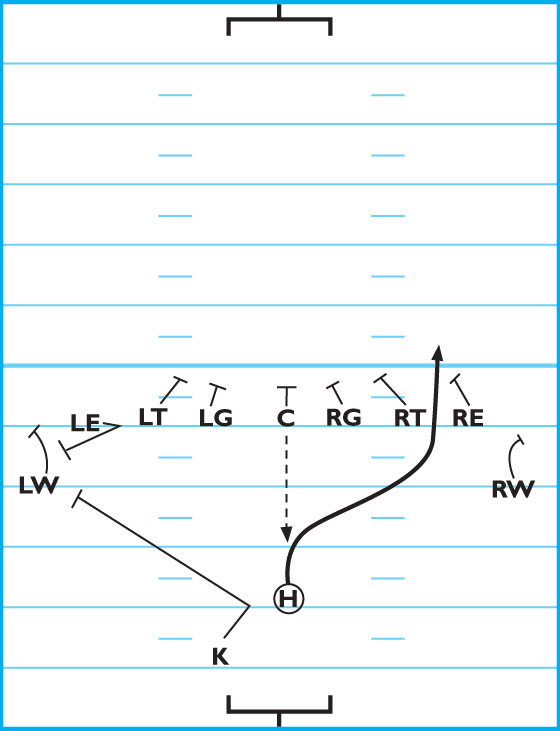
DIAGRAM 6: FG Fake With Run. The holder picks up the ball and runs for the OT’s outside leg. Run this play away from the opponent’s block side. The front-side blockers block the inside gaps while the backside blockers reach the play side and hinge. The kicker follows through with the kick to freeze the defense and looks for any penetration from the backside. The play-side wing stops penetration from the D-gap.