To win consistently and develop championship level football teams requires outstanding play on the edge of your defense. Obviously, it’s not the only prerequisite. However, without being able to set the edge of the defense and force the ball to go back in the direction it came from or risk being stopped for no gain or a loss, you cannot play outstanding defensive football. You must find athletes who can keep everything back to their inside vs. the run and then are mobile enough to play in space vs. the pass.
On the college level, you recruit this young man but on the high school level you have to develop this young athlete and teach him how to play the position with great technique. I truly believe that this position is under-coached in that it’s almost epidemic how poor outside linebacking is on all levels. Too many times the athletic ability of the OLB is the determining factor in picking your starter but high school coaches don’t have the luxury of having skilled athletes often enough to man those two critical positions.
Their play must be taught through well thought out drills that serve specific purposes. One of the big problems in high school is that most linebacker coaches coach both inside and outside linebackers, but these positions are as different as quarterback and center. There are two different skill sets involved so just linebacker drills doesn’t cut it for the outside linebacker. His drills must reflect his position requirements.
It is my belief that you don’t pick an outstanding OLB by his physical characteristics and while we’d all like to have two 6’5” 230 pound studs manning the outside spots, many times we are forced to find second or third string defensive backs who just don’t have the ball skills to start in the secondary. Or, you’re faced with players who just aren’t physical enough to play ILB and take on guards all game long. While I’ve been blessed coaching with a few of those 6’5” guys, many of the young men I coach are rejects from other positions. It’s my job to get them ready to play the most demanding position on the field with, often, limited athletic ability. It’s not fair to say all had limited ability, many were terrific athletes. However, how have we won 160 games while losing only 10 with six State Championships in my 13 years coaching outside linebackers at Bolles when a great player was not the starter?
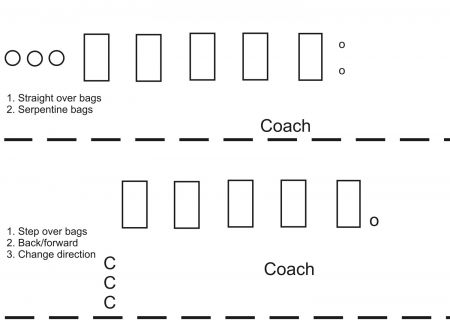
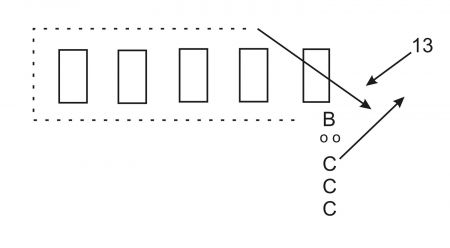
Outside linebacker drills start with footwork and change of direction drills. We do a series of bag drills every practice where we go over, around, and through them from both directions. We end every pass with a form tackle emphasizing the tackle as the critical part of the drill. Some passes through the bags has a stationary ball carrier at the end but many passes require the athlete to tackle a moving target so that he must take his mind off the bags and concentrate on making his tackle and what direction the ball carrier is moving when he exits his bags. This is teaching game conditions where the body is doing one thing but the mind is thinking ahead to the target or in this case the ball carrier (See Diagrams 1-3).
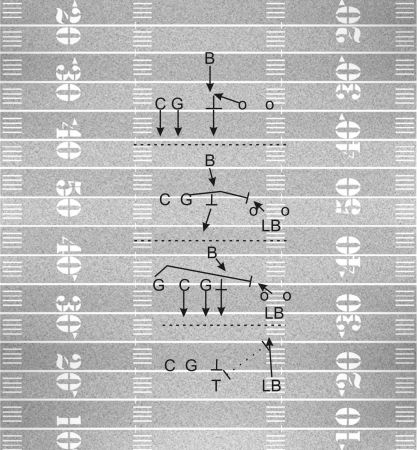
Since we teach a constricting defense or an outside-in approach, the next set of drills teaches the outside linebackers to keep all blockers and the ball carrier back to his inside with proper shoulder control and footwork. These drills set the inside leg upfield and all contact is done with the inside shoulder. These drills also are designed to keep the upfield movement of the OLB vs. the run to a minimum as we don’t want to open a vertical gap between him and his defensive tackle. An uncovered OLB must read the offensive tackle to the near back, if there is one, to determine squeeze in or pass rush. Reading the tackle’s initial movement is the key. The OLB covering the TE must get his pass/run read from him and react accordingly. The main point of emphasis in these drills is keeping the inside foot upfield while keeping the shoulders square to the LOS (See Diagrams 4A-4D).
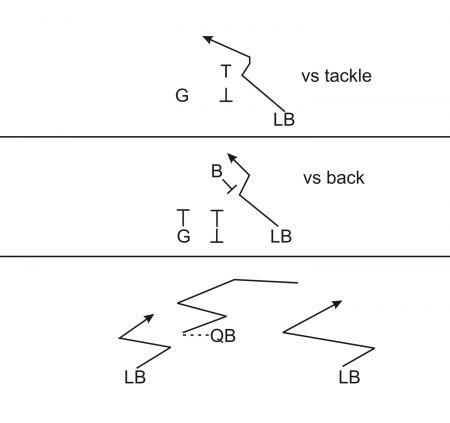
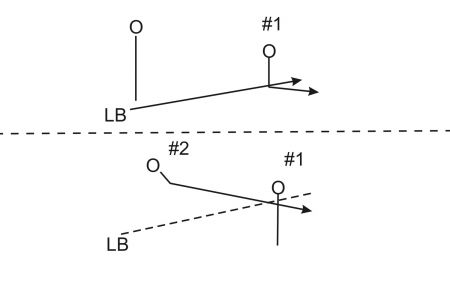
We then finish with pass rush drills and coverage read drills to mimic game conditions so during a game there is no hesitation on recognizing the run or pass. Versus spread teams the walked OLB reads the #2 receiver and adjusts his pass drop off of that read. In cover 3, if he gets a straight off release, he immediately heads to the flat thinking out pattern by the #1 receiver. If he gets an immediate release out pattern by the #2, he thinks curl by #1 and tries to get underneath that first and then reacts to the out by #2. The point is, design your drills to mimic game conditions by position and limit drill work just for work’s sake. We incorporate conditioning into our drills as much as possible saving valuable time at the end (Diagrams 5 and 8).
Our 2010 season saw us win 11 in a row only to lose to the eventual champion on the road. However, my two outside linebackers both started their careers at other positions. It really takes two years to develop good OLB skills and I like it even better when I can start them off as ninth graders learning the fine points of the 3-4 scheme.
OLBs come in all shapes and sizes. Some have terrific ability and some with just enough to walk upright without stumbling. The drills you design must, however, form the tools necessary to play winning football. p
About the Author: Rich Thomann has been coaching linebackers for the past 13 years at The Bolles School in Jacksonville (FL). He previously was a head high school coach and the defensive coordinator at Gardner-Webb. Thomann was a starting linebacker for Notre Dame for two years and later played with Jacksonville in the World Football League.