ONE OF THE principles on which our offense is based is to have a “series approach” style of attack. A series, to us, is a package of plays comprised of an inside play, an outside play, a play-action pass, a counter and a quarterback keep.
The Down is a part of the Belly series that has the fullback running off-tackle or the QB faking to the FB and either running the option or passing.
The success of the Down play is based on the angle blocking at the point of attack and the ability of the FB to strike quickly and with power.
When attacked with the complementary plays in this series, an opposing defense is put into conflict.
Down-Belly Terminology
Our program uses specific terminology to help players remember and execute their assignments for the Down Belly series.
Î “Backer.” A defensive man positioned off the line of scrimmage in a 2-point stance.
Î “Down.” The area from the outside foot of the next adjacent lineman inside a player to the helmet of the next adjacent lineman.
Î “Fire.” Having a player aggressively block the play-side gap — the area from a player’s outside foot to the inside foot of the next adjacent lineman outside of him.
Î “Gap.” The area from a player’s inside foot to the outside foot of the next adjacent lineman inside him — otherwise known as the area between two offensive linemen.
Î “On.” The area covering the width of an offensive lineman’s feet.
Î “Reach.” To step laterally toward the point of attack and then block as assigned “Fire” when the defensive man is on; may exchange assignments with an adjacent blocker.
Î “Wall Off.” Block defensive pursuit at a point immediately beyond the line of scrimmage.
Down-Belly Player Rules
The following rules indicate what the player assignments and responsibilities are for the Down Belly “right.”
Ï Tight End: “Down,” “Backer.” Instruct him not to block a defender who is aligned on his inside shoulder or in the gap.
Ï Right OT: “Gap,” “Down” and “Backer.”
Ï Right OG: Pull and trap the TE area.
Ï Center, Left OG and Left OT: “Fire,” “On,” “Backer.” This is zone or scoop blocking on the backside of the play.
Ï Split End: Cut-off block. He must block downfield at the closest point where he intersects the defender’s path to the FB.
Ï QB: Reverse-pivots flat and fast at 180-degrees, meshes with the FB and fakes the Down Option.
Ï Right Halfback: Influences the first man inside, “Wall Off.” Influences the defensive end by stepping directly toward him. Places his hands on the DE, releases inside and heads for the LB.
Ï Left HB: Leave in motion and sell the fake pitch at the flank.
Ï FB: Serves as the ball carrier on this play. Runs toward the inside foot of the TE. His first step should be either a cross-over or lead step. Our team prefers to have him use a lead step toward the inside leg of the TE, and as the QB meshes with him, we tell him to square his shoulders and head north-south.
“Down Right”
The following illustrates what the “Down Right” play looks like versus three common defenses to the TE.
DIAGRAM 1: If the Center can handle the Nose Guard by himself, the right OT should use an evasive technique and climb to block from the front-side LB to the backside LB.
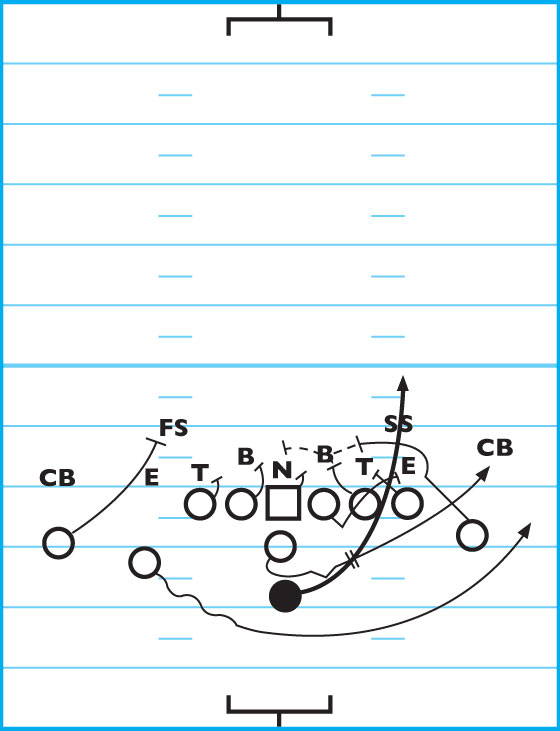
DIAGRAM 2: If the Center needs help on the NG, he makes a call to the right OT. The right OT must come all the way down to the NG and finish off the block with the Center.
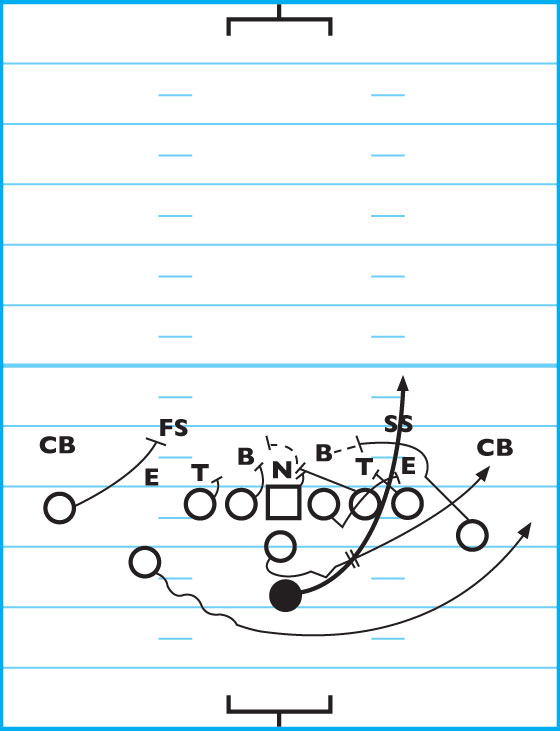
DIAGRAM 3: If the TE can’t handle his assigned down block, you should change the right OT’s rule to “Gap,” “Down, “Post.”
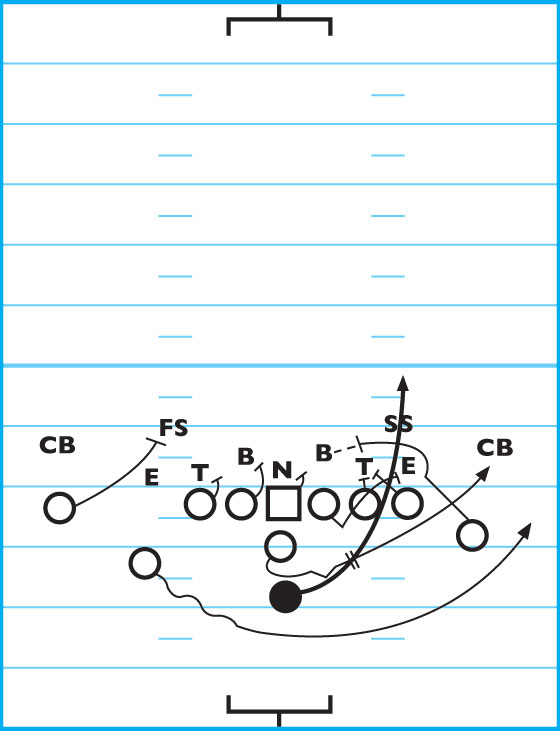
DIAGRAM 4: If the NG aligns in the A-gap or plays a “2i” (inside shade of right OG), we make a “Tackles” call, where the Center and right OG double the defender, while the right OT pulls and traps.
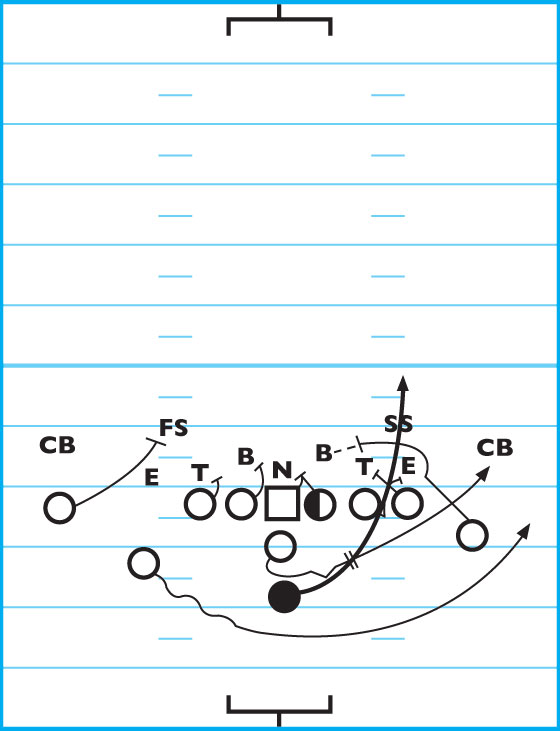
DIAGRAM 5: Against a 4-4 defense (where the right OT is covered), the TE stretches his split to 5 feet. We coach the TE to take the easiest release to the LB. The right OT blocks down on the defensive tackle. The right OG pulls and traps the DE who has been widened by the TE’s split. The right HB steps down and influences the DE and turns out on No. 4 or the outside LB.
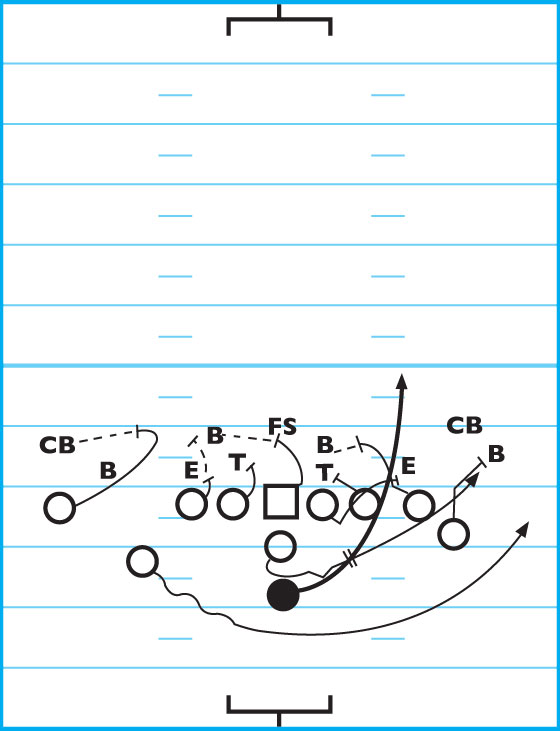
If the right OT is uncovered, the FB now aims for the tail of the right OT and squares his shoulders on mesh with the QB.
DIAGRAM 6: On occasion, when we’re facing a 4-4 defense, we’ll reduce the split of the TE to 2 feet. By tightening the TE, we’re trying to make the 7-technique DE align as a 5-technique. The TE will interpret his rule as “Down.” The right OG pulls and traps the outside LB.
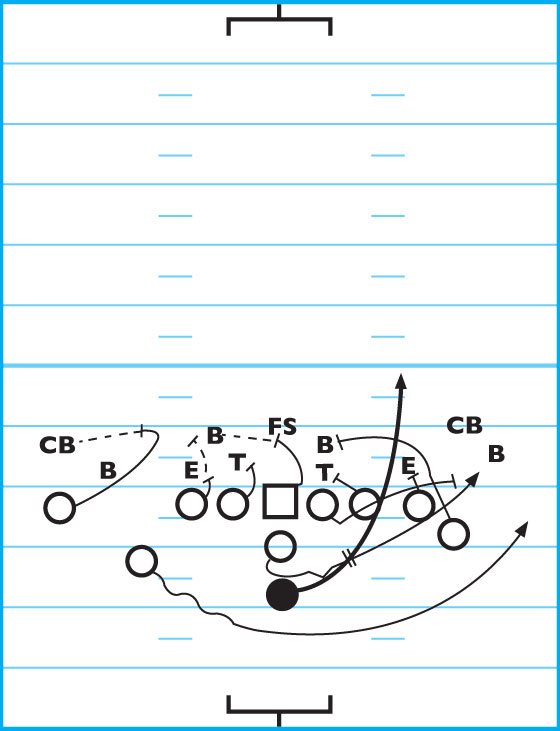
The right HB influences the DE and walls off the inside LB. The FB must hug the TE’s downblock.
DIAGRAM 7: Against a 4-3 defense, the TE releases inside and blocks the Sam LB if he’s there or goes toward the middle LB. The right OT blocks down and the right OG pulls and traps. The right HB influences and walls off the SAM LB. Because the right OT is uncovered, the FB runs a tighter track to the tail of the right OT.
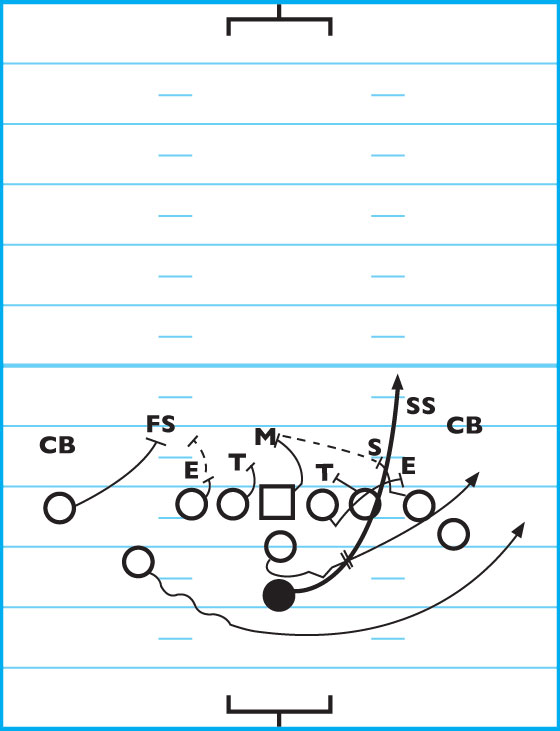
DIAGRAM 8: In our Jet Sweep series, the Down Play with extended motion puts the DE into conflict on his responsibilities.
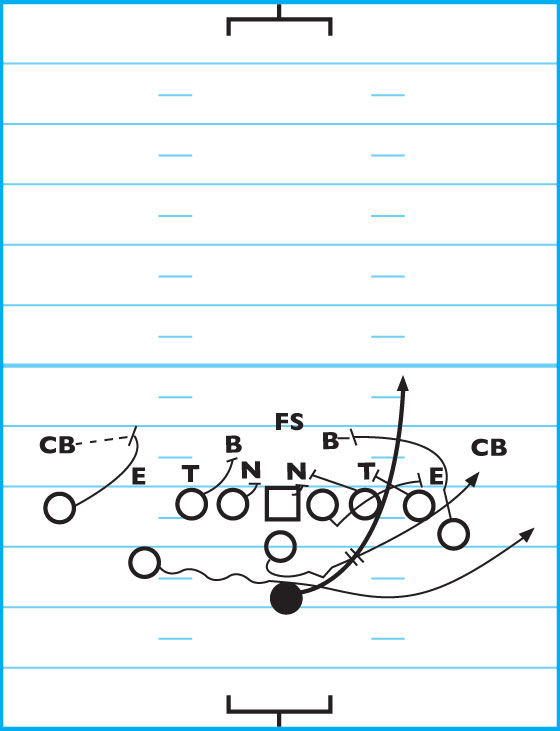
DIAGRAM 9: Another clever way to use this attack is to use misdirection motion and then run the Down Play.
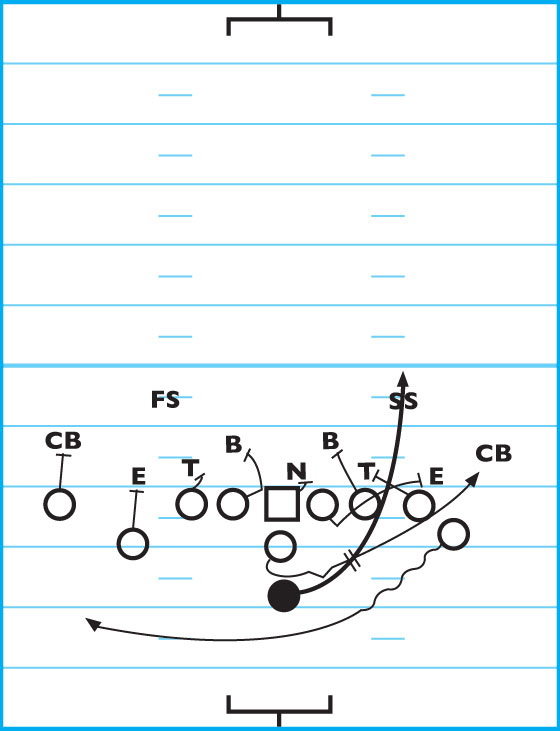
Some defensive coaches instruct their DEs to run upfield to stop the Waggle Pass as soon as the DE sees the wing back motion away from him.
In this instance, everybody runs the Down Play, except for the left HB, who loads on the DE (No. 3) and right HB who goes in 3-step motion and runs a pitch route.
Sets Up Other Plays
The Down Belly play sets up the Buck Sweep, Jet Sweep and Bunch Passes off the Down action. Our offense likes to combine the Down and Down Option as a “check with me.” In the huddle, the play is called “Down or
Down Option check with me at the LOS.”
If the TE Identifies a 6-technique or 7-technique, the QB calls out our code word for the Down Option. If the TE calls “9-9-9” the QB calls the code word for the Down Play.