Making an open-field tackle in space is one of the most difficult challenges in football – at every level.
Most of the information contained in this article was gained over 35 years of clinics and practices attended. The key concepts that we emphasize are that there are two brackets on the field, a fixed bracket, the sidelines and a moving bracket, the closest teammate to you. With those things in mind, we are never away from help on the field. Each player has to know where his help is and leverage the ball carrier to that help. The second concept is to keep the ball carrier in front of you and inside of you.
Making a play in space is often decided by genetics but you can teach players how to approach a ball carrier and put themselves in the best possible position to make the play. Here are some defensive drills we use: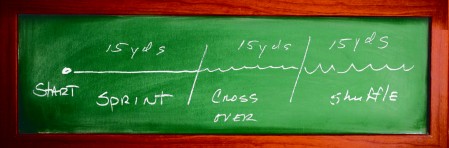
Diagram 1.
TRACKING DRILL (Diagram 1): We approach the ball carrier in three phases: 1. There is a lot of space between our defensive player and the ball carrier so we long stride (feet narrow and run full speed like a sprinter) to take up ground and not give up yards to our opponent. 2. We have closed the distance and then cross over run, turning our shoulders square to the LOS but continue to long stride. This begins to put us under control but still allows us to take up space. 3. The tackler shuffles his outside foot back, and tracks the ball carrier into the contact zone. In running the drill we start out on the sidelines with a coach at 15 yard intervals. The players long stride 15 yards, then have cross over runs for 15 yards and finish with a shuffle. This is typically the first drill we do as a warm up.
• Sprint to cover ground - long strides with a narrow base.
• Cross over run - as you start to get in striking range continue with long strides but turn shoulder square to LOS to begin to get in tackling phase.
• Shuttle - keep butt down, outside foot back, keep a ‘C’ curve in the lower back while keeping ball carrier in front and inside.
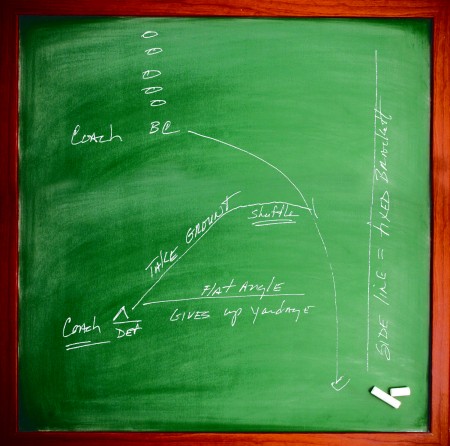
Diagram 2.
GAIN GROUND DRILL (Diagram 2): The players are 20-25 yards apart and the ball carrier starts running for the fixed bracket (sidelines) while the defender arch’s inside out using his long stride to take up space. The defender then has a cross over run and shuffle to a “tag off” position with the ball carrier. The first time through the drill the ball carrier can’t cut back. As everyone gets familiar with the drill, we allow the ball carrier one cut. A big focus of this drill is to not allow the ball carrier to run toward the goal line. While we wait for him to get to the defender, he needs to “take the space” from the ball carrier in order to give up the least amount of yardage.
• Use long strides to get to the ball carrier, then cross over run to shuttle. Use fixed bracket to squeeze ball carrier (ball carrier can cut back as drill advances).
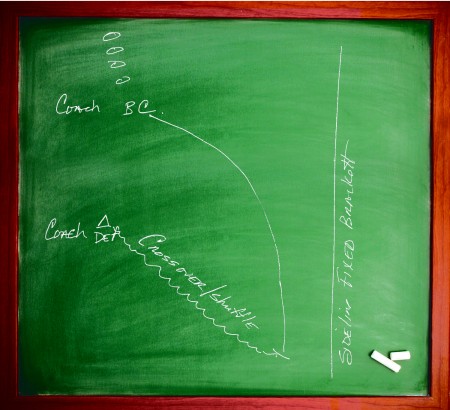
Diagram 3.
LAST MAN DRILL (Diagram 3): The players are now 15 yards apart. The last man drill simulates a break away ball carrier and only one defender is between him and the end zone. In this situation, we are willing to give up ground but not a TD. The ball carrier takes the same approach while the defender now starts running under control at an angle that forces the ball carrier to the sidelines. The defender should give ground and slow the ball carrier down while the rest of the defense rallies to the play.
• Defender can give up ground but not a TD. Forcing off ball carrier creates opportunities for turnovers.
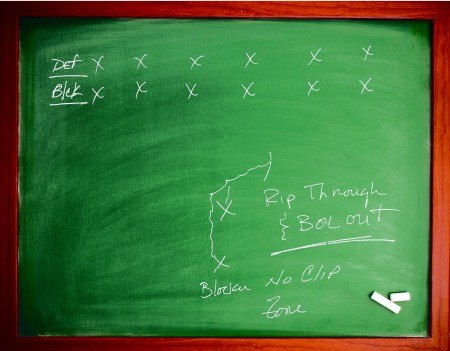
Diagram 4.
OPEN FIELD BLOCKING DRILL (Diagram 4): The purpose of this drill is to teach players how to avoid blocks in the back in open space. Using a partner alignment, the defender is placed two yards ahead of the blocker. The blocker approaches from the rear and RIPS THROUGH the armpit of the defender and then the blocker uses his back and hips to “box out” the defender.
• When blocking, remember no clip zone.
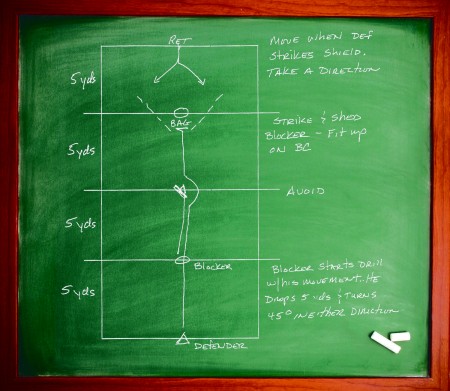
Diagram 5.
STRIKE ZONE DRILL (Diagram 5): in a 10-yd. by 20-yd. square, the tackler is forced to make full speed decisions on how to avoid the blocker with the use of speed or his arms. He then works on striking and sheding the blocker and fits up the tackle on the ball carrier.
• Defender reacts to blockers movement. Use long strides and avoid blocker at ten yards opposite the blocker’s profile.
Remember, the most difficult thing in football is to play effectively in space.
About the Author: A successful high school coach in San Diego County, Ed Carberry moved into coaching on the junior college level in 2004. He spent three seasons as head coach at Mt. San Jacinto Community College and recently completed his fifth season as the Head Coach at Southwestern College.