“Coach, every play is a race to me. I’m racing my teammates to the ball. If I lose the race I might not get to hit anyone on that play.”When I first started coaching, I was intrigued by how hard some players would play the game. Many ran faster when the ball was snapped than others. I thought all those players were just born that way, with that “motor.” One day I asked one of those players why he ran so hard. He found that the harder he ran, the more opportunities he had to make plays. That young man had learned that behavior. He loved the physicality of football and knew that if he did not pursue the ball, he may not get that opportunity. We want all of our players to play like that. It is difficult to teach that type of attitude, but not impossible.
We work to emphasize pursuit and effort every day with our defense. The reasons are really threefold. The first reason is, like all defenses, we want to prevent big plays and points. If we can get 11 players running through their responsibilities to the ball, we can make up for a lot of things. That is, poor calls by the coach and mental or execution mistakes by players. If one player misses a tackle, we still have ten others with a chance to prevent a big play and/or points. The second reason we emphasize pursuit is turnovers. We want the opportunity to force the turnover by being the next player there to the ball. That, of course, is obvious, but to recover a ball you need to be pretty close to it. The third reason is we want the offensive team to feel pressured. We want the ball carrier to have to walk through our 11 players back to the huddle every play and make it feel as if there are more than 11 defenders out there.
How we emphasize pursuit is also important. Our staff preaches maximum sustained effort all day. Leveraging and running to the ball is a habit. We cannot flip the switch on Saturdays and expect to play that way. Our habits are formed with repetition. The first thing we do every day in-season (after warm-up) is a full speed pursuit drill. These are perfection drills. It is done perfectly and at full speed from start to finish or we run it again. We have four pursuit drills that we try to rotate through practices during the week.
RUN PURSUIT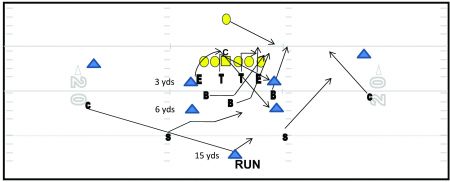
Diagram 1.
This drill teaches angles, fits and leverage on an outside run play. We use cones to simulate the angles for the backside defensive linemen and corner (Diagram 1). The execution is as follows:
• Offensive line simulates a zone play. RB will run at a toss angle. Coach reverses out and tosses the ball to the RB.
• Defensive line on the backside take their trail angle and then simulate the ball breaking the line of scrimmage. They then turn and run, taking an angle to touch their cone. Playside linemen will fit themselves in on the ball carrier based on the defensive call.
• LBs will scrape/fold and fit themselves in on the ball carrier based on the defensive call.
• DBs will run through their responsibilities based on the coverage call. One DB will take the TD angle (simulating saving a TD). All players finish at the ball before the whistle is blown.
Keys:
All players should leverage the ball through their responsibilities. Make sure they fit themselves in on their run fits.
3-STEP PURSUIT
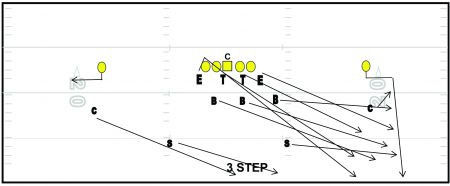
Diagram 2.
This drill teaches angles, fits and leverage on a 3-step pass or an outside screen play (Diagram 2). The execution is as follows:
• Offensive line simulates a 3-step drop. Coach will take the snap, rise up and simulate an out route throw to one of the WRs. That WR will then turn up the sideline running at about 75% speed.
• DL will run through their responsibility on 3-step screen – if QB’s face is to them, they will jump to block the ball when the long arm comes off the football. Backside keeps coming. When the ball is released, they turn and run, taking an angle to catch the WR.
• LBs simulate their coverage drop and break on the long arm trigger. They then pursue an angle to the WR.
• DBs simulate their coverage drop and break on the long arm trigger. They then pursue an angle to the WR.
Keys:
Do not chase another player. Take deeper angles and adjust back upfield. Simulate a tackle off the hip of the WR as he runs by you. Do not touch the WR. When the last player makes his tackle, the coach blows the whistle and all players sprint back to the line of scrimmage.
INTERCEPTION PURSUIT
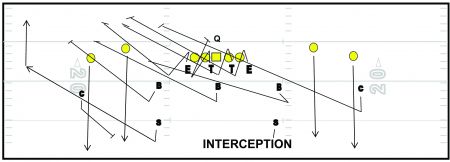
Diagram 3.
This drill teaches defenders to become offensive blockers (Diagram 3). The execution is as follows:
• Offensive line simulates 5-step drop. WRs run streaks and do not attempt to touch the ball.
• DL throws pass rush move on OL and then another one on air. Turn and sprint to where the ball is thrown by the coach. When the ball is caught, turn up the field and become a blocker.
• LBs take their coverage drop and break on the long arm trigger. Then, turn upfield and become a blocker.
• DBs take their coverage drop and break on the long arm trigger. Then, turn upfield and become a blocker.
Keys:
Interceptor runs upfield to the nearest sideline. Make sure the TD-saving tacklers (intended receiver and QB) are blocked. Point to your man. Everyone finishes through the line of scrimmage. If the interception is dropped, finish the play as if it was caught and run it again.
DIRT PURSUIT
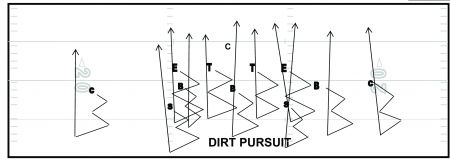
Diagram 4.
This drill teaches our players to compete and show their teammates how hard they will play (Diagram 4).
• Players begin by running in place. Coach blows the whistle and all players hit the ground on their stomachs, pop up and sprint at a pre-determined 45-degree angle away from the coach.
• Every time the whistle blows, the players hit the ground and sprint at the opposite angle. When the coach blows a double whistle, they hit the ground and sprint straight back through the line of scrimmage.
We grade pursuit and effort on every play of every game. Players get a positive or a negative grade on each play of the game. When our players come to watch film, they can probably tell you what plays, if any, were negative for them before we watch it. They have been taught to understand what a negative looks and feels like. Players can receive a negative grade if they:
1. Loaf on the field.
2. Change speed during the play (e.g., speed up late only to get to the pile).
3. Stay on the ground.
4. Do not turn and sprint when a pass is released.
5. Get passed by another player.
6. Don’t finish.
7. Pass up a hit.
Our goal each year is to create a culture that breeds tough minded, competitive football players, who love to race. We believe these drills are an important part of that process.
About the Author:
Gregg Horner begins his 18th season on the VCSU staff this fall, serving as both the Assistant Head Coach and Defensive Coordinator. During his tenure at VCSU, he has been a part of three conference championships and three national playoff appearances. A 1990 graduate of VCSU, Horner also holds a Master’s Degree from South Dakota State.