A good defensive back must have the ability to cover receivers, tackle running backs and do this most of the time in a one-on-one situation. In this article we will examine a number of drills that will improve the skills of these players to accomplish their responsibilities.
Impaired View
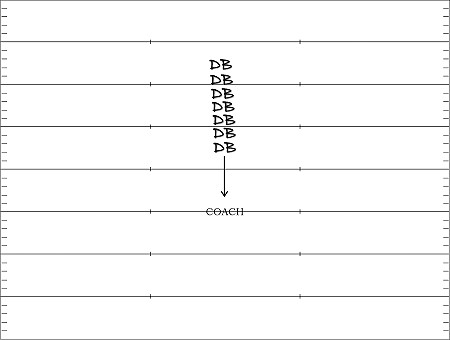
On defensive day we start our defensive backs with two impaired view drills. The first drill that we do is the one line tip drill and the second drill is the duck. In both drills the players get in a single line 15 yards ahead of a coach who signals the first two players to come towards him. The difference between the two is that in the tip drill the first player tips the ball to the second player. In the duck drill the first player will duck at the last moment which will let the thrown ball get to the second player in a hurry (See Diagram 1).
Foot Work
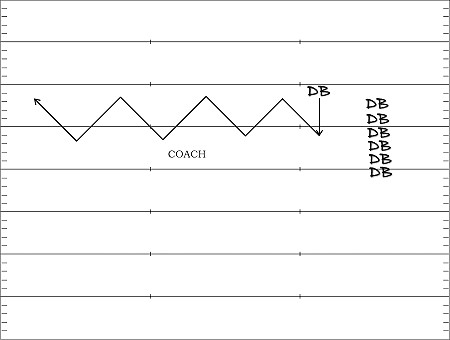
The second set of drills that we do are designed to improve the defensive back’s footwork. The first drill is the W drill. In this drill the players get in a single file line 15 yards to the left and 10 yards in front of a coach. The first player will come out and get into proper position and the coach will wave him forward and back with a football. The player will do this all the way across the field. The coach will look to make sure the player has the proper body lean, pushes off of his plant to go back, and pumps his arms throughout the drill. At the end of the drill the coach will throw the player the ball and he must catch it and sprint past the coach (See Diagram 2).
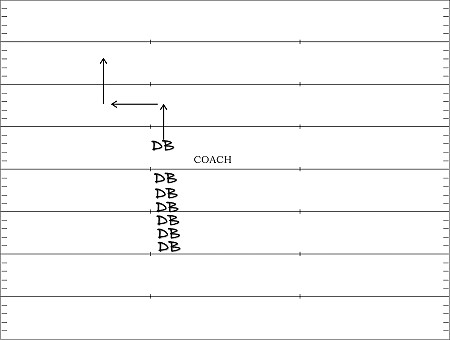
The second footwork drill is the wave drill. In this drill the players will get into a single file line 10 yards to the coach’s left. The first player will come out and get into proper position and the coach will wave him back and to the side and then deep. The coach will look and make sure that the player has the proper body lean, pushes off of his plant foot, pumps his arms and makes the proper body turn while keeping his eyes on the coach during the entire drill. The coach will then make a deep throw and the player must run and get it (See Diagram 3).
Coverage
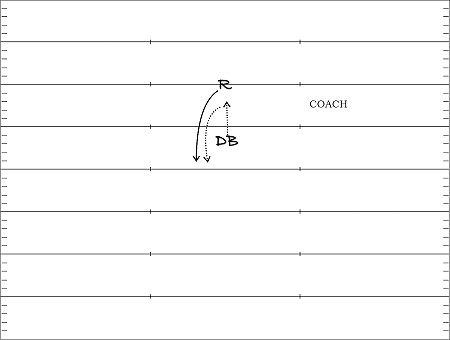
In our defense, our defensive backs play a lot of press coverage. So in practice we teach the players how to press the receiver. In this drill the players are divided up into two groups, receivers and defensive backs. The receivers will line up 10 yards outside of a coach, who had just told him the route he is to run. The defender will line-up head-up on the receiver and in a proper stance. At the snap of the ball the defender will shove both palms into the chest of the receiver and direct him to the outside, taking away all quick inside routes. He will then go hip-to-hip with the receiver all over the field (See Diagram 4).
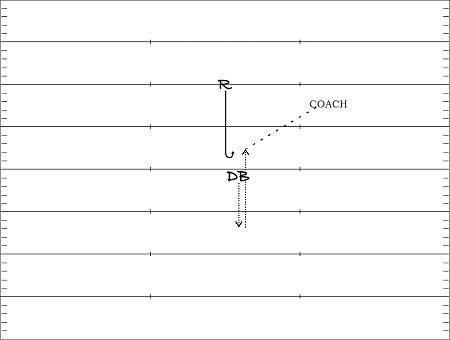
The next coverage drill we use is the break and strip. In this drill we set a defensive back ten yards in front of a receiver and have that receiver run a route. The defensive back must back pedal away from the receiver until the ball is thrown. After the ball is thrown, he breaks hard on the receiver and tries to first make the interception, secondly break up the pass, and third, strip the ball away from the receiver and make the fumble recovery (See Diagram 5).
Run Support
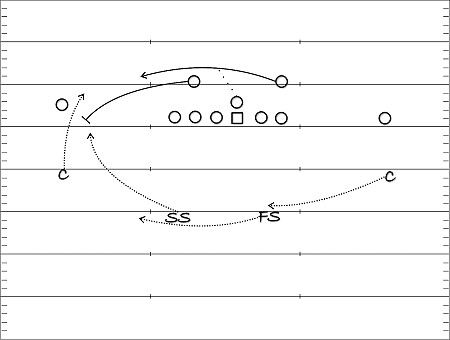
Your defensive backs must be able to play against the run. A drill we use to teach the players their roles against the sweep is the force drill. In this drill we put our defensive backs into their proper positions and we will run a sweep to one side and then the other. The sweep corner will have come across the line of scrimmage, take on the lead blocker, maintain outside leverage, and force the ball carrier to turn the run up into the inside. The other defensive backs will rotate into their proper positions (See Diagram 6).
Tackling
The best tackling drill that I have found involves the use of a tackling sled. In this drill the defensive back lines up in front of a tackling sled, which has a jersey on it and hits it square with his shoulder pads and grabs the cloth of the jersey. He then drives the sled to the ground. The player is taught to explode from the ankles to the knees and through the hips in making the tackle.
Rotation
In this drill we have the defensive backfield line up in their proper positions. We then run a variety (run and pass) of plays against them. The players must vocally make their pre-snap reads, against three receivers and a full backfield and then rotate into proper position after the snap and complete their assignments during the play (See Diagram 7).
Shell
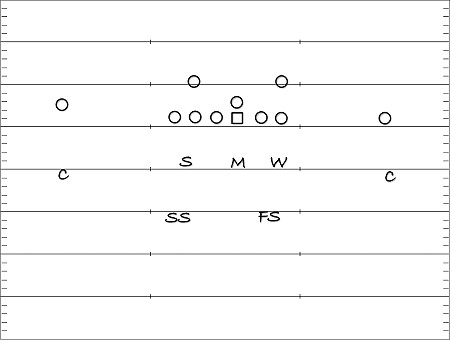
In this drill the defensive backfield and the linebackers are together and in proper position. A scout team will run plays at them and they must work together in making their pre-snap reads as well as completing their assignments.
In conclusion I hope these drills can greatly improve the play of your defensive backs. This, in turn, will improve the play of the whole defense.
Chris Booth recently retired after being both an assistant coach and head coach in Peterstown, WV. He can be reached at ChrisBooth@GridironStrategies.com.