HAVING A SOLID secondary is a luxury for any defense. Knowing that you have swarming defensive backs that are fundamentally sound allows you to be more aggressive with defensive packages and looks.
Backpedaling
Backpedaling quickly and fluently is a critical part of being a ball-hawking secondary player. To backpedal at top speed while maintaining coordination and agility, your DBs must:
- Create a balanced base with legs shoulder-width apart.
- Have the feet staggered with a toe-to-instep relation.
- Run with the upper body slightly bent forward.
- Bend slightly at the knees and lower the butt.
- Begin to transfer some weight to the balls of his feet.
- Stay low and keep a good balance with a low center of gravity.
- Step back with the inside leg or whatever leg is back.
- Push off with the front leg while stepping back.
- Pump the arms the same as when running forward.
- Keep the head up with the chin in front of the hips to maintain proper balance (called “nose over toes”).
DB Drills
DIAGRAM 1: Backpedal Drill.
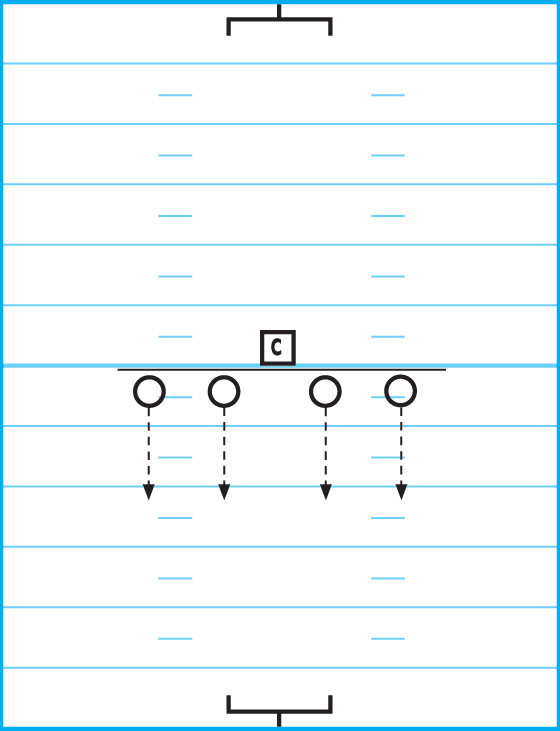
The coach has three or four DBs assume a defensive stance, 5-yards away and facing him. The coach holds a football above his head. When the coach slaps the ball, the players start backpedaling, accelerating to top speed. The players back-pedal for 10 yards.
Remind your players to stay low and pump their arms as if they were running forward and require them to keep their upper bodies slightly bent forward. Perform this drill for four repetitions.
DIAGRAM 2: Backpedal, Flip.
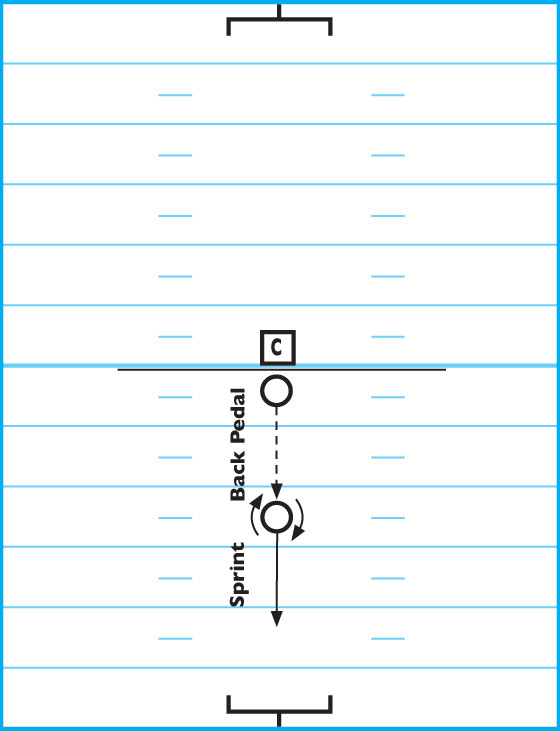
The coach has three to four DBs assume a defensive stance, 5-yards away and facing him. The coach holds a football above his head. When he slaps the ball, the players start backpedaling, accelerating to top speed. After the players backpedal for 7 or 8 yards, the coach slaps the ball again to signal the player to flip in the direction indicated. After executing the flip turn, the players throw open the elbow and sprint 10 to 12 yards.
Teach your players to get out of their backpedal on one step so they can get into a full-speed sprint as soon as possible. Have them open up and flip to the right on the first two reps, then open to the left on the last two reps. Repeat this drill four times.
DIAGRAM 3: “W” Drill.
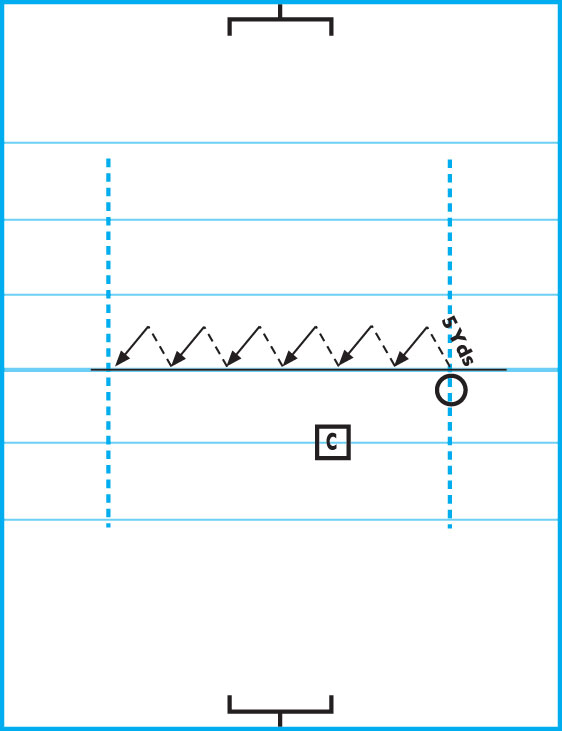
Coach has one DB at a time assume a defensive stance, 5-yards away and lining up on a hash mark. On the coach’s “Go!” command, the player backpedals at a 45-degree angle.
When the player gets to 5 yards, he plants and sprints forward on a 45-degree angle for another 5 yards. The player continues this until he reaches the other hash mark. The next player in line waits until the player in front of him starts his second backpedal before beginning his backpedal.
Require your players to yell, “Pass!” when they backpedal and “Run!” when they sprint forward. This gets them in the habit of communicating while running. Don’t let your players overextend when they plant and sprint forward. This drill should be run twice from hash mark to hash mark.
DIAGRAM 4: 45-Degree Pass.
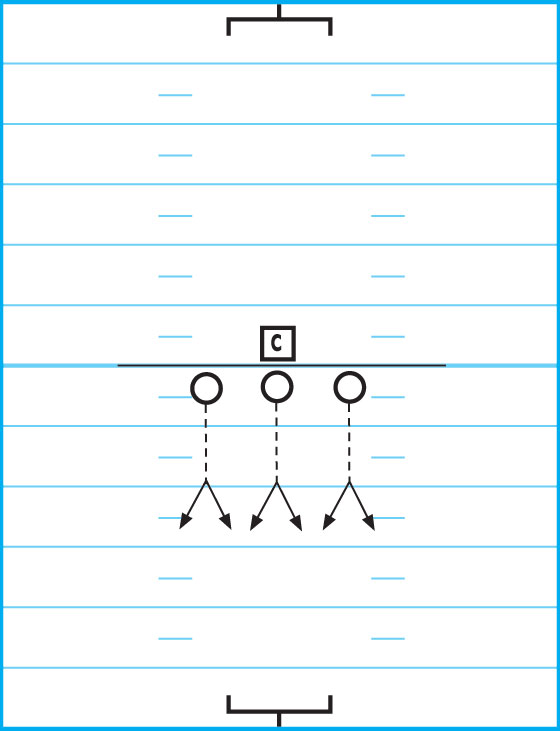
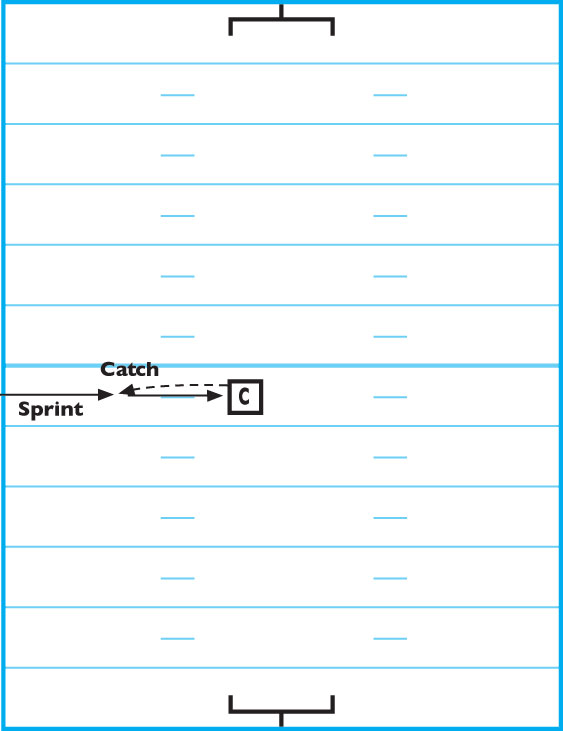
The coach has three or four DBs assume a defensive stance, 5-yards away and facing him. The coach holds a football above his head. When the coach slaps the ball, the players start back-pedaling, accelerating to top speed. The players will back-pedal for 5 to 7 yards. The coach will then hold the ball out to his right or left and the players plant and sprint in a 45-degree angle to the side dictated by the coach. The coach throws the ball up and the players try to intercept the ball. When the ball is caught, the DB sprints back to the coach.
Your players must plant and break off the opposite foot of the direction in which they are breaking. They should accelerate to full speed after the change of direction and run at a 45-degree angle while watching the coach, looking for the ball to be thrown.
DIAGRAM 5: One Man Sled.
DBs form a single line, one behind the other, facing the one-man sled at a distance of 10 yards. On the coach’s command, the first player in line sprints forward, gets into a good-hitting position in front of the sled, wraps his arms around the midsection of the sled, thrusts his hips forward and drives the sled until the coach gives the command to “Drop it!” The next DB in line hits the sled as soon as the coach gives the command “Hit!”
Each player must tackle with a good wrap — head up, eyes open and neck bowed.
DIAGRAM 6: Angle Tackling.
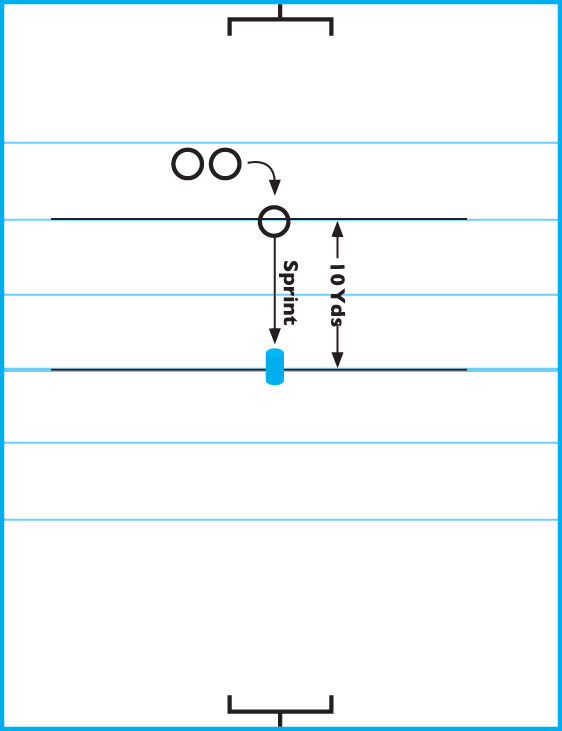
Coach places a towel or a scrimmage vest 6 yards from a sideline. One player serves as the ball carrier (BC) and the other as a tackler (DB).
The players face each other 10 to 12 yards apart and 10 yards from the sideline. On the coach’s “Go!” command, the ball carrier runs to a point between the towel and the sideline and attempts to make the defensive player miss him. The tackler starts on the same command and tries to cut off the runner at the point of attack.
Your DBs must tackle with a good wrap, head on the football and thrust of the hips. DB must knock the ball carrier out of bounds or make a good, angle tackle.
DIAGRAM 7: Man-To-Man Fades.
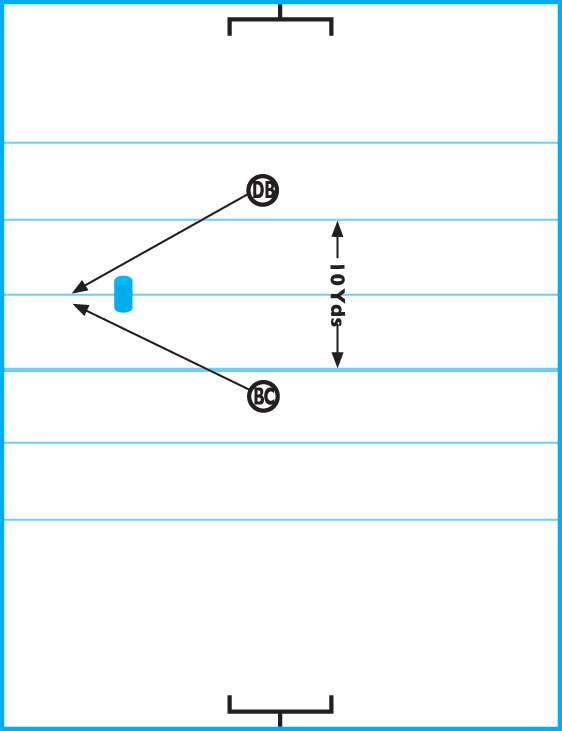
The drill begins with the coach, the DB and a receiver all on the line of scrimmage. The players line up 5 yards from the sideline, while the coach is positioned inside the hash mark.
The DB faces the receiver with his back to the coach and has his hand on the receiver while the receiver sprints straight downfield on a fly pattern. The DB trails the receiver on his inside shoulder, trying to squeeze him toward the sideline. Once the receiver has gone 20 to 25 yards, the coach throws a pass that both players go after.
Your DBs must read the receivers head and eyes, and rip through the receiver’s upfield arm. Have the DB look back for the ball over his inside shoulder, while maintaining contact with the receiver and timing his move or jump for the ball once the pass has been thrown.
DIAGRAM 8: 90-Degree Break.
The coach faces one player at a time, positioned approximately 5 to 10 yards away. The coach starts the drill by commanding, “Set!” When the player is in a good defensive stance, the coach shouts, “Go!” The player reacts by moving directly backward and yelling, “Pass!”
The player keeps his eyes on both the coach and the football and after he runs 5 to 7 yards, the coach moves the football right or left. The player reacts immediately by moving in the same direction as the football at a 90-degree angle laterally. The coach throws the football in the direction of the DB.
The player yells, “Ball!” when the ball is thrown, intercepts the pass and sprints back to the coach. Most teams have a call word for an interception — such as “Bingo!” — to let teammates know there was an interception.
Your defensive players must stay low, change directions quickly and attack the ball while it’s at the highest point in the air.
DIAGRAM 9: Partner Tip Drill.
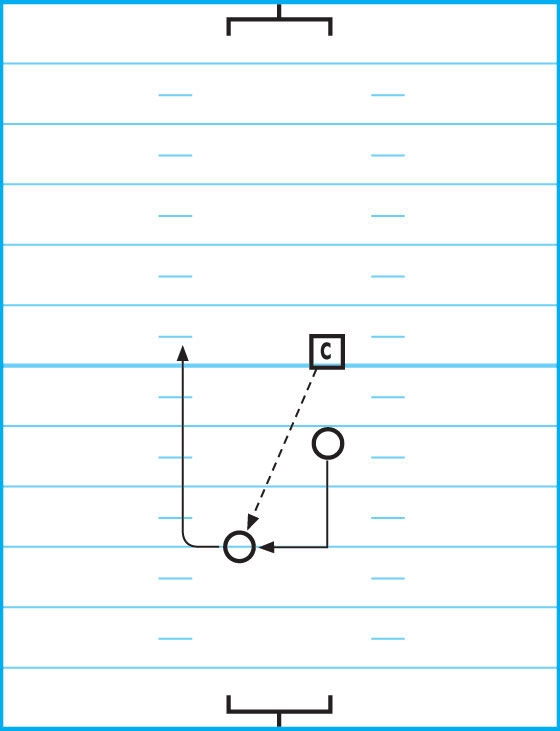
The coach faces two players, who are positioned 5 to 10 yards away on the hash marks. The coach starts the drill by shouting, “Set!” When the player is in a good defensive stance, the coach slaps the ball and the players backpedal straight back while yelling “Pass!”
When the players are 15 to 20 yards away, the coach throws the ball to one of the two. The player who is receiving the ball, tips the ball into the air, so his partner who is sprinting from the other side can intercept the ball. When the ball is intercepted, both players sprint back to the coach, yelling “Bingo!”
Make sure that your DBs communicate loudly and clearly in this drill. They must yell “Pass!” when the coach slaps the ball, “Ball!” when the ball is in the air and “Bingo!” when the ball is intercepted.
This drill teaches your DBs to go full speed after the ball while it’s in the air. This is a good drill to make into a competition. Partners usually get very competitive in this drill.
Pre-Practice Drills
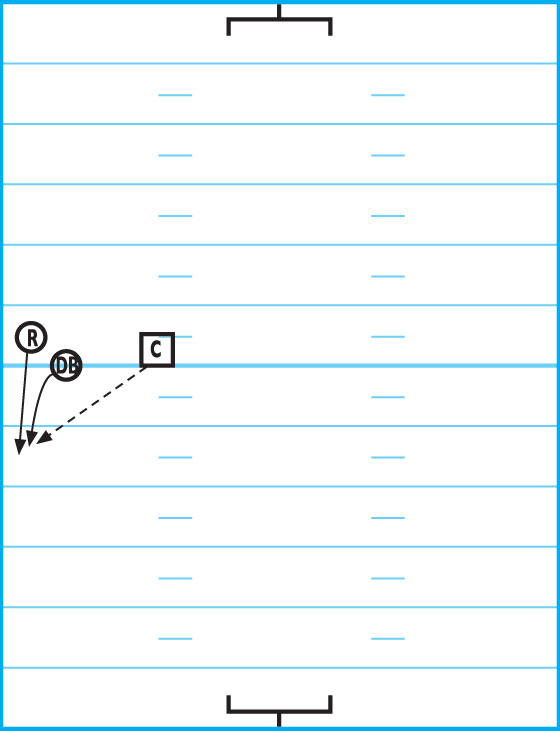
DIAGRAM 10: Strip Drill.
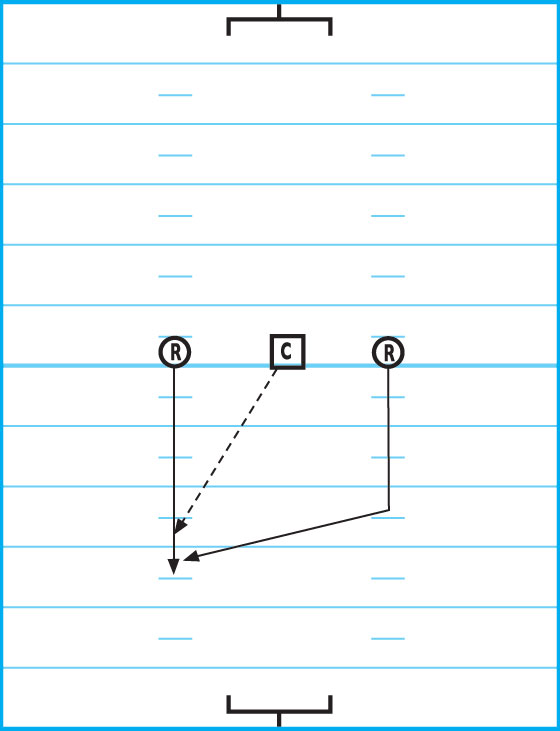
The coach stands at the center of the field, with a pair of players (one receiver, one DB) 10 to 15 yards off toward one sideline. On the signal from the coach, both players run toward the center of the field to a point directly opposite the coach.
The coach passes to the receiver. Once the offensive player has touched the ball, the DB reaches around the receiver with his outside arm to strip or dislodge the ball. The DB can only make his play on the ball after the receiver has touched it.
The DB must be prepared to tackle the receiver in case his outside arm doesn’t strip the ball from the receiver’s hands. Your players should be given several repetitions from both sidelines and rotate as receiver and defender.
Interception Drill. Same instructions as the Strip Drill, but the DB tries to cut in front of the receiver and intercept the pass.
DIAGRAM 11: Fumble Recovery Drill.
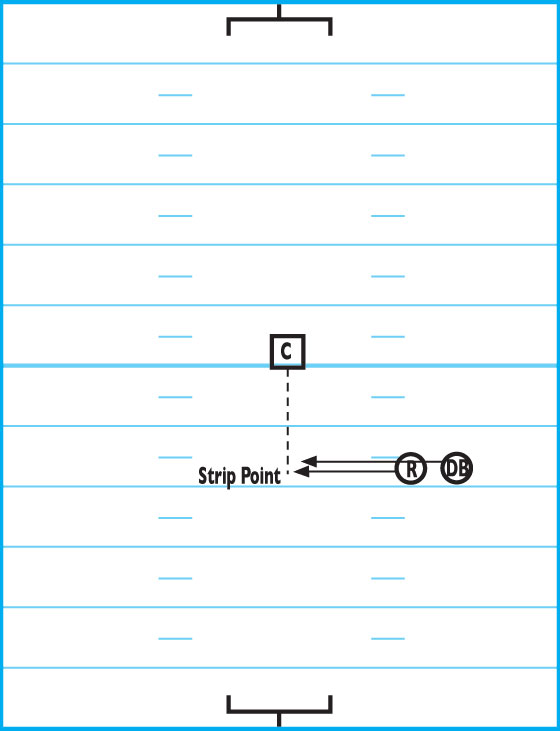
The coach has his DBs form one line 20 yards away and facing him.
When the coach raises the ball showing pass, the first player in the line sprints toward him. When the player is within
10 yards of the coach, the coach throws the ball at the ground several yards in front of the player.
Throw it hard and try to make the ball take some wild bounces. The DB must focus on the moving ball and make the recovery.
Place heavy emphasis on the importance of getting control of the ball before attempting to pick it up and run. If the DB is having trouble picking up the loose ball, instruct him to hustle and fall on the ball to make sure of the recovery.