OUR TEAM’S PHILOSOPHY is that the kicking game is going to win at least two games a year and should never contribute to a loss.
This philosophy has led our coaching staff to commit more practice time to special teams and special-team drills to determine the individuals we want on those teams. You’ll find that many of your opponents are lacking when it comes to preparing for the kicking game and your team will have a tremendous advantage.
Use Pre-Practice Time
Our team tries to dedicate at least 10 minutes to a pre-practice period where returners catch balls and kickers work on punting, field goals and kickoffs. This is also the time to work through special scenarios such as punt blocks or fakes.
Next, we build in a 20-minute period after the pre-practice where our special teams work on two phases of the kicking game. This period is dedicated to full team work against the scout team.
Kickoff Coverage
No other play requires more aggressiveness, discipline and courage than covering kickoffs. The following scheme allows a team the opportunity to pin an opponent while providing a stable, safety system in case a returner should break the “war zone.”
DIAGRAM 1: Place the kicker on the hash mark (right or left) to limit an opponent’s return to half the field.
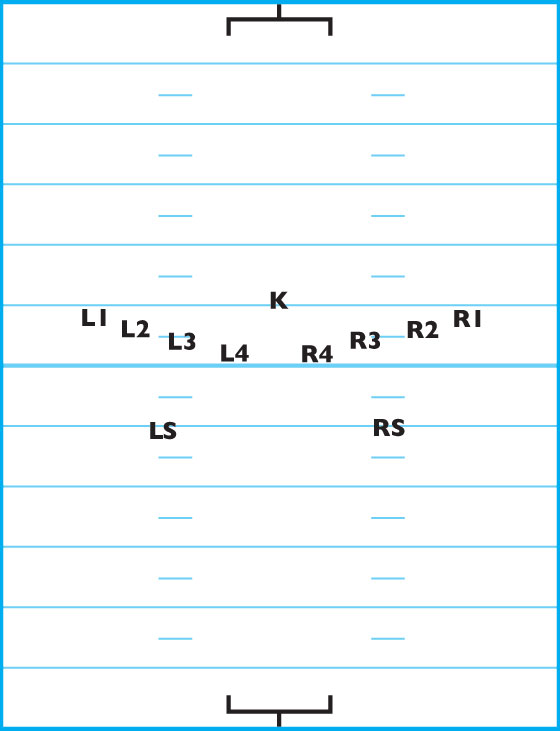
Once the ball is kicked, there are two different zones: the “avoid zone” and “contact zone.”
If it’s an average kickoff, the avoid zone involves the opponent’s front line. Have your players try to avoid contact and get back into their designated lanes.
PLAYER ASSIGNMENTS:
Assignments for each member of the kickoff unit are as follows:
L1 and R1: Contain. These individuals squeeze the ball carrier into the middle six coverage players. They must also become good enough to squeeze and make plays once the ball carrier has committed.
L2, L3, R2 and R3: These are your “aggressive head hunters.” They must avoid initial contact and stay in their lanes while keeping the returner on their inside shoulder. They must squeeze the ball carrier and prepare for the “war zone.”
L4 and R4: These are your “suicide bombers.” They must be willing to bust wedges without fear. They must stay in their lanes and develop a 4-yard relationship with each other, while keeping the returner on their inside shoulder.
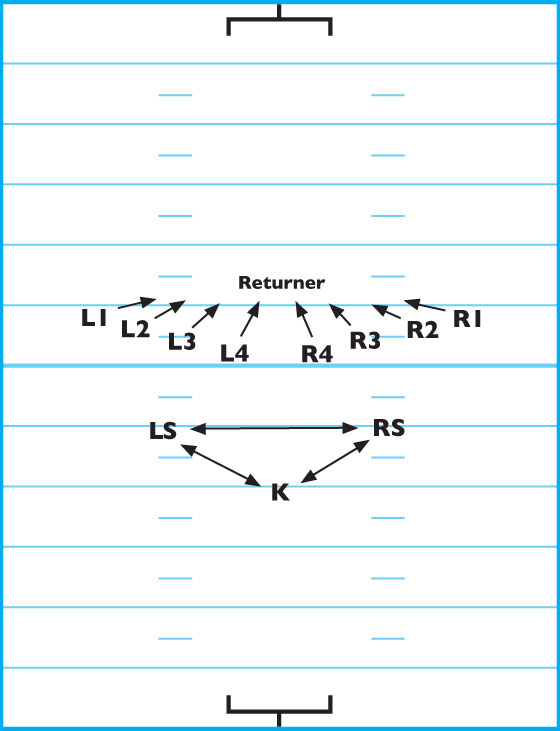
LS, RS and K: These players will develop a 3-man triangle to protect against long returns. LS and RS will settle in 10 yards from the “war zone” and the kicker will settle at 15 yards. They must work together in squeezing the ball carrier. It’s critical that the kicker keeps the ball on the hash mark on the kickoff.
DIAGRAM 2: Tell your coverage players to keep the returner on their inside shoulder. Note the 3-man triangle formed by LS, RS and K.
Shedding Blocks, Making The Tackle
The next zone involves taking blocks, shedding and wrapping the returner. Players should take on blocks by locking out their arms and grabbing the opponent’s shoulder pads near the chest.
Upon contact, they should look for the returner and shed the blocker to the right or left before hitting and wrapping up the returner.
DIAGRAM 3: Contact, shed and wrap drill. This drill involves the proper techniques for shedding a block, wrapping up and making a tackle. It can also serve as a great conditioning drill because all your players are utilized.
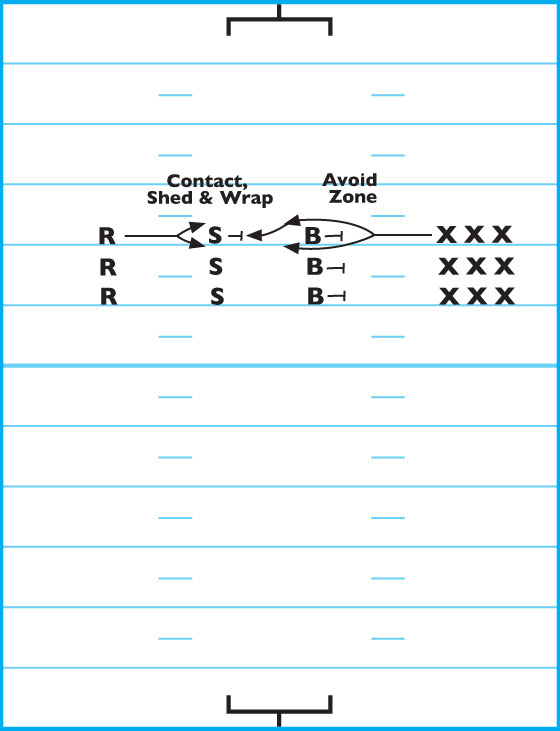
Line up groups of your coverage team players (X) into three lines. Stagger three return team players — a zone blocker (B), a secondary blocker (S) and returner (R). On the coaches signal, X runs at B, avoiding the zone contact and then makes contact with S. X sheds S, converges on the returner and wraps him up with a solid, form tackle.
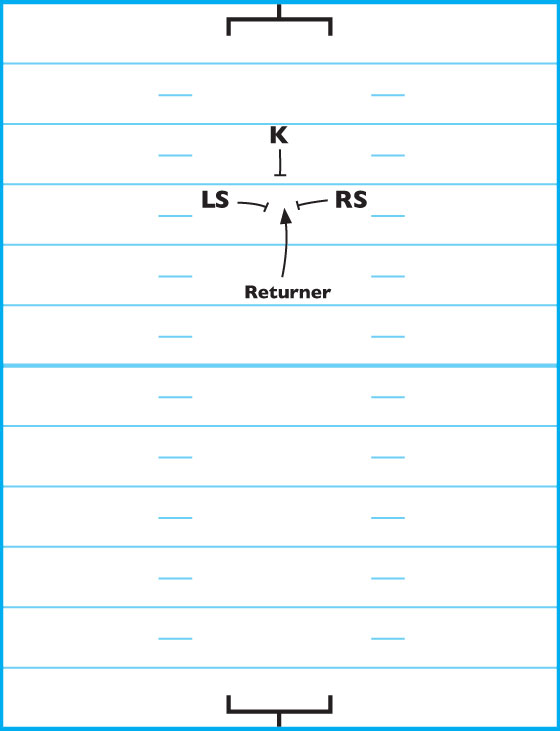
DIAGRAM 4: Coverage drill. Here’s a drill that we use with our three safety players on kickoff coverages. A coach will toss the returner a high lob that simulates a kickoff and the three safety players will work on keeping the returner on their inside shoulder while squeezing and boxing him in to make the tackle.