SPECIAL TEAMS PLAY is an important, albeit sometimes forgotten, aspect of a football game. Place special teams as an equal partner with the offense and defense, then practice it as much as the other two areas.
No matter the situation, live by the philosophy that the next play is the most important play. Don’t worry if your team just got torched for an 80-yard touchdown pass, your players need to rise to the occasion and block the extra point. Getting a block or creating enough pressure to cause a shank on the extra-point or field-goal attempt makes a drastic difference in the outcome of a game.
So, due to its significance, we line up and play the extra point or field goal like a usual down on defense — defend the goal line and don’t give up any points.
When attempting to block a field goal, you want to get off the field and deny your opponent the opportunity to score. Also, if the opportunity presents itself, you want to score.
Treating the field-goal of extra-point block with significance also means putting your skilled athletes on these special teams. However, many times, these athletes aren’t used to being in these situations. Teach them the dos and don’ts of blocking a kick.
Don’ts
Don’t be offside.
Don’t rough the kicker.
Don’t have 12 men on the field.
Don’t let your mind wander. Be ready for the fake at all times.
Dos
Do move with the movement of the ball, not the sound of the call.
Do use the proper angle and block point.
Do think offense when a kick is blocked behind the line of scrimmage.
Do pick up the ball and run.
Do be ready for the swinging gate, the shift to regular offense or any other type of fake.
Also, be sure your players are aware of the rules of extra points and field goals. They need to know when to advance the ball and when it is a dead ball.
preparation for blocking A Kick
Each position on the kick-blocking team needs to work on its specific assignments. Divide the team into four groups in practice when working on blocking field goals or extra points.
The defensive line works on alignment, takeoff, assignment and technique. The coverage players work the fakes that the opponent has shown and work on alignment and coverage. The edge blockers or second-level blockers work on the outside blocker’s steps when going to block the point. Also study the look your opponents have shown in previous weeks. The outside linebackers work with the blockers on alignment, shuffle and scoop.
The following diagram shows our Block R-L. Remember, the extra-point and field-goal teams do not huddle, so this gives you a look at the offense to make adjustments.
DIAGRAM 1: Block R-L. This block is an overload to one side with pressure coming from the edge and over the offensive guard and tackle. One side of the defensive front is the block side and the other the backside. The overload occurs when the strong safety and the free safety (the best block personnel) line up to the block side. The edge blockers, strong safety or free safety can align in this position on the line of scrimmage or stem to the alignment.
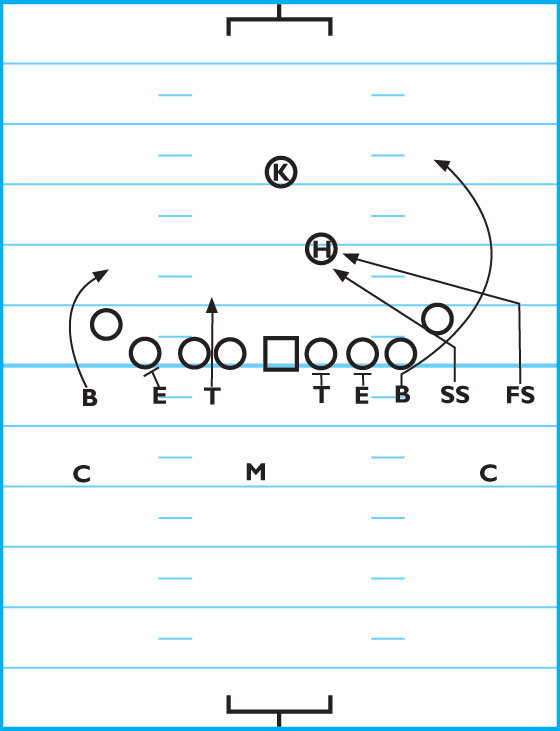
Here are the player responsibilities:
Block-side tackle: Align head-up on the offensive guard using a three-point stance with the inside foot back. Execute four steps and get the hands up.
Backside tackle: Align at the B-gap away from the block side. Attack the gap and get up the field.
Block-side end: Align head-up on the offensive tackle using a three-point stance with the inside foot back. Knock the OT back four steps and get the hands up.
Backside end: Align on the inside eye of the TE with the outside foot back. Go man-to-man on the TE.
Block-side linebacker: Align head-up on the TE. Attack the TE turning his shoulders inside toward the ball. Shuffle outside and upfield. Be prepared to scoop the ball and run if blocked. Contain all fakes.
Backside LB: Align on the outside eye of the TE. Shuffle outside and upfield. Be prepared to scoop the ball and run if blocked. Contain all fakes.
Middle LB: Align over the center. Go man-to-man on the block-side TE. Stem over the OG when the kicking team is ready.
Strong safety: Align on the nose of the TE’s outside hip using a three-point stance with the outside hand down and outside foot back. Go to the block point 3 yards in front of the holder with thumbs together and arms extended at block point.
Free safety: Align on the nose on the wing’s outside hip. Go to the block point 3 1/2 yards in front of the holder with thumbs together and arms extended at the block point.
Corners: Go man-to-man on the wings.
kick-blocking drills
Putting your team in a position to block a critical field goal or extra point starts with drills in practice. Try the following drills to work on individual skills needed in the kicking game.
DIAGRAM 2: Outside Blocker Drill. This drill teaches the outside rushers the proper takeoff and block angle. Have half the line lining up with the holder and kicker. The holder and kicker go through normal kicking procedure. The blockers work on taking off with the ball movement and going to the block point. They use a three-point stance with the outside foot back. They key the ball out of the corner of their eye for takeoff. They turn the corner, flatten and go to the block point. The coach stands behind the blocker and tells him which player to let through. This way, one blocker comes through free so there isn’t a collision.
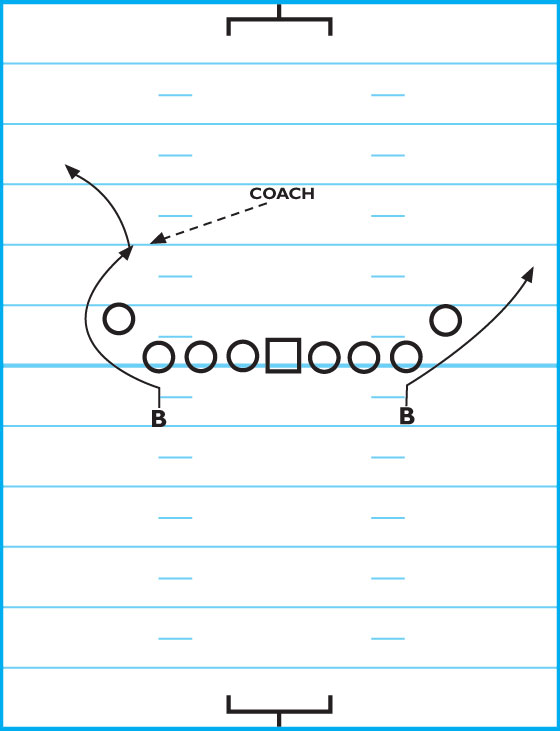
DIAGRAM 3: Outside Linebacker Drill. This drill teaches the linebackers to scoop and score or contain on fakes. Both blockers align over. They then execute the collision and shuffle outside to execute their assignments. The coach flips the ball as if the ball were blocked. Players scoop the ball and run 10 yards simulating scoring.
DIAGRAM 4: Cover People Drill. This drill teaches all players involved in coverage — especially the Mike LB and the corners — how to deal with possible fakes. The corners cover the wings and the Mike handles the TE in man-to-man coverage. The coach determines the routes to run.
jump block
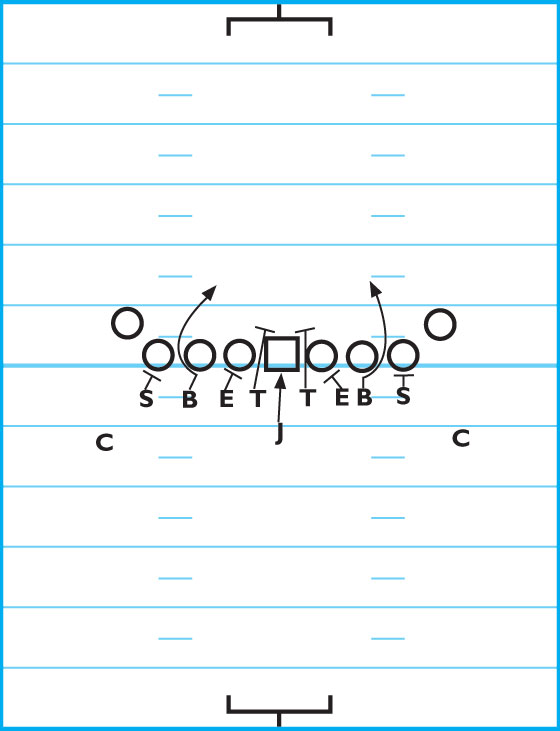
If the team you are facing has a kicker who has a tendency to kick the ball low or if the team is soft in the middle, utilize the Jump Block to stuff a field-goal or extra-point attempt. Diagram 5 shows the action of the Jump Block and is followed by three drills so each segment of players is prepared for this type of block.
DIAGRAM 5: Jump Block. These are the player responsibilities when executing the Jump Block.
Blockers: Attack the OT and occupy him so he cannot attack the jumper, then work upfield for contain.
Jumper: Line up in the path of the ball. Time the jump so that you can catch the ball coming off the ground.
Tackles: Attack the inside shoulder of the OG. Slide to the A-gap.
Ends: Attack the crook of the OG’s neck and take him back to the holder.
Safety: Use man-to-man coverage on the TE.
Corner: Use man-to-man coverage on the wing.
DIAGRAM 6: Tackle & Ends Drill. This drill teaches tackles and ends to knock back the line of scrimmage and get their hands up. It also teaches the defensive tackle to penetrate and go for the block if the center attacks the jumper. Align the tackles and ends on the offensive line and let them work on pushing back the LOS.
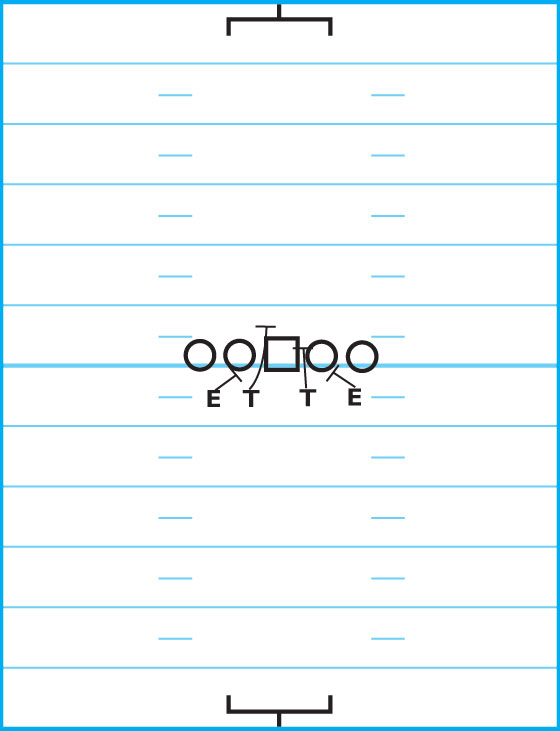
DIAGRAM 7: Jumper Drill. This drill helps the jumper perfect his steps and timing. The jumper practices walking off the steps from the ball so he will jump into the LOS. He lines up with a center, holder and kicker, who go through the normal kicking procedure. When the ball is snapped, the jumper jumps to the block point.
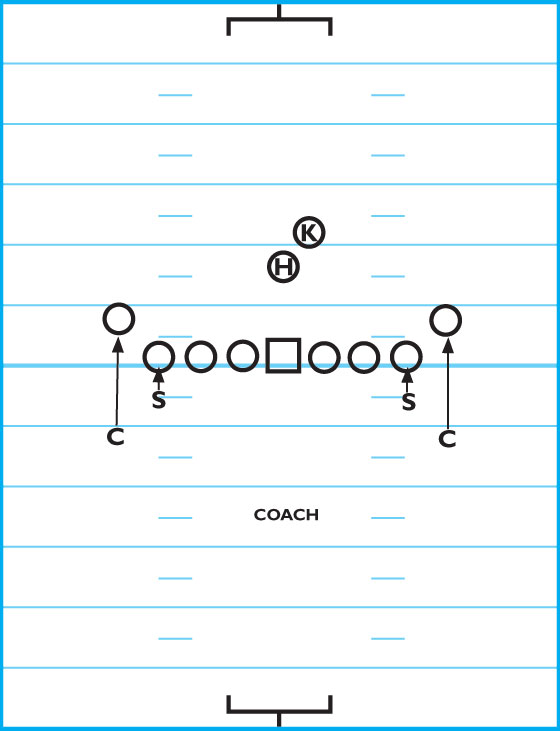
DIAGRAM 8: Cover People Drill. This drill is perfect for corners and safeties as it teaches all the coverage players how to deal with possible fakes. The safeties are lined up on the TEs, just as in the Jump Block. The corners are lined up against the wings. These coverage players are in man-to-man coverage and the coach predetermines the routes to be run.
safe block
Sometimes situations don’t warrant an all-out assault on the opposition’s kicking team. When an opponent’s field-goal attempt is not crucial to the final outcome as a first down or touchdown might be, dictate whether or not heavy pressure is placed on the kicker. Better safe than sorry might be a cliche but it’s the truth in some kick-blocking scenarios. If you go with an all-out attempt and the kicking team calls a fake, you might be giving up a touchdown instead of a field goal.
In these situations, apply a little pressure on the kicker and be in position in case he misses or the team fakes the extra point or field goal. This is referred to as a Safe Block.
DIAGRAM 9: Safe Block. These are the player responsibilities when executing the Safe Block.
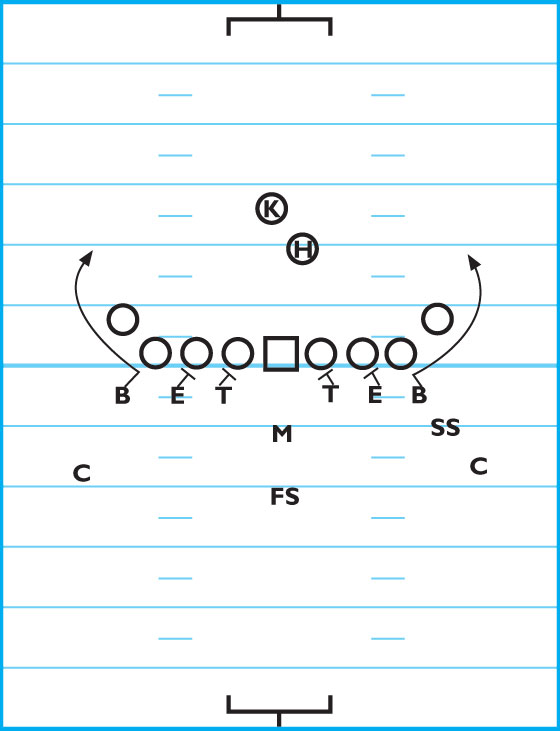
Tackles: Align on the offensive guard’s outside shoulder.
Ends: Align on the offensive tackle’s outside shoulder.
Outside LB: Align on the tight end’s outside shoulder.
Middle LB: Align head-up on the center. Stem to cover (man-to-man) the TE to your left.
Strong safety: Align head-up on the
TE to the right. Cover the TE man-to-man.
Corners: Align on the wing’s outside eye. Cover man-to-man on the wing.
Free safety: Align 8 yards off the line of scrimmage. Be alert for the possibility of a fake.
playing vs. the gate formation
Some teams align in an unusual formation so your squad must be prepared for all trick plays and formations. Give your players a cover down rule that they can apply to these situations.
DIAGRAM 10: Defending The Gate Formation. These are the player responsibilities when defending the Gate Formation.
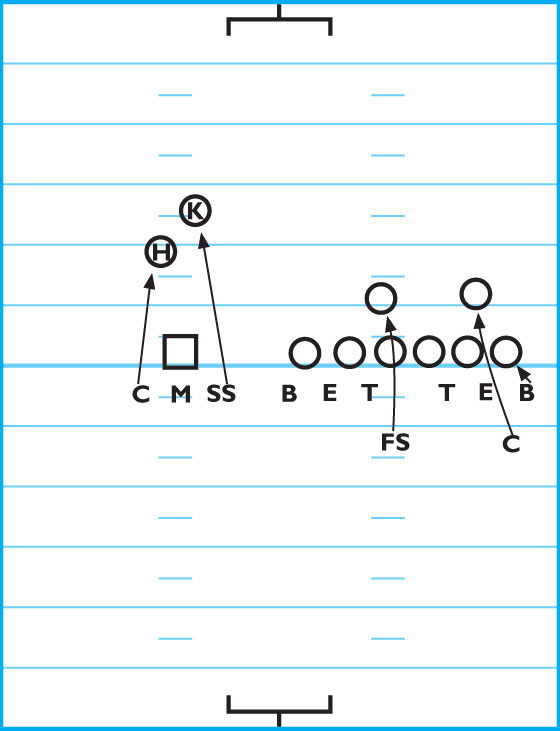
Right OLB: Align on the end’s outside eye on the LOS. Contain all runs. Against a pass, man-to-man cover the TE.
Left OLB: Align on the outside eye of the last man on the LOS. Keep eyes on the ball. Be alert for lateral to the wing. Pick off any pass attempt.
Ends: Align on the tackle’s outside shoulder and control the gap.
Tackles: Align on the guard’s outside shoulder and control the gap.
Middle LB: Align head-up over the ball. Cover the center man-to-man versus a pass or a run. after the gate shift back to kicking formation, give the block call to the defense.
Left corner: Align on the LOS if the ball is snapped. Blitz and engage the holder man-to-man.
Strong safety: Align off the LOS if the ball is snapped. Take the kicker man-to-man.
Right corner: Align off the LOS in pos-
ition to cover the right wing. If the ball is snapped, play the wing man-to-man.
Free safety: Align off the LOS in position to cover the left wing. If the ball is snapped, play the wing man-to-man.
taking everything into account
Success in the offensive and defensive games depends on the flawless execution of each squad member’s responsibilities and the same principle applies to special teams. The bottom line is to make something good happen.
When considering the best course of action in a kicking situation, take into account such items as time, score and possible momentum shifts. Once a decision is made to attempt to block a kick, there is no substitute for adequate planning. Luck sometimes may account for the good things that happen in football games but, more often than not, it is the planning and practice that result in spectacular, game-winning plays.