Being an offensive line coach, I try to convince my offensive coordinator to run the ball as many times a game as we see fit. I know my linemen and I know they love it when we run behind them. This past season, at East HS, we had a senior laden line, many of whom I have coached for the past three years. I will try to convince the coordinator to run guard trap to the full back at least four to six times per game. I will also lobby to run this play in goal line situations. Running this play on the goal line gives my linemen great confidence and a great deal of pride. I will explain how we block trap versus multiple fronts and on the goal line. Allow me to offer a little background first: we are a traditional Wing-T team with a numbering system where the one hole is on the extreme right and the nine hole is on the extreme left with the center as number five (See Diagram 1).
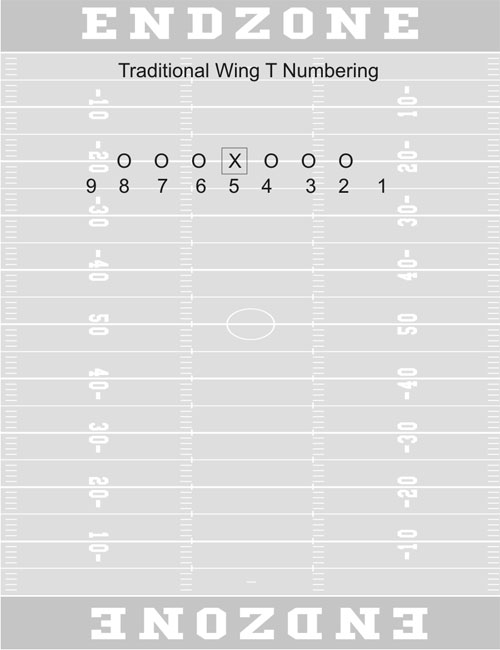
Our guard trap is in the trap, sweep, waggle series (20’s) and we are running it to the four or six area. We would call guard trap 24 or 26. We coach up Trap out of every formation we have, which in effect gives us the option to run this play anywhere on the field versus any front thrown at us. The only time we do not run trap is versus double-eagle with a mike stacked on the nose.
Versus a 4-3
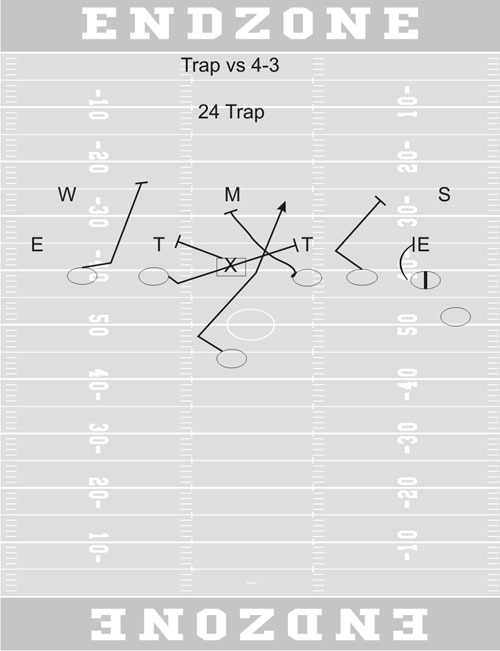
Out of a traditional Wing-T 100 formation, the fullback aligns four yards behind the quarterback. We have a tight end and wing on the right side. Ideally, we want to trap the widest man past the center but we also allow our QB to keep the play if it is called into 2i or gap-technique. When trap is called we instruct our play-side guard to widen his split from the center to about 3.5 to 4 feet and we ask the pulling guard to shorten his splits to about 2 feet.
The play-side guard is shouting a technique number out each play, so he is giving away the position of the DT to the opposite guard. The opposite guard now knows if this will be a long or short pull. The center and back-side guard must work together. These two are essentially creating a cross-block. I instruct our guards that if they make a traditional pull-step, they have lost the trap already. The guard’s right foot must replace the center’s left foot on this block. This forces the guard to pull into the line. On the next step the guard will brush shoulder pads with the center. This is how tight the two linemen must be. The play-side guard is determining if he should rip underneath the DT or if he should wrap around, outside of him. He will be blocking the middle linebacker. If the play-side DT is in a 3-technique then the guard rips underneath him to the mike. If that DT is in a head-up (2 technique) or inside of him, he must take an outside release step with his right foot, hug the DT with his left foot, and then shoot to the mike.
The play-side tackle will inside combo with the tight end up to the sam. The back-side tackle will take a down-step with his right foot, make sure the DE doesn’t cross his face then continue up to the will. The back-side guard’s head must be up field on the trap in order to keep the DT pinned and not allow him to get down field (See Diagram 2).
Versus a 4-4
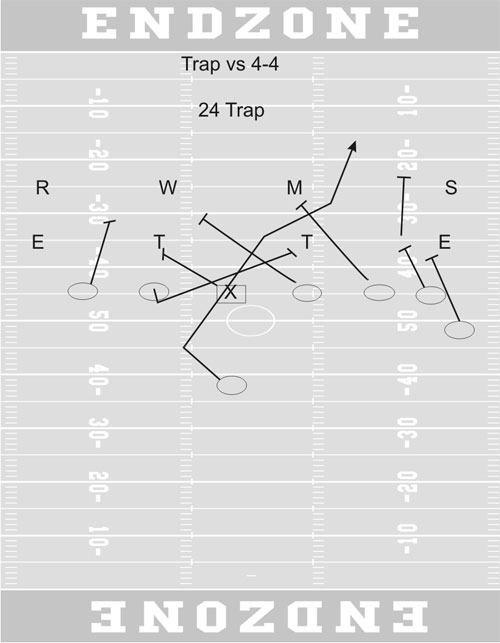
The back-side guard, center and play-side guard’s steps are all the same with the exception of one technique. The play-side guard will rip underneath the DT and continue up to the far-side inside backer. This means that the play-side tackle will have to rip inside and rub shoulder pads with the DT in order to get up to the near-side inside backer. This will leave the play-side outside backer to be blocked by the TE. He must also rip inside to try and cut off the outside backer’s flow into the play. The wing will have to follow the TE inside to cut off the DE. This will, in essence, create an inside combo with the TE and wing. The back-side tackle will rip inside and have the same responsibilities as he did versus a 4-3. He has to block the DE if he crosses his face. If the DE does not cross his face, then the tackle can release up to cut off the back-side outside backer (See Diagram 3).
Versus a 5-2 and a 3-3 Stack
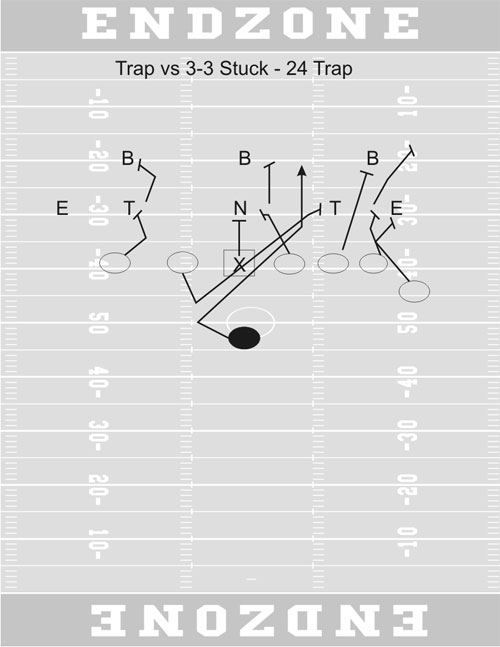
When running this play versus 50 fronts, the fullback MUST be aware that there is a nose and the play will break wider than usual.
The center and play-side guard combo block the nose up to the far-side inside backer. The play-side tackle has the same rules as the play-side guard had versus the 40 front. He can rip underneath the DT if he is head up or in a 5-technique. If the DT is in a 4i technique, the tackle must release outside then up to the near-side inside backer. The TE and wing will inside combo block the DE up to a possible monster backer or even the corner. The back-side tackle must inside release so the DE does not rip across his face. The trapping guard has to take a little bit of a deeper step so he does not get picked off by the center. After he passes the center he must re-position himself into the LOS in order to root out the DT (See Diagram 4). The main difference between the 5-2 and the 3-3 is that the center and guard combo is up to the middle linebacker, not the far-side inside backer. The play-side tackle will release inside or outside to the stacked backer behind the tackle (See Diagram 5).
Versus Eagle and Double-Eagle Fronts
This is where it gets really fun and the offensive line figures out that they are really superior linemen. Running trap into an eagle or double-eagle front correctly, the o-line starts to grow a lot of confidence. This is when the o-line takes control of the d-line.
In diagram 6, trap is drawn up to what I call an eagle front. Versus an eagle the center must make a down call with the play-side guard. This means that the center has to block back on the DT and the guard blocks down on the nose. The play-side tackle has to release inside, to block the play-side linebacker. The TE and wing inside combo and the back-side tackle rips inside, cuts off the DE or continues up to the backer.
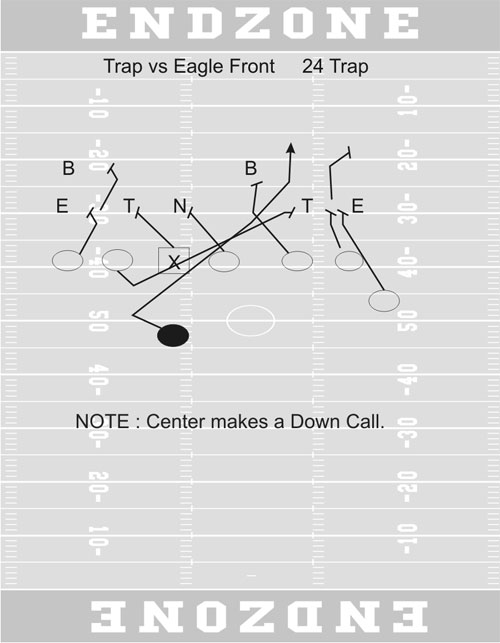
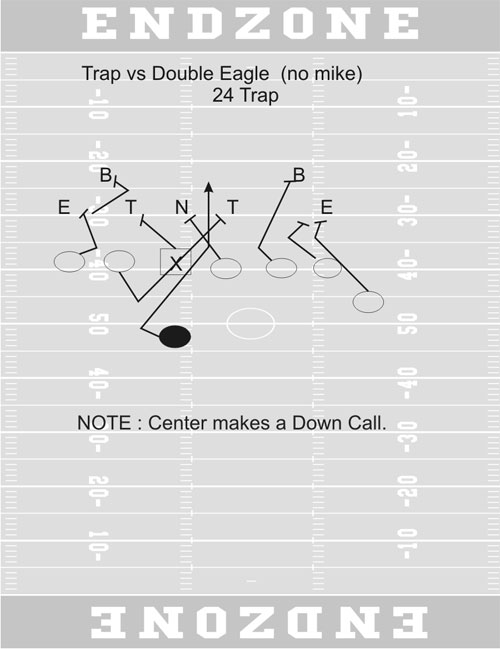
Diagram 7 illustrates a double-eagle. All of the linemen’s rules are still the same with the exception of two aspects. First, The play-side tackle does not have to make a decision to either rip down or outside release. He should have a free release right up to the backer in front of him. Second, the trapper will have an extremely tight trap. The center and the play-side guard still have down calls but they have to get to their assignments quickly. As previously stated, we do not run trap into double-eagle mike. We can only run it into double-eagle with the mike removed over the tackle.
Trap On The Goal Line
Now this is where it really gets fun. I love to run trap here. If you can run guard trap on the goal line and score or run it for positive yards, it has unbelievable effects on both teams. First, it demoralizes the defense. Second, it gives the offense great confidence.
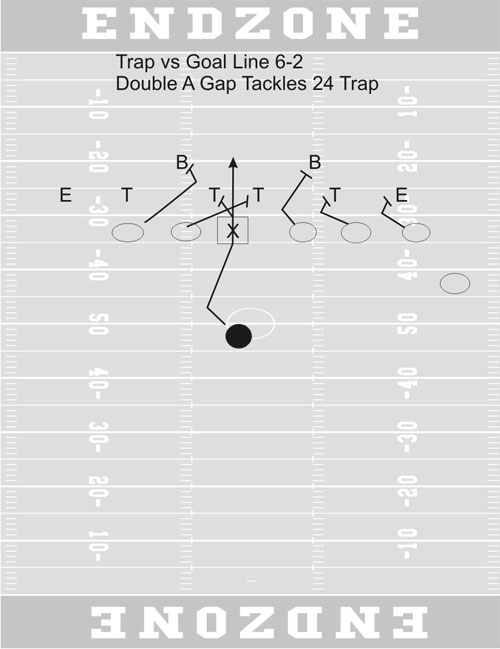
Running the trap into a 6-2 defense with double A-gap players is risky and very tight. Everyone has the same rules, the trapper and the center must get movement on their blocks. The center’s and trapping guard’s block essentially becomes a cross-block. The full back must know that he has to get right up into the guard’s block. If he improvises and cuts it anywhere outside the guard’s block, he is on his own (See Diagram 8A).
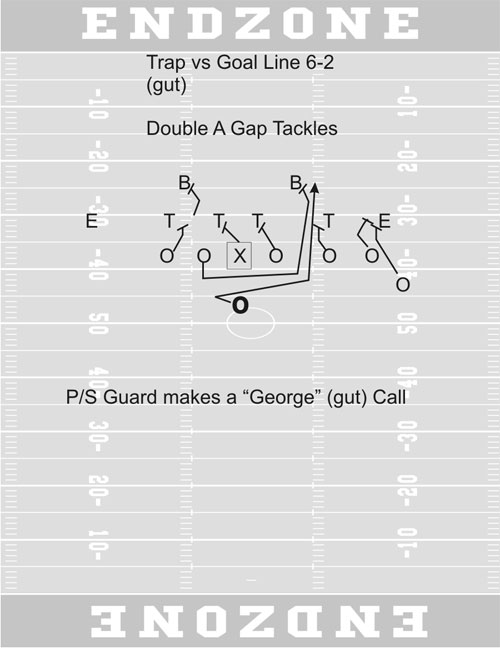
A variation for trap on the goal line is trap-gut (See Diagram 8B). To block the trap-gut, the play-side guard blocks down on the play-side A-gap DT. The center blocks back on the back-side DT and the trapping guard “gut” blocks past the play-side guard and up into the hole to the play-side linebacker. As a staff, we can call this play from the sideline or it may become a half-time adjustment. It can also be an adjustment, on the field, by the linemen. If they feel that they will not be able to make the regular trap, the play-side guard makes a “george” call signaling the back-side guard to gut block up to the linebacker.
Trap Variation
One way in which we can change up trap is by influence – pulling the play-side guard. We would do this if we find that the DTs are keying on our guards running sweep. Another reason why we may run influence is if the DTs are pinching regularly. Diagram 9 is drawn up against a 4-3 defense and is called 24-Indiana (influence). The center back blocks, the back-side tackle cuts off the DE and goes up to the will, the play-side tackle fires up to the sam, and the TE and wing inside combo the DE. The play-side guard pulls away from the play (to our right for 24 trap) and acts like he is running sweep. His job is done if he pulls the DT out and possibly even makes the DE widen out with him. The trapping guard “gut” blocks around the center and up to the mike. This leaves the play-side DT unblocked. We believe that trap hits so quickly that if the DT follows the influencing guard for at least one step, then the full back will be past him already.
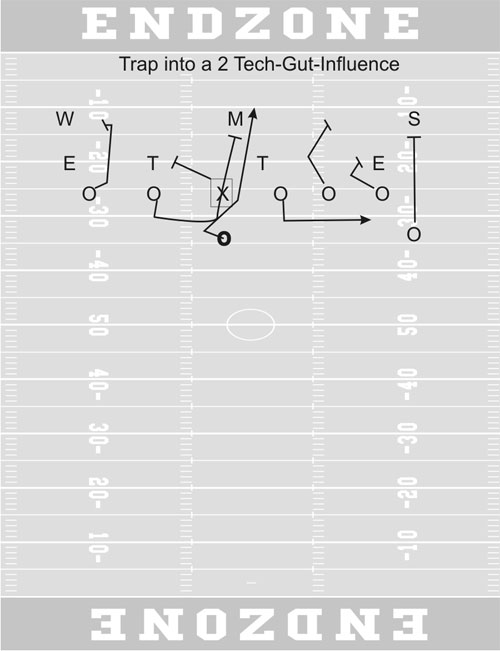
Guard trap can be run from any formation in our offense, as long as we have a full back in the backfield, at any time in the game, at any field position, and during any situation. Running guard trap is so much fun for an offensive line. A majority of times the DT who is being trapped does not see it coming and gets pancaked by the trapper. This usually provides a great deal of levity in film sessions.
About the Author
Coach Denton began his coaching career as a student assistant at Bloomsburg University of PA under Head Coach Danny Hale. He returned back to New York and started coaching varsity football with his father at South Side High School as the defensive coordinator and offensive line coach where they won the county championship in 2001. After a brief stint at Commack High School, Denton joined up with Jim Saladino at Smithtown East High School. This past season Smithtown East had their most successful season in seven years making the playoffs for the first time since 2001.