ONE POINT CAN make all the difference in the world during the course of a football game. A failed extra point can also affect a team’s strategy for the rest of the game.
In a recent NFL playoff game between San Francisco and Green Bay, former coach and current TV commentator, John Madden, made this statement when the 49ers blocked an extra point in the first quarter: “That point sits there the whole game.”
A blocked extra point is the only way a team can take away a point from its opponent. Most observers take extra points for granted and automatically think of touchdowns as being worth seven points. NFL statistics show that only 1 out of 27 extra points fail. The failure rate is higher at lower levels of football, but extra points still have a high percentage of overall success. Teams trying to increase this failure rate must design ways to pressure the extra-point attempt.
Blocking Philosophies
There are three basic ways to block an extra point or field goal:
1. Rushing Up The Middle. Penetration up the middle is the most effective way to block the kick, but it is very difficult to get penetration because of line splits and the blocking scheme.
2. Rushing From The Sides. Blocks from the side require players that possess speed, timing and knowledge of the correct rushing angles.
3. Coming Over The Top. Players who can jump high and block kicks from the middle have more success on the upper levels because kickers aren’t allowed to use a kicking tee. Most high school kickers are able to get quick elevation on their kicks because they can use a tee.
Numbers Vs. Time
Each unit has inherent advantages on an extra point or field-goal try. The rush team outnumbers the kick team by an 11-to-9 ratio since the holder must hold the ball and the kicker must kick.
The major advantage that the kicking team has is time. If the kick is launched quickly and with good trajectory, it’s not likely to be blocked.
A block team doesn’t necessarily have to block a kick to be successful. If a kick-block unit has had good push and penetration on an attempt, it could cause the opposing kicker to misfire on a later attempt.
Extra-Point, Field-Goal Blocks
Try these two types of point-after and field-goal blocks. The first block will be a combination edge and middle block. The second block will be an overload block.
DIAGRAM 1: Kicking team base formation.
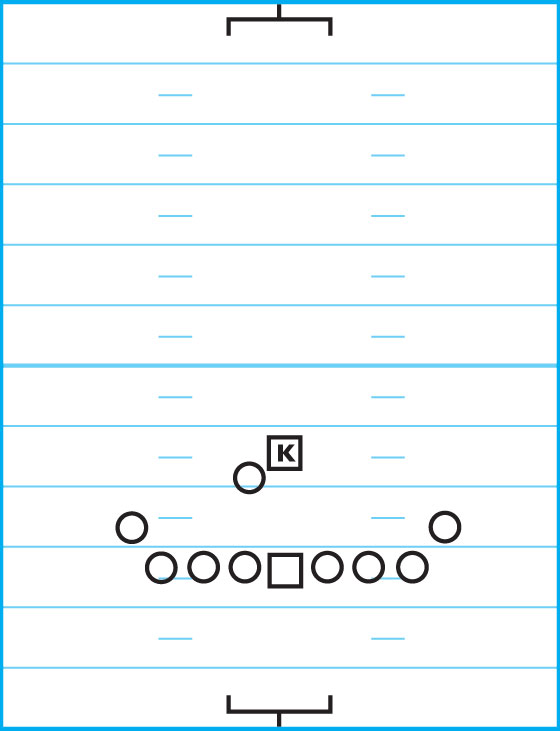
DIAGRAM 2: Defensive positioning.
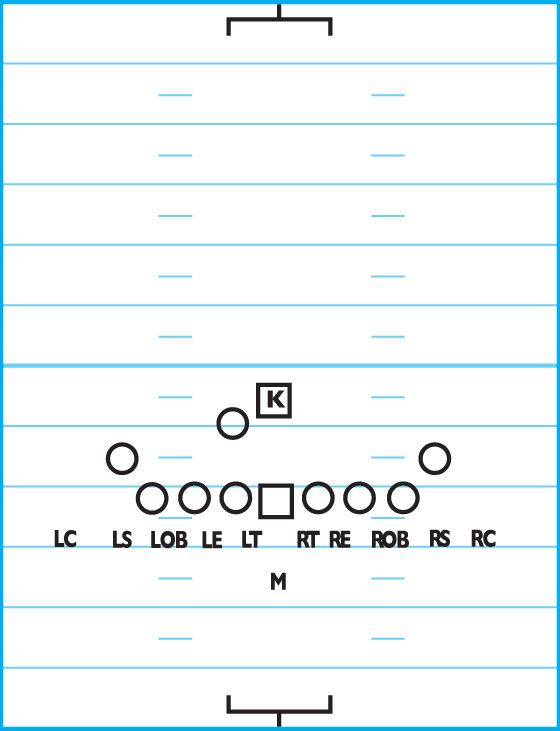
DIAGRAM 3: Block left.
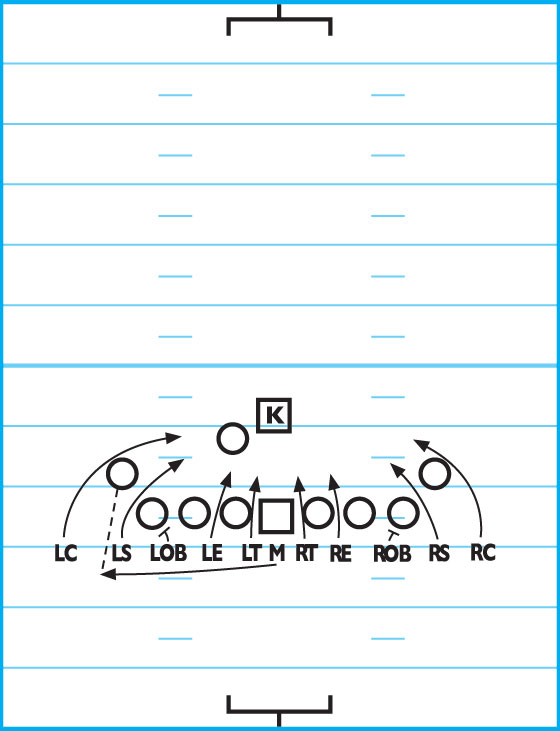
PLAYER ASSIGNMENTS:
Left Corner (LC): First assignment is to check the inside alignments. He makes a “stay onside” call to his side of the formation. On the snap, he rushes through the outside half of the wing. He will align cocked and to the inside with the outside foot up. He should line up wide enough to get a good angle to the kicking spot.
Left Safety (LS): On the snap, he rushes hard through the gap between the wing and end. Makes himself small by ripping through with his outside shoulder and turning his jersey number toward the ball.
Left Outside Backer (LOB): Blitz engage the tight end. He will take the end man-to-man if the end releases.
Left End (LE): Power rushes through the outside shoulder of the guard and tries to knock him back. After he gets movement, he’ll climb and throw his inside hand up on a two count.
Left Tackle (LT): Power rushes through the inside shoulder of the guard and tries to knock him back. After he gets movement, he’ll climb and throw his inside hand up on a two count.
Right End (RE): Power rushes through the outside shoulder of the guard and tries to knock him back. After he gets movement, he will climb and throw his inside hand up on a two count.
Right Outside Back (ROB): Blitz engage the TE and draw his block. He will take the end man-to-man if he releases.
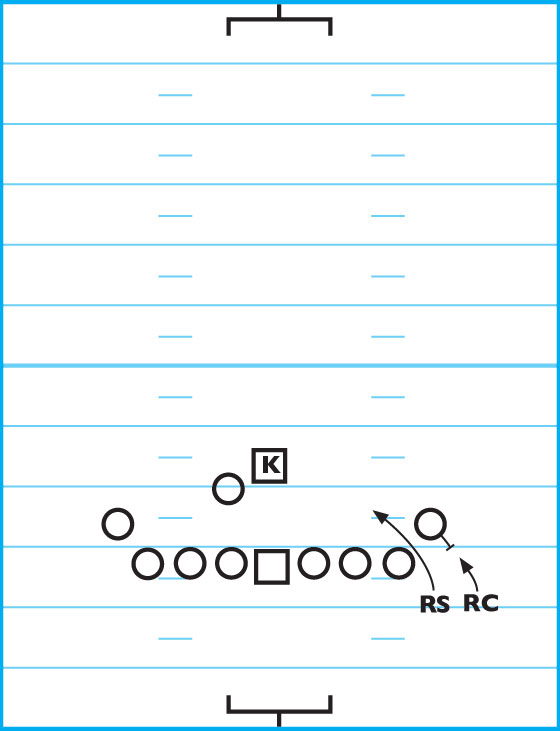
Right Safety (RS): Rushes hard through the gap between the wing and the end. He reads the block of the wing. Should the wing block down hard with his head across, the RS will take him man-to-man (corral technique).
Right Corner (RC): Checks alignment inside and makes a “stay onside” call. He rushes hard through the outside half of the wing. He reads the block of the wing. If the wing blocks down, the RC will continue rushing and try to block the kick. If the wing steps out or doesn’t step out at all, the RC will blitz-engage him and take the wing man-to-man if he releases (corral technique).
Monster (M): Aligns near the ball and just prior to the snap, pulls out and covers the wing to the block side.
Corral Technique: Read the scheme between the corner and the safety away from the called block side. Each man will read the block of the wing. The safety will take the wing man-to-man if the wing blocks down. If the wing blocks out or doesn’t move, the corner will take him man-to-man. The other man in the scheme continues on and tries to block the kick.
DIAGRAM 4: Down block by the wing. The RS takes him man-to-man and the RC tries to block the kick.
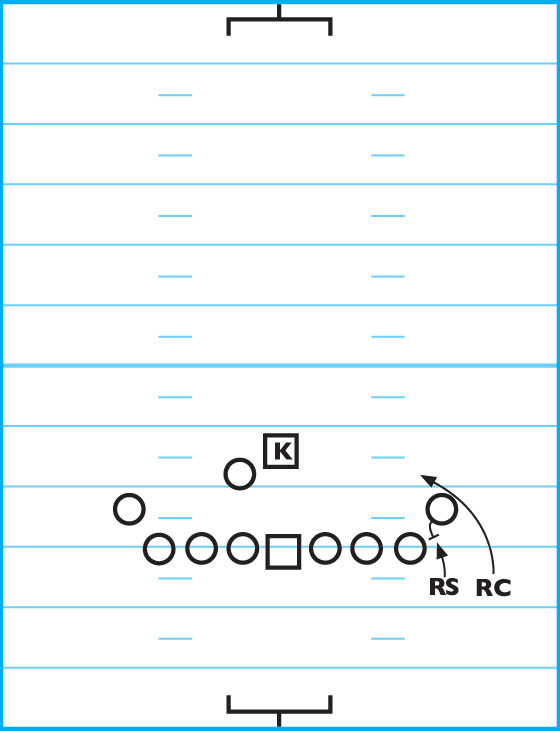
DIAGRAM 5: Wing blocks out or doesn’t move. The RC takes him man-to-man and the RS tries to block the kick.
Overload Scheme
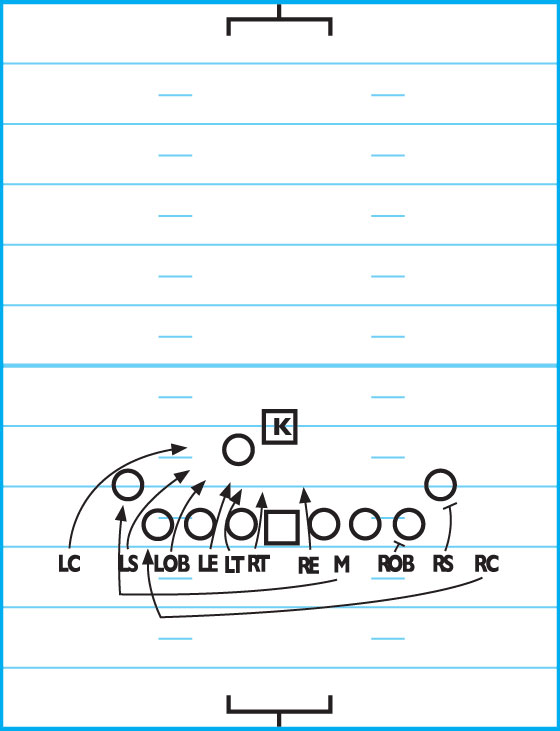
An overload scheme seeks to outnumber the protection to the called side.
DIAGRAM 6. Overload left. This scheme places six blockers on one side of the ball.
PLAYER ASSIGNMENTS:
LC: Same assignment as block left.
LS: Same assignment as block left.
LOB: Rushes the C gap.
LE: Widens to a 4-I alignment and rushes hard through his landmark. On a two count, gets his inside hand up high.
LT: Power rushes through the outside shoulder of the guard and tries to knock him back. After he gets movement, he climbs and throws his inside hand up on a two count.
RT: Moves across the ball to the call side. He aligns on the inside shoulder of the guard and tries to power-rush through him, staying on the inside shoulder. After he gets movement, he climbs and throws his inside hand up on a two count.
RE: Shifts down to the A gap. On the snap, he gets movement and gets his inside hand up on a two count.
ROB: Blitz engages the TE and covers him man-to-man.
RS: Blitz engages the wing and takes him man-to-man. He’s responsible for containment on his side.
RC: Moves late to the overload side and takes the TE man-to-man.