LOOKING FOR A SHORT-yardage package that is highly effective, easy to teach, balanced and adaptable to your talent? The Wishbone Power Package provides all of these options and more.
The power package is the first part of our offense to be installed every year. It will teach your team to have the toughness that is essential to any successful offensive.
The blocking scheme is simple and provides for double-teams and blocking angles at the point of attack. The base play provides a back who has good vision, an option to cut back against the grain, hit the predetermined hole or bounce outside to utilize his speed.
The play is easily run to both sides of the field and the formation does not tip off a defense. Opponents looking to outnumber the offense have a difficult time getting an extra man to the side where the offense will attack, because the quarterback can count players and check off to prevent this.
Here is the basic play shown against two common defensive fronts:
Offensive Line
Splits,
Alignments
DIAGRAMS 1, 2: The guards split 2 feet from the center. The better the center, the wider the splits can be. Never go further than 3 feet.
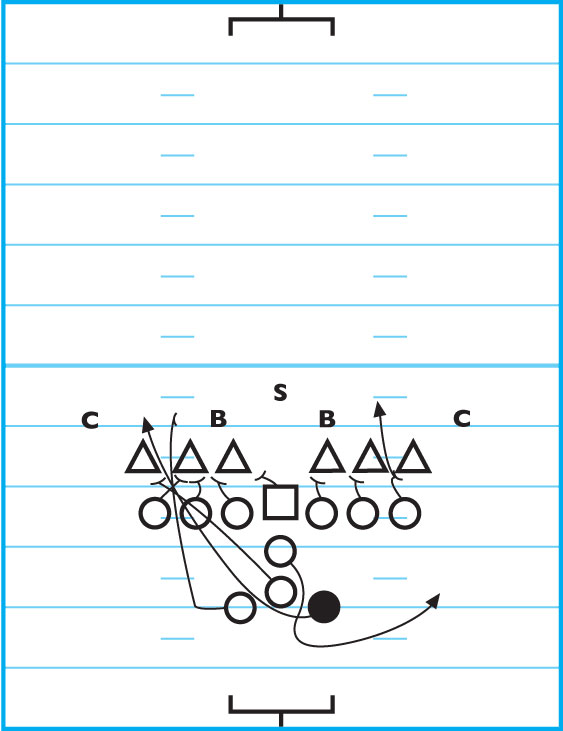
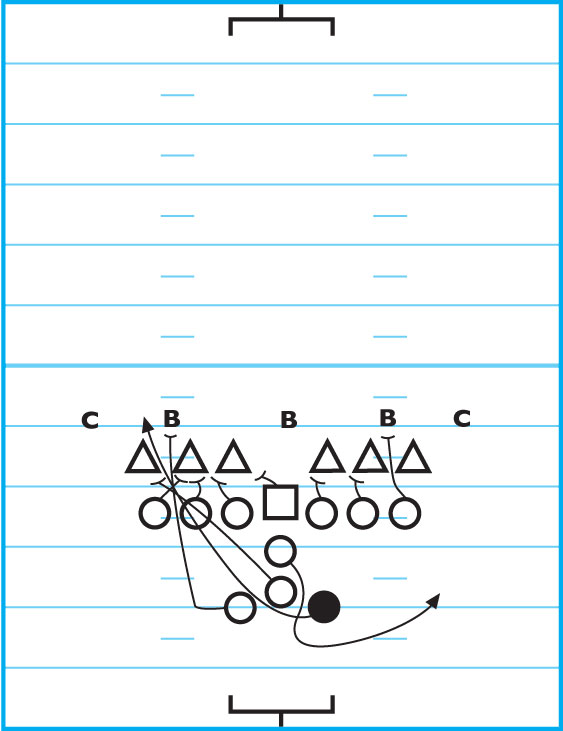
The tackles and tight ends are split 3 to 5 feet. Cut these down when you are inside the opponent’s 10-yard line.
The fullback aligns with his hand 3 to 4 feet behind the QB. Adjust this depth accordingly, based on the quickness of each individual back. The halfbacks align directly behind the OGs, with their hand even with the heels of the FB.
Basic Blocking Scheme
The basic blocking scheme begins with a double team by the TE and OT. In the event of a stack alignment, the OT and TE must communicate about who will come off the double-team to take a blitzing linebacker.
All other offensive linemen take a zone step toward the play and block:
- The play-side gap.
- The man on.
- The nearest LB.
The backside TE should base block using the same rules as the other offensive linemen. The essential blocking objectives are movement at the point of attack and prevention of any defensive penetration.
Execution
The FB kicks out the end-of-line defender. His first step is a 6-inch step directly at the defender. Make sure that the FB’s chest is over his knee on the first step. The FB’s head should be on the inside hip of the defender and after contact, he should punch the defender in the chest with his hand.
The play-side HB takes a lateral step to allow the FB to clear, then heads straight into the hole. He should look inside first, then block the first defender threatening the hole.
The QB will reverse-pivot away from the center and make the handoff deep in the backfield. After making the exchange, the QB should drift back two steps and watch the ball carrier, then bootleg to the opposite side of the play.
The ball carrier takes a lateral step, receives the ball and attacks the line of scrimmage at the point of attack. The exchange is made deep in the backfield to enable the back to see the hole and make any necessary cut.
Blocking Adjustments
Several blocking adjustments can be made as dictated by the defense and personnel. When the opponents use a gap defense, your linemen should make a “down” call where all linemen block the gap opposite the play. This scheme is effective at preventing penetration by defensive linemen and is a good compliment to the base scheme.
A second adjustment that can be made is to switch the blocking assignments of the FB and the HB. The HB blocks the end-of-line defender and the FB leads up into the hole.
A third adjustment is to have the play-side OG or backside OG pull and kick out the end-of-line defender. The FB would fill for the pulling OG and a run fake could be implemented.
Drilling The Play
Hand shields are an effective tool in drilling the Wishbone Power Play. Station three players at the end of a strip, one to simulate an end-of-line defender, one to simulate a filling LB or safety and a third to simulate a potential tackler.
Initial Drill
DIAGRAM 3: Walk through all facets of the play, making sure that footwork, body position, points of contact, ball handling and aiming points for blocking are correctly executed. After walking through the drill, proceed to halfspeed. Have each group of backs perform four repetitions so you can watch each back. Progress to full speed as the players demonstrate correct execution of all required skills.
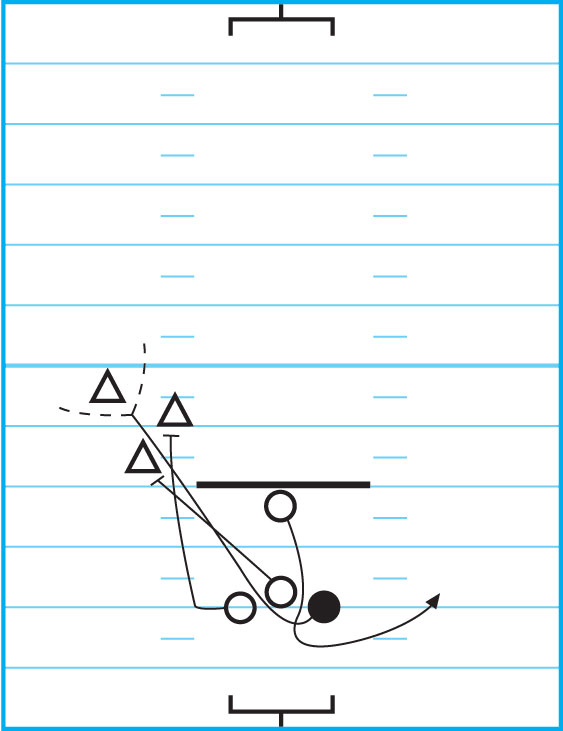
An important coaching point for the FB is to read the charge of the end-of-line defender. If the defender gets upfield, the FB must aim for the inside hip of the defender. If the defender’s charge is inside, the FB must seal the outside hip and the ball carrier and lead HB must read this block as a bounce to the outside.
Drill In Half-Line Situation
DIAGRAM 4: After drilling the play with the backs only, drill the play in a half-line situation to allow the linemen to make blocking calls and adjustments. You can make calls to the defense to simulate defensive reaction.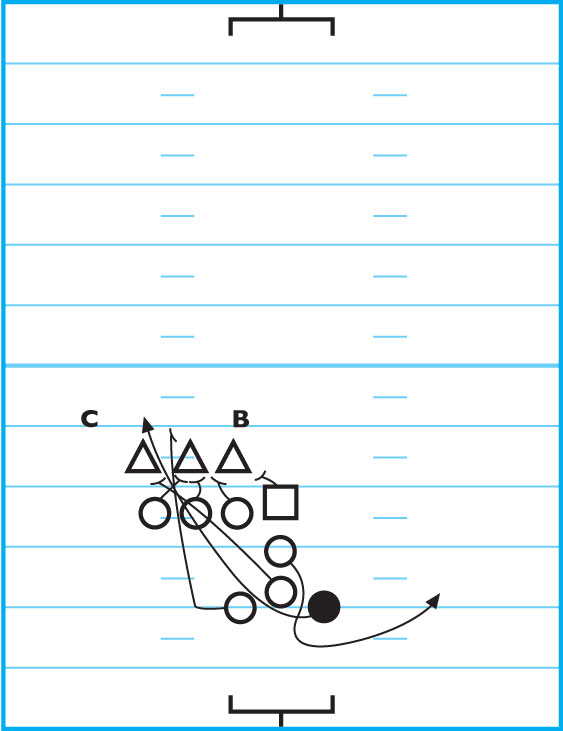
Complimentary Plays
A play-action, boot-leg pass and a counter lead complete the Wishbone Power Series. These plays provide deception, variety and take advantage of defensive pursuit.
The first is the play-action pass. The action of the pass is the same as the run and the offensive line blocks exactly the same.
Play-Action Pass:
DIAGRAM 5:The playside TE is the primary receiver. He blocks down as if to double team, releases and runs a corner route 12-yards deep.
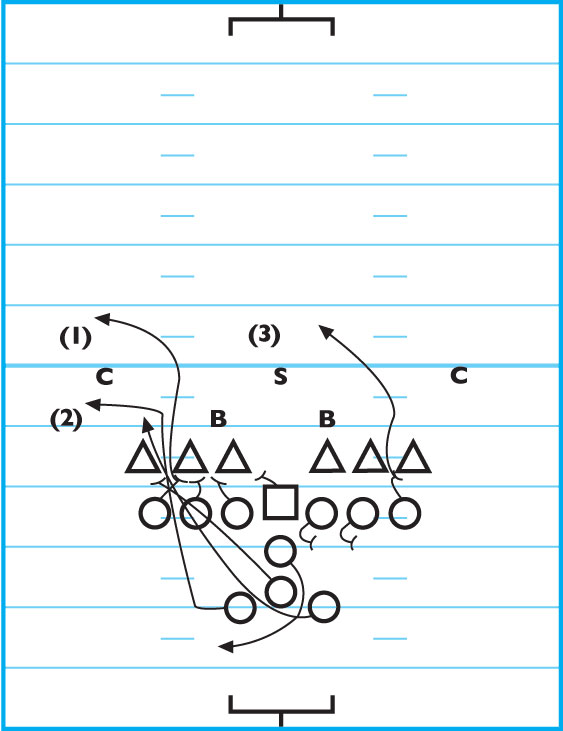
The play-side HB leads into the hole and makes contact with the first inside defender, then he bounces off and releases outside 1-yard beyond the LOS.
The backside TE blocks for a one count and runs a deep post pattern. It is important that this receiver does not cross an imaginary line made by the center.
After a ball fake, the QB pulls up and reads the receivers in this progression.
1. Play-side TE.
2. Play-side HB.
3. Backside TE.
4. Run.
Play-Action Variation
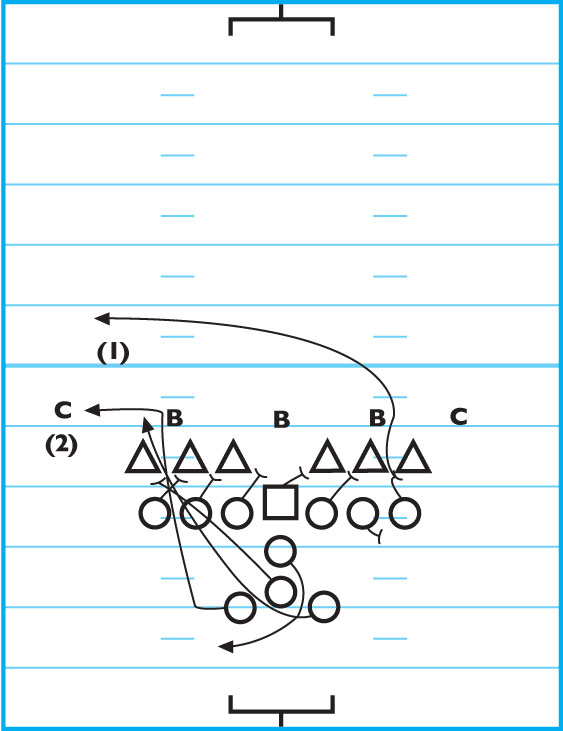
DIAGRAM 6: This shows a variation in blocking and pass routes.
Boot-leg Pass
DIAGRAM 7: A boot leg pass forces the secondary and backside pursuit to stay honest. All linemen block as if the base play is being run.
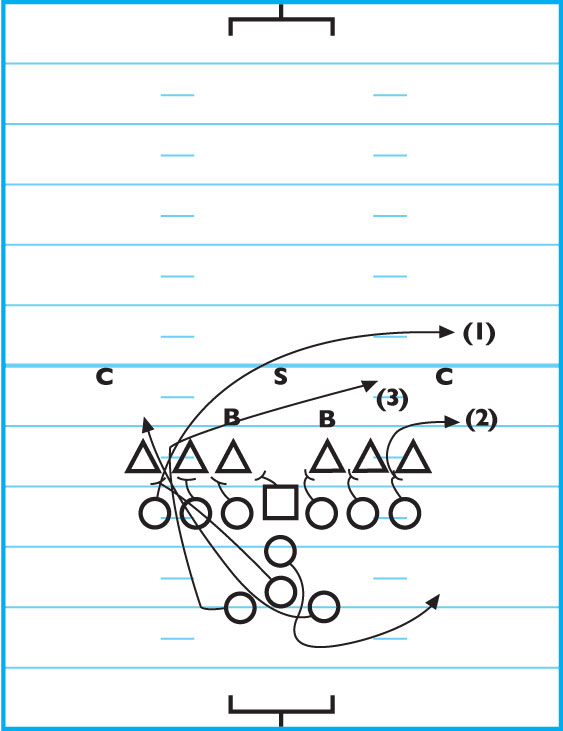
After executing his fake and watching the ball carrier for two steps, the QB will boot leg out to the other side and look to throw. The QB reads his progressions long to short and tries to read the underneath coverage.
The primary receiver is the backside TE, who has run a 12 to 14 yard diagonal pattern.
The playside TE blocks for a one count, then releases into the flat.
A third receiver, the lead-blocking HB, can run a crossing pattern at 8 yards.
Counter Lead Play
DIAGRAM 8: The counter lead play takes advantage of LB and secondary pursuit. All linemen base block following the gap, and utilize basic blocking rules.
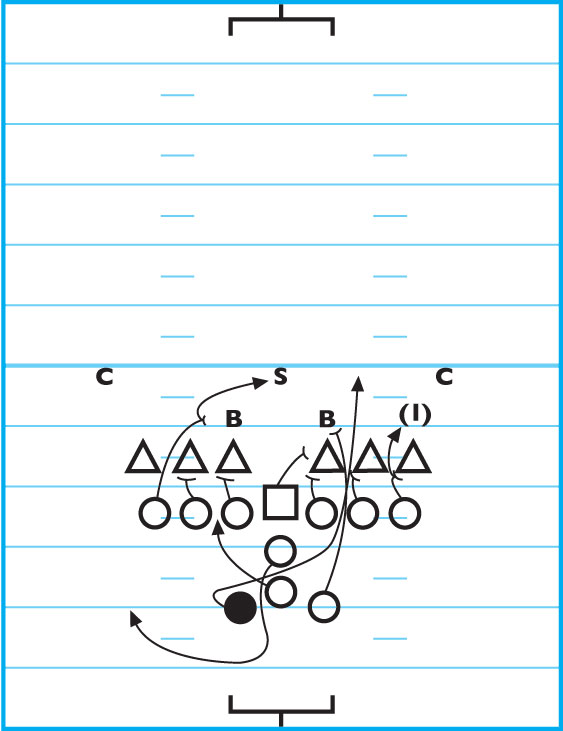
The play-side HB leads into the hole and blocks the first opposite colored jersey, looking from inside to outside.
The backside HB is the ball carrier, takes a jab step, then cuts toward the hole and reads the block of the other HB.
The QB opens away from the play, makes a flash fake to the FB and hands off to the backside HB, who has taken a jab step and cut toward the hole. After making the exchange, the QB makes a boot-leg fake.