With the advent of spread offenses in today’s college game, many defensive coaches have moved, or are contemplating moving, to the 3-5-3 defensive set. The theory behind this defense is to get more speed on the field in order to deal with the speed and athleticism of today’s offenses. Running a 3-5-3 defense also potentially puts eight men in the tackle box on every play. With these facts in mind, the defensive logic of the 3-5-3 indicates eight men in the box will stop the option running game. Sounds legitimate. But I, for one, do not buy into this line of thinking. Instead, I truly believe that the option game can dominate any defensive set, including the 3-5-3. How can this be? Well, by running an option offense, one or more defensive players can be “read” by the QB instead of having to be blocked by the linemen. This, of course, should lead to a numbers advantage in favor of the offense at the point of attack and leave the defense in peril. Whether there are six, seven, eight or even nine personnel in the box, an option offense that is executing on all cylinders should be very effective.
Below are three plays that are run out of different offensive sets. All three show how the option can be used productively vs. a 3-5-3 defense.
Flexbone, Triple Left
(vs. 3-5-3, Cover 1 Man Free)
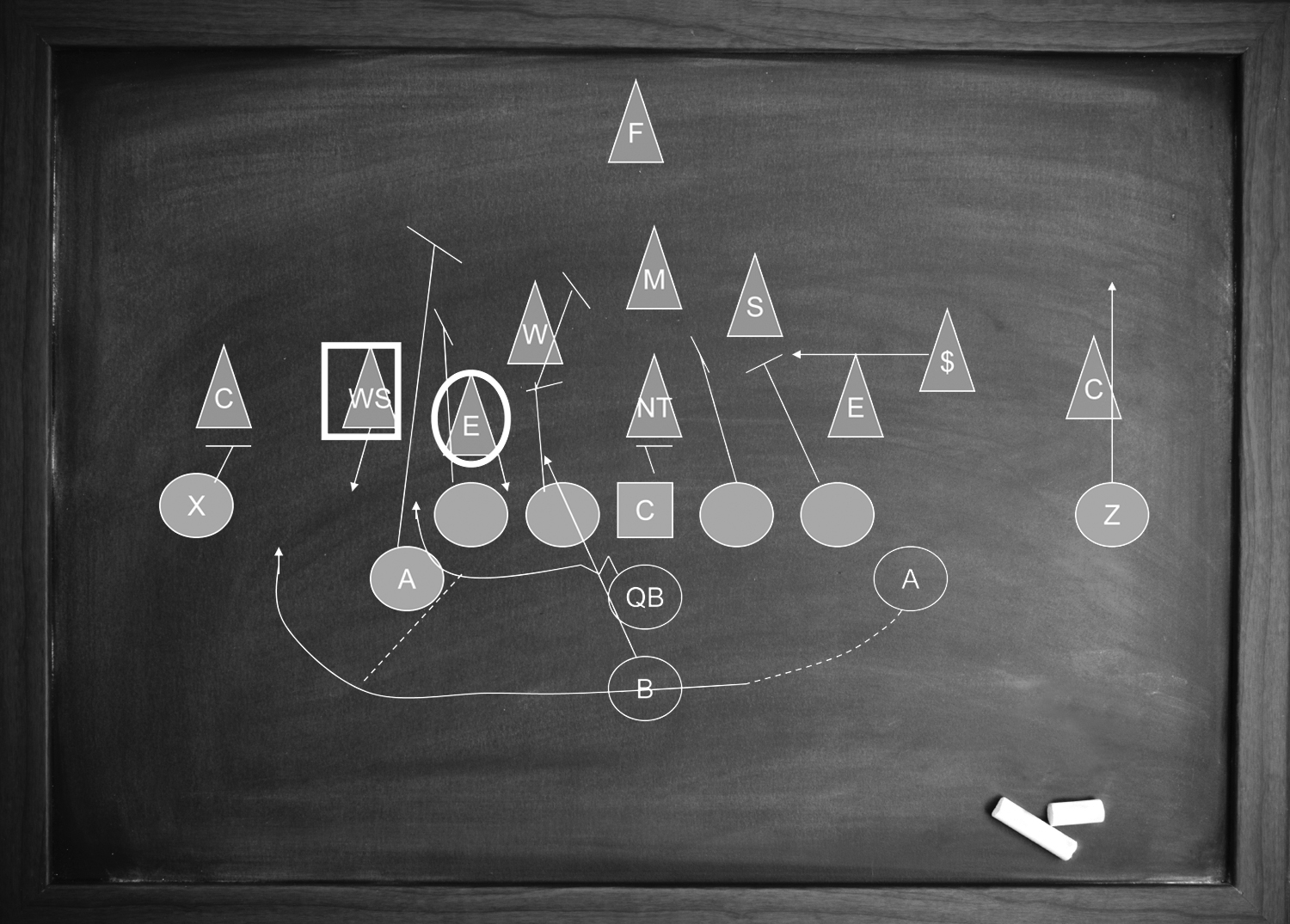
Like its name indicates, the flexbone formation is an extremely flexible offensive set. On any given play, there are four eligible receivers who are all very close to the line of scrimmage who can go out on a variety of pass routes. At the same time, the flexbone can also be used as an effective running formation either with a power running game or with a run option strategy.
Execution: The QB puts the proper A back in motion. On the snap, he goes into a mesh with the B back whose aiming point is the crack of the playside guard’s butt. The QB “reads” the first down lineman in the B gap to the outside (in Diagram1, the dive key is the defensive end – circled). Unless this dive key defender comes down both “hard and flat” on the B back, the ball will always be given to the fullback who will then follow his blocks on a simple dive play up the gut. However, if the QB gets a “pull” read, he will then run down the line of scrimmage and attack the inside leg of his next read, the pitch key (in this case, the weak safety – in the square). The QB will always keep the ball and run for the touchdown by going off tackle unless that pitch key defender turns his outside shoulder towards the QB. If so, the QB must pitch the ball to his trailing A back.
Blocking Assignments
Center = Base NT
PSG = Block for the dive play on Will; if Will goes to the outside, block on the second level
PST = Block second level by sealing playside corner
BSG = Look for $ coming down line of scrimmage
BST = Second level
PSA = Second to third level (FS)
X = Stalk corner
Z = Take corner downfield
B = If not given the ball, block second level defender
Gun Pro Right, Triple Left
(vs. 3-5-3, Cover 1 Man Free)
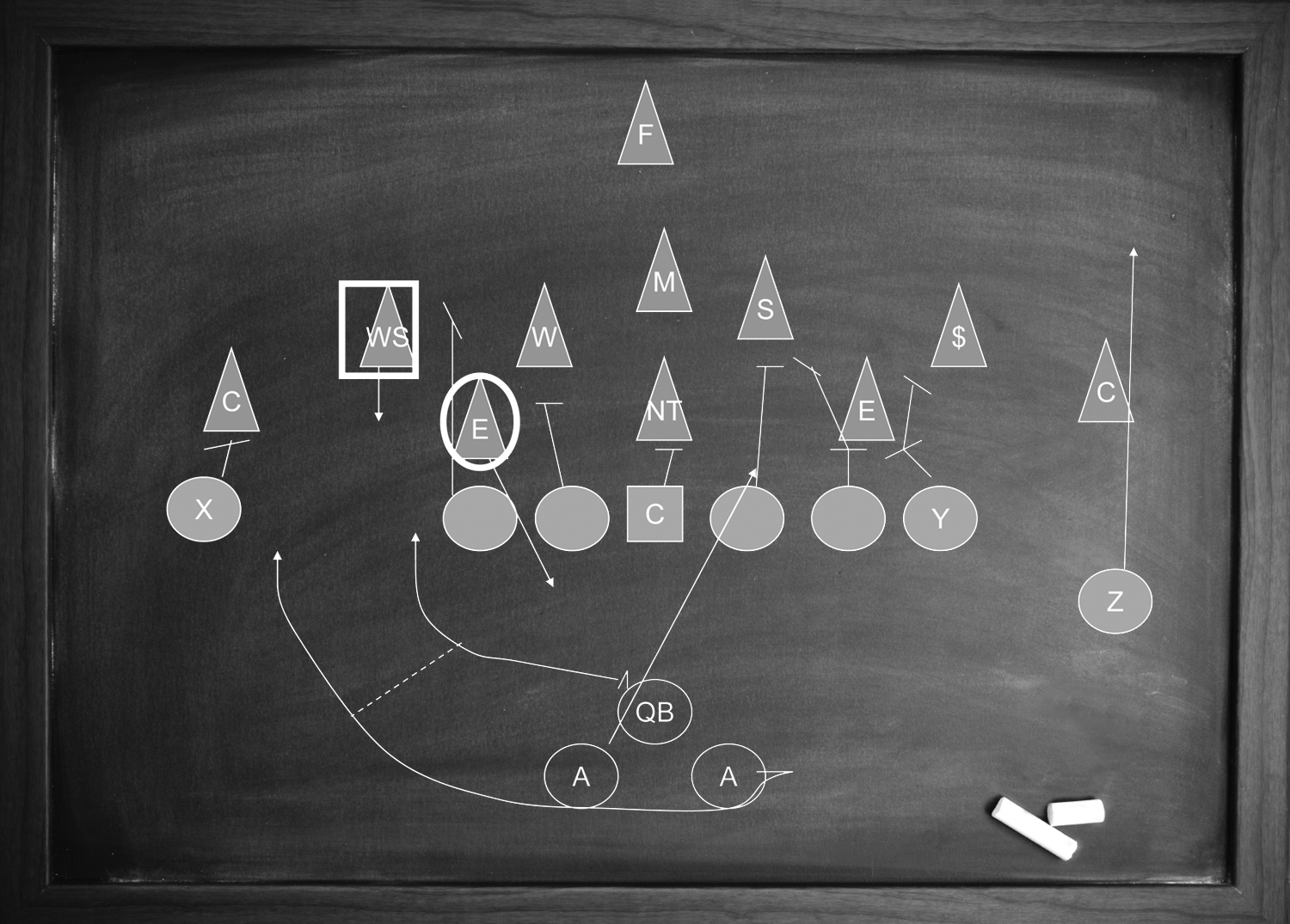
Execution: Run out of the shotgun, this play starts with a mesh between the BSA back and the QB. The aiming point of the BSA back is the crack of the butt of the backside guard. During the mesh, the QB reads the intentions of the first down lineman in the B gap to the outside (in Diagram 2, this defender is shown in the circle). The QB will always give the ball to the BSA back unless this dive key defender comes down on the BSA both hard and flat. If a pull is performed by the QB, he will then take the ball down the line of scrimmage and attack his pitch key defender. If this defender turns his outside shoulder towards the QB, the QB will perform a pitch to the trailing the BSA back. If the defender’s shoulder does not turn, the QB takes the ball off tackle for the score.
Blocking Assignments
Center = Base NT
BSG = Get Sam (blocking for dive)
BST = Combo end to $ (block for dive)
Y = Combo end; possible block on $ depending on how he chooses to play it
PSG = Get Will
PST = Seal the inside
Dive A Back = if you don’t get the ball and are not tackled, go to second level
Z = Take Corner downfield
X = Stalk Corner
Base Pistol, Speed Option Left
(vs. 3-5-3, Cover 1 Man Free)
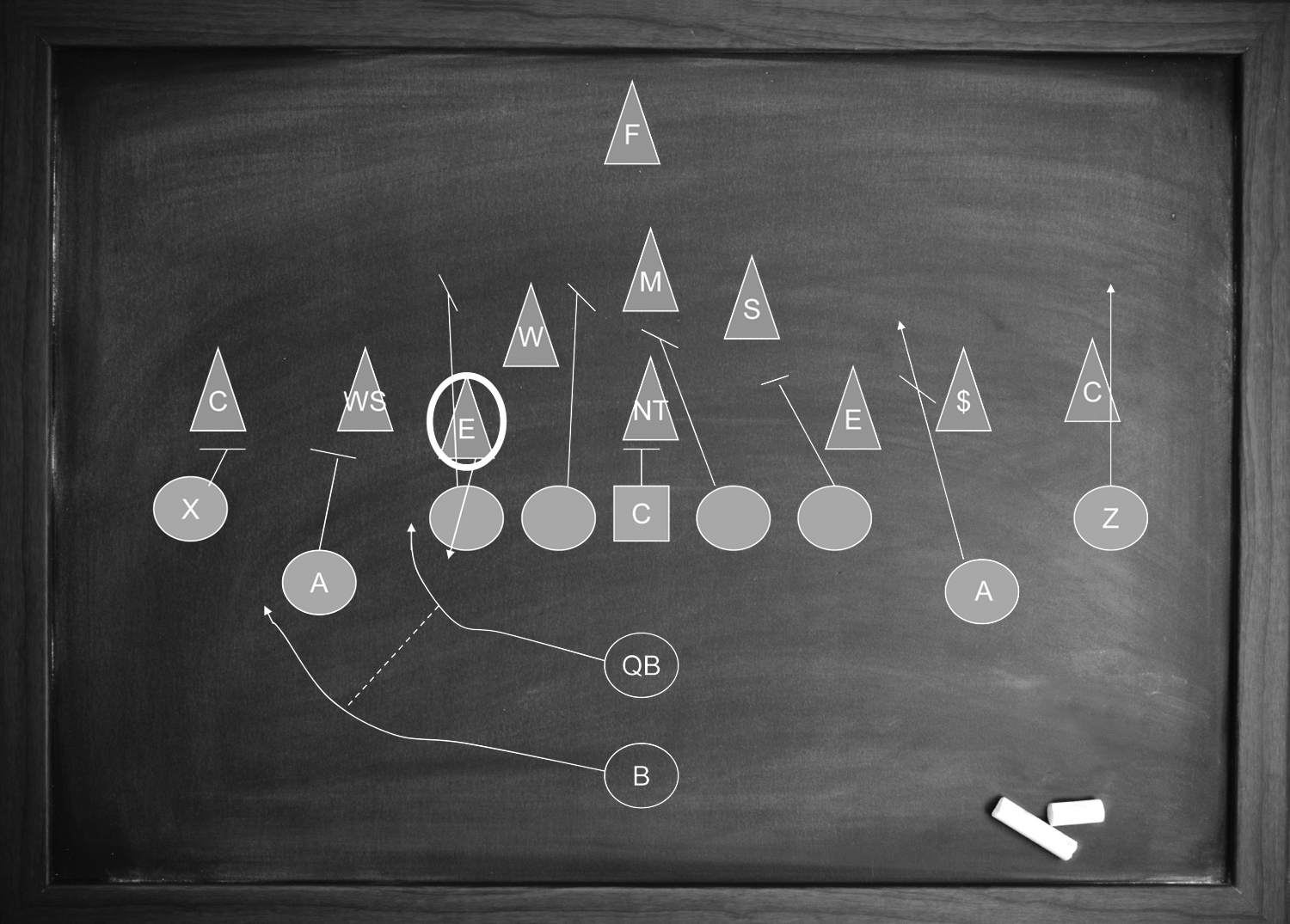
This is a great quick hitting, double option play that can be executed even by teams who do not normally run much option. The Pistol formation is a very curious formation. Instead of having the QB stand five yards behind the center in the shotgun, the Pistol has the QB stand three yards directly behind the center, with the tailback another three yards directly behind the QB.
Execution: The QB takes the snap and immediately runs down the line of scrimmage to attack the pitch key defender (in Diagram 3, it is the defensive end – circled). The QB should want to take the ball the distance to the goal line and should only pitch the ball to his B back if the pitch key defender comes directly at him.
Blocking Assignments
Center = Base NT
PSA = Take the weak safety
X = Block corner
PST = Will
PSG = Block second level
BSG = Second level
BST = Second level
BSA = Take $ down field or block him if he breaks down
Z = Take corner downfield
Coach’s note on the selection of pitch key defenders: Coaches who run the option run game have the advantage of deciding “who” they want to pitch off of and “who” they want to block. Simply stated, some defenders are easier to read, then block, while others are easier to block, then read. It all comes down to breaking down game film in order to determine who the best defenders are on any given team.
It is my hope that this information will help you take a good critical look at how the option game can indeed help your offense go to new heights. Have a great season.
About the Author: Paul Markowski is the Fullbacks Coach at Simon Fraser University, a Division II college in British Columbia, Canada. Markowski holds a Bachelor’s Degree from Lakehead University.