The Shield Punt differs from the standard punt formation in two basic ways. First, the splits of the front line are three to five yards as opposed to the tight formation of the spread. The other important characteristic is the placement of three-up backs that set the shield for the punter. This seemingly simple variation allowed our players to make the most of their abilities and downplay the areas that were in need of improvement.
Let’s take a look at the personnel I tend to utilize in the Shield Punt. The formation is comprised of guards, tackles, tight ends, up backs, the long snapper, and the punter. The guards are generally linebackers or some of our larger safeties. The tackles and tight ends are defensive backs or wide receivers. I like to use linebackers, tight ends and/or fullbacks as the up backs. I’ve seen other programs put offensive linemen in the up back position of the shield, but I don’t. We need players in the shield that can run fakes as well as provide adequate coverage. The long snapper’s main job in the shield punt is to deliver the perfect snap every time. The speed of the snap to the punter must be under .85 seconds. The snapper has no blocking responsibilities. As for the punter, I find that directional punting is more important than hang time.
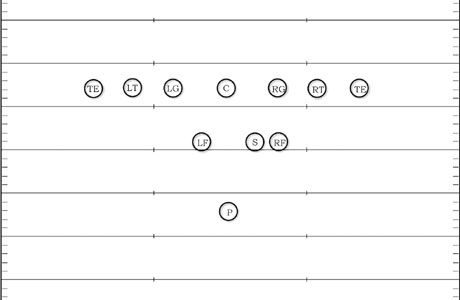
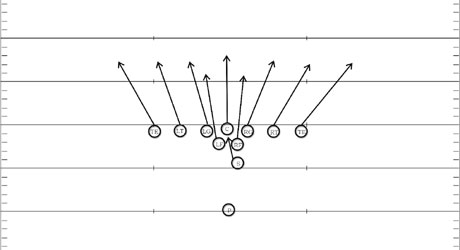
The alignment in the Shield Punt is quite simple (See Diagram 1). I tell the guards, tackles and tight ends to take a three to five yard split. This spacing is very friendly to players with limited speed and athletic ability because it already puts the players in their coverage lanes. The shield is set at seven yards deep. I keep all three players (up backs) of the shield facing the defensive unit. This allows us to run quick fakes if the defense doesn’t defend our formation. The punter is set 15 yards deep. Below is our base formation of the shield punt (See Diagram 1).
|
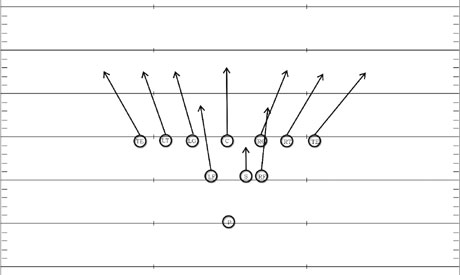
We use a zone blocking scheme in the Shield Punt. I instruct the players to open step with their outside foot and pivot on the inside foot. Their hands should shoot out with a straight arm blow to the chest of the defender. I want them to drive their feet for three steps and then release up field into their lanes (See Diagram 2).
|
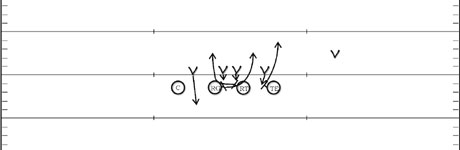
In order to be effective, the B and C gaps must be protected in the Shield Punt. It is imperative that we get our hands on the defenders that penetrate these gaps. Any pressure that comes from the outside D gap should not result in a blocked punt as the angle is too wide. The A gaps are protected by the shield. When we see two or more defenders trying to penetrate the B and/or C gap, we make a PINCH call. This line call alerts the tackles or tight ends to block their inside gap. Their goal is to make contact with the two defenders and jam them into each other. After three steps, the guard and tackle will switch lane responsibilities in coverage. If we have two players in the B gap and one player in the C gap, the PINCH call will bring the tight end down to secure the C gap (See Diagram 3)
|
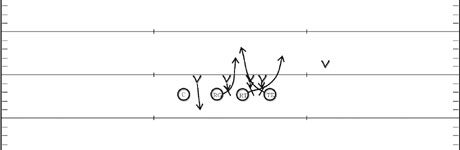
If we get two defenders only in the C gap, we still make a PINCH call but the tackle and tight end will do the pinching. The guard still protects the B Gap. After the tackle and tight end make contact on the defenders in the C gap, they will switch lane responsibilities in coverage (See Diagram 4).
|
The Shield Punt has been very effective for the Panthers’ special teams unit. Since making this change, we have only had one blocked punt in three seasons and that was basically the result of a bad snap. The 2007 season starred a freshmen punter; his season average was 40.2 yards per punt. He was ranked second in the SWAC Conference. Furthermore, the punt coverage allowed an average of only 7.38 yards per return. These statistics help illustrate the productivity of the punting unit. Special teams performance has provided Prairie View A&M a competitive edge in winning field position- an important ingredient in the making of a successful season.
If you have any questions you can email the author at JohnPearce@GridironStrategies.com
WHAT IF?
Q1. What if you see four defenders in the A gap as you’re about to try the Shield Punt?
When we get four defenders rushing the A gaps, we will check the punt call to a RUGBY PUNT. This will allow the punter to move away from the pressure.
Q2. What if you see an all out blitz as the ball is being snapped?
If we know a team is coming with an all out blitz, we can check to our Tight Punt Formation. This will tighten the splits in the gaps and present the defensive with a 9-man front (See Diagram).
|
Q3. What if the defense decides just to make contact with your offensive linemen and not really rush the punter but be more concerned with the return?
I want the defense to have an easy rush. I feel we have the advantage in getting off the line of scrimmage and applying coverage to the return man.