A special teams play that’s disguised can confuse your opponent. This is especially true on the punt return.
In our program, we implement a strategy where our players have simple rules to follow that allow us to be successful in the kicking game with minimal mistakes. Our special teams are no different than our offense or defense. We expect our players to use proper alignment, assignment, execution, and effort. We work on special teams every day. We believe that if we cover the kicking game every day, we can get maximum effort and execution.
Like most programs, we use word association to relate to schemes and plays. In our punt return game, our theme is the Wild West. We call our base scheme on punt return “Jesse James.” This is a safe punt return. We have our front nine players line up and “hold ‘em up” (block) man to man. Then we have our two return players downfield. There should not be any opponent running free downfield. We have two outside linebackers on the edge to make sure there are no fakes. We have the return man that does not receive the ball block for the other return man. This scheme is easy to teach and allows the players to be aggressive and not get confused on the blocking scheme. We have had big returns in the punt game and have scored touchdowns from this simple scheme.
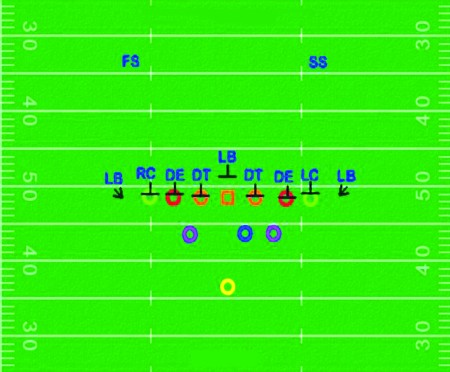
Diagram 1a.
Diagram 1-A shows our safe punt return against a punt formation with no split receivers or gunners. We align our corners over the end player on the line of scrimmage or the number one receiver. Our outside linebackers are responsible for a possible fake and contain after the punt. The defensive interior and Mike linebacker are responsible for blocking the offensive line.
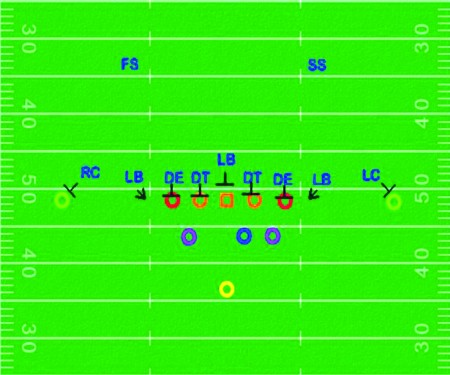
Diagram 1b.
In Diagram 1-B, when the opponent has gunners, we move our corners out over them. Their rule is to block and force the gunners as wide as possible. We still have our outside linebackers containing and securing the edge in case of a fake. The defensive tackles and Mike linebacker continue their rules in holding up the offensive linemen.
Diagram 2a.
Diagram 2A is our punt block set up. We go from holding up the opponent to applying B-gap pressure. We call our punt block “Outlaw”. We are trying to improve our field position by either getting a blocked punt or forcing a bad punt.
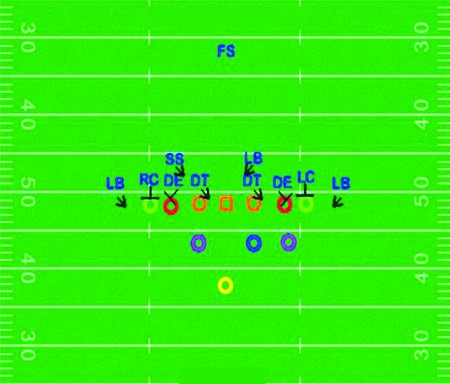
Diagram 2b.
In Diagram 2B, we have our corners on the split receivers, forcing them out wide just like in “Jesse James.” We still have our outside linebackers protecting the outside edge for a fake first, and then they can apply pressure on the punter. The defensive ends are trying to force the offensive tackles out. We bring our SS down over the right defensive end.
On the snap, the defensive tackle will fire through the A-gap, allowing the SS to shoot through the B-gap. The opposite DT will fire through the B-gap, allowing the MLB to shoot through the A-gap. With the different angles of attack at the line of scrimmage, we can cause confusion on gap protection and put maximum pressure on the punter.
Diagram 2B shows “Outlaw” without split receivers or gunners. The blocking scheme is the same as with the split receivers. We put the corners over the end guys and block just like they would in “Jesse James.” We put maximum pressure with the same B-gap attacking scheme that was described in Diagram 2-A. We can change our gap pressure weekly depending on what we detect might be the opponent’s weakness in protection during film study.
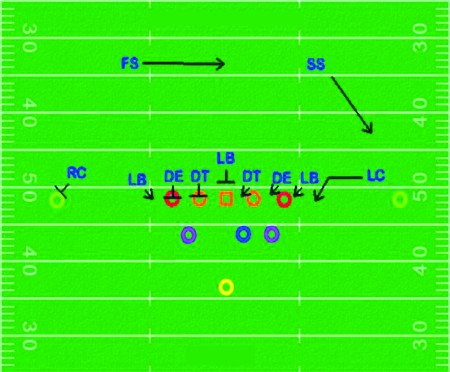
Diagram 3a.
In Diagrams 3A and 3B, we can apply pressure from our “Jesse James” look. This scheme allows us to look like we are setting up our safe punt return. We can catch the opponent by surprise by bringing an extra man off the edge to apply extra pressure. We can do this from either side by bringing a corner off the edge. We bring either the SS or FS down to cover the split receiver depending on which corner we are bringing off the edge. If we want the left corner to come off the edge, we call “Outlaw Blue.” If we want the right corner to come off the edge, we call “Outlaw Red.” We move the corner and safety on the timing of the snap. This requires some practice to get the timing down, but can be accomplished quickly.
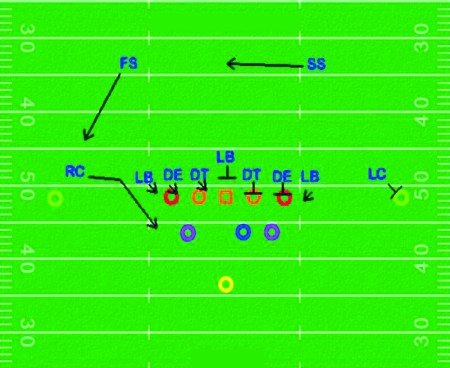
Diagram 3b.
In our punt return schemes, we want to be simple yet aggressive. “Jesse James” allows us to be safe in the punt return but also provide an opportunity to return the football and improve our offensive field position. “Outlaw” will allow us to improve our field position by applying gap pressure either by getting a block or a poor kick by the punter. The blue/red tags off “Jesse James” allow us to give a safe look then rotate to an aggressive style in the special team phase.
The simplicity and movement of the players in these punt return schemes allows the players to have fun and make an impact in the kicking game and influence positive field position for our offense. Most of all, they have fun and contribute to the success of the team.
About the Authors: James Housdan enters his second season this fall as head coach at Parkers Chapel High School (AR). 2013 will be his 13th year as a coach. Housdan previously coached at three Arkansas high schools – Pulaski Academy, Johnson County Westside, and Southside Batesville. He is a 2000 graduate of Arkansas State and has both a Bachelor’s and Master’s in Education.
Mark Looney is the wide receivers, defensive backs, and special teams coordinator at Parkers Chapel High School. He has been coaching for 10 years and for the last 16 years has been the baseball coach at Parkers Chapel.