Our base package at Hartwick College is a 4-2-5 alignment which allows us to be multiple, but simplistic for our players. With the flexibility of our 4-2-5 attack, we can zone blitz from a 4-3, a 4-4, and a 3-4 alignment with the same terminology and keys. The system allows us to be successful with different levels of abilities and skill sets. We normally are not the largest defense in the conference, but our zone blitz system puts our players in attack mode and forces bigger teams to chase us with uncertainty. With our long-stick and blitz read technique, we were able to lead the Empire Eight conference in sacks during the 2009 season.
Our system allows us to be aggressive, but limit big plays often given up in man coverage. We feel this is the best way to attack the decision maker and force him into post-snap decisions instead of knowing his reads pre-snap. The blitz read techniques allow us to attack multiple protections and run schemes with one blitz. We are able to practice one blitz and still be multiple. The long-stick and blitz read creates offensive line confusion which allows success for our smaller front.
Our players enjoy blitzing and the system keeps them from being a static target for the offense. We feel that we are taking the tempo to the offense. Finally, on third downs we can force quick or hot throws and keep the offense from putting together large gains. We teach our student-athletes the strengths and weaknesses of our zone blitz package. They understand we are only bringing five players which means that one-on-one pass rush must be a win for us. The secondary understands that the football will be coming out hot and we must be quick with our keys. We instill a mentality of rallying to the football as a unit.
Our most successful zone blitzes involve one or both of the techniques we are going to discuss. When we zone blitz, we do not always give our blitzers or defensive linemen a pre-determined gap to rush. They will insert into gaps depending on the blocking scheme for that particular offensive play. It still allows us to be gap sound and aggressive, while confusing offensive blocking schemes. For our defensive linemen, this is called a long-stick technique.
The long-stick technique is what allows our defensive linemen to cause confusion along the offensive line. We will tell our long-sticking defensive linemen to read a certain offensive player. For example, if we are reading the guard, we look at his hips. If the guard’s hips stay or come at me, we will shuffle twice and insert into the gap across his face. If his hips move fast away, we will shuffle once, insert in the gap, and chase. By inserting and chasing backside, the defensive linemen will cancel both gaps.
We drill our defensive linemen to be in a balanced stance during a long-stick. We want to be off the ball by about 6 inches with our weight more on our back feet with our feet even. As the ball is snapped, we use our shuffle-shuffle technique with our eyes at the target’s hips. The defensive linemen will shuffle in a very low stance. We drill this technique in a grid alignment using a yard line to keep them lateral and low. The defensive linemen will look like they are in a four point stance, but with their hands off the ground.
Another drill is the long-stick read drill to teach the defensive linemen where to insert on certain reads. We can do this from an inside shade or an outside shade. This will build full speed repetitions to enable a reaction during a game. We do not want them to think about where to go, but rather react to the read by muscle memory (Diagram 1).
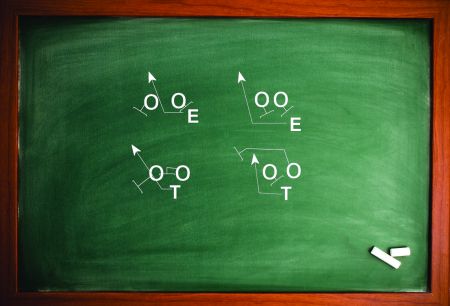
Diagram 1: Long-Stick Reads (Note: The read is the left offensive player)
During our zone blitz, we will also teach a similar technique to our blitzers. We will instruct them to “read” a certain offensive lineman. The blitzer will insert into the inside gap if the read stays or blocks outside. If the offensive lineman blocks inside, we insert to his “butt-side”, or the outside gap. The key to this style of blitz is to maintain depth before the blitz and stay tight to the read lineman once he inserts.
Getting lazy with the blitz path will allow other offensive linemen to block you or you will run yourself out of the play. We recommend no closer than three yards when starting a read blitz. This allows the blitzer to run full speed while reading the assignment. We must read at full speed, no hesitation. Any closer and the players tend to run into the read instead of inserting to the correct gap. We remind them that if hips stay or move out, insert inside gap. If the hips are fast inside, insert outside gap. The analogy of staying on his butt side is something that helps the players understand the concepts. We will also drill this technique using a Read Drill (Diagram 2).
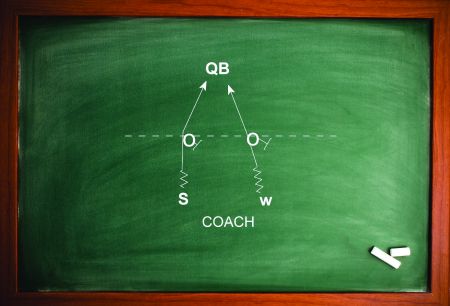
Diagram 2: Blitz Read Drill
The coach will give the offensive linemen a certain direction and the blitz will insert at speed. We will also use a similar drill for blitz pursuit during a run play. We want to make sure we break at the heels and chase the football.
On several of our blitz combinations, we will incorporate long-sticking and a blitz read. To disguise our intentions, we will show multiple secondary alignments and stem our defensive linemen. This pre-snap movement will increase the confusion on the offensive line.
Our top two blitzes are called Texas and Florida. They can be tagged in any direction like Strong or Field. We will use different coverage behind our five man pressure, but our main coverage is three deep-three under.
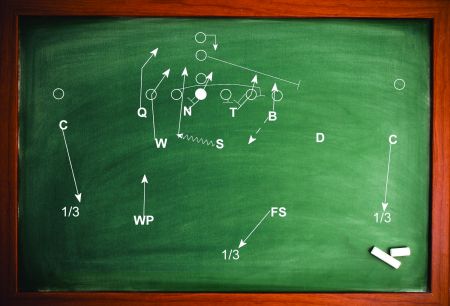
Diagram 3: Defensive tackles long-stick away from the blitz side
In diagram 3, our defensive tackles long-stick away from the blitz side and insert based on the blocking scheme. The tackle and nose can stem to their alignment before the snap to cause uncertainty. The Sam will blitz the A gap to the blitz side while the Will reads the tackle on his blitz. This blitz puts the center in a tough situation to pick up either the nose long-sticking or the Sam blitzing the A gap. The nose can cancel the A and B gap on the play side with his long-stick read. The tackle’s long-stick allows him to escape a double team to the play-side. The Boss end does not drop into coverage if he reads run or sprint-out in his direction.
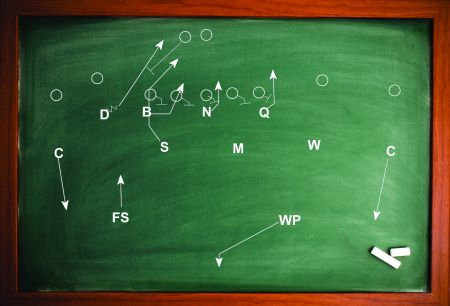
Diagram 4: Running a contain blitz
In diagram 4, we are running a contain blitz by the Dog while the Boss and Sam read their assignments. This blitz is diagrammed out of our “Okie” group which allows us flexibility and speed by not having to drop a defensive end. The Sam reads the tackle as described earlier in the article. The Boss will long-stick and read the blitz-side guard. The diagram shows full slide protection which gives us a two-on-one vs. the back. If the offensive tackle had picked up the Dog, we would have the two-on-one with the Boss and Sam vs. the back. The game plan by most offenses will be to slide to the direction of the blitz. This reaction is the reason why we drill and practice showing multiple alignments to keep the offense from a proper pre-snap read of our blitz direction and coverage.
In conclusion, we feel our technique of reading the zone blitz allows us to be successful against multiple offensive systems. It is very important to drill these techniques and have your players understand the reads must be at full speed. Read does not mean hesitate and then blitz. We want to make sure we can close the distance while making the proper read. We feel these techniques allows our defense to be multiple to an offense, but simple to us.
About the Author: Ben Bullock, the DC at Hartwick College, just completed his fourth season at the school. He previously was on the staff at SUNY Brockport, beginning his career there as a student assistant. Bullock lettered for three years at Brockport and earned a Bachelor’s Degree in 2003.