OVER THE YEARS, many of my teams have used the Wishbone offense, which means we primarily ran the football, and approximately 60 to 65 percent of our rushing attack was based on the triple option.
The triple option is where our offense begins, but we’ve also felt the need to develop a package that complements our base offense.
It’s imperative to prevent the defense from scheming methods to remove our fullback as a running threat. In the Wishbone, the fullback must run with the ball. Over time, we have had to devise ways for our FB to be a factor in the offense — the triple option is not enough! The trap and trap-option series has given us a consistent method of keeping the fullback involved.
Fullback Trap
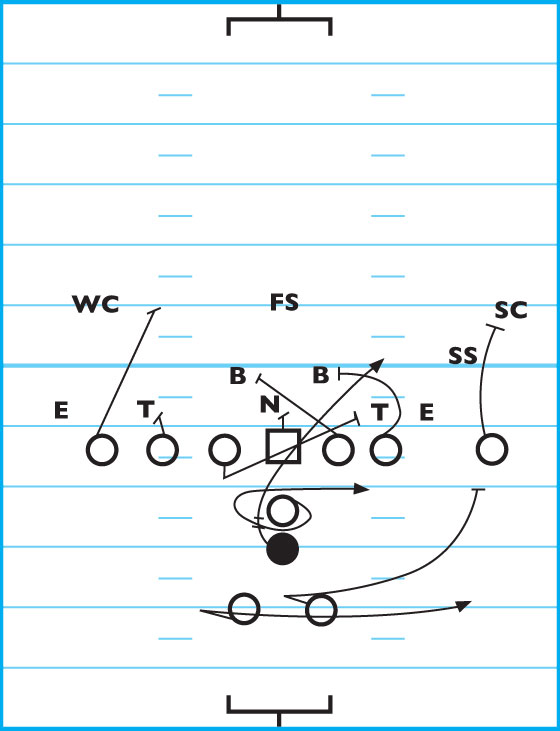
The FB trap is a consistent play that can be executed against most defenses. Generally, we will trap the first defensive lineman past the center and have the ability to change the direction of the play at the LOS based on the alignment of the defensive front (see Diagram 1 and 2). We don’t prefer to trap a four-defender side.
DIAGRAM 1: SE Side Trap Vs. 50 Defense.
If we elect to trap an A-gap defender, we add the term “goal line” to our trap play (as shown in Diagram 2). This play allows us to trap most goal-line defenses and to assist the FB in knowing where the trap will occur.
DIAGRAM 2: Trap Vs. Shade.
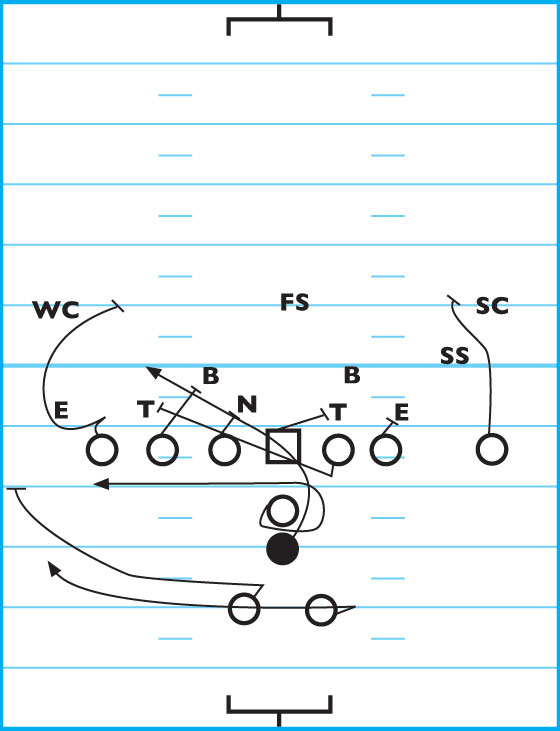
The FB aligns with his heels 5-1/2 yards from the front tip of the ball. This could vary slightly, depending on the speed of the FB. The FB should know prior to the snap where the trap will occur, based on the defensive alignments.
On the snap, the FB runs an S-course, putting the play-side foot in front of the off-side foot (crossover). It’s important that he does not step outside the offside foot. We’d like the FB to stay tight to any down block — stay inside out of the trap block and break off the block on the play-side LB.
The quarterback executes a full turn (360 degrees), or “whirlybird” action. We prefer this action because of the holding effect it has on the linebackers and FS. On the snap, the QB will reverse pivot slightly past six o’clock. His second step (balance step) must insure that his shoulders are perpendicular to the LOS. The third step is a ride step and following of the FB — turning to the inside, sinking the mesh, and carrying out the option fake.
Trap Option
Once the trap has been established and LBs begin to step up on play recognition, the defense makes itself vulnerable to the trap option. The QB action and subsequent mesh with the FB has the potential to freeze the LBs and FS. When this occurs, it’s time to run the option off the trap fake. The backfield action is identical to the trap — everything must look the same (see Diagrams 3-5).
DIAGRAM 3: Goal-Line Trap.
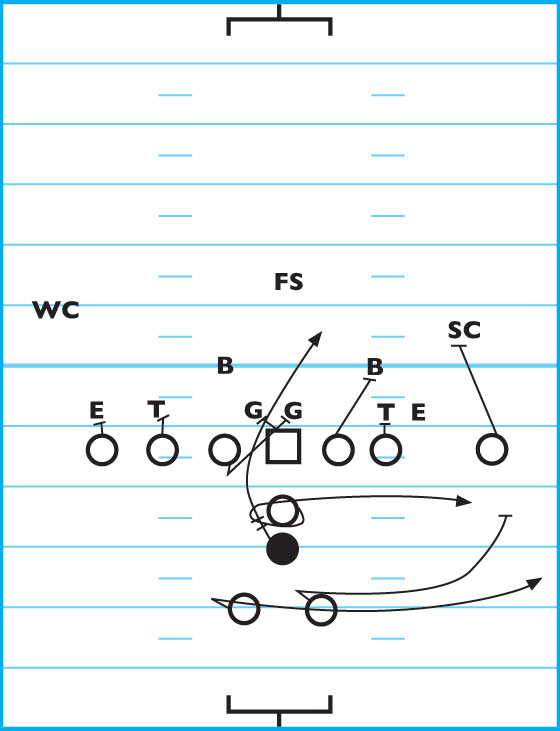
DIAGRAM 4: SE Trap-Option.
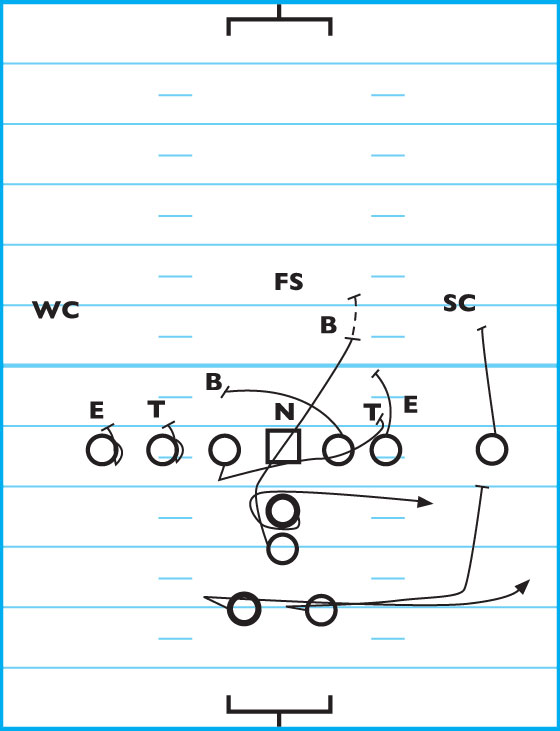
DIAGRAM 5: Trap Option Vs. Shade.
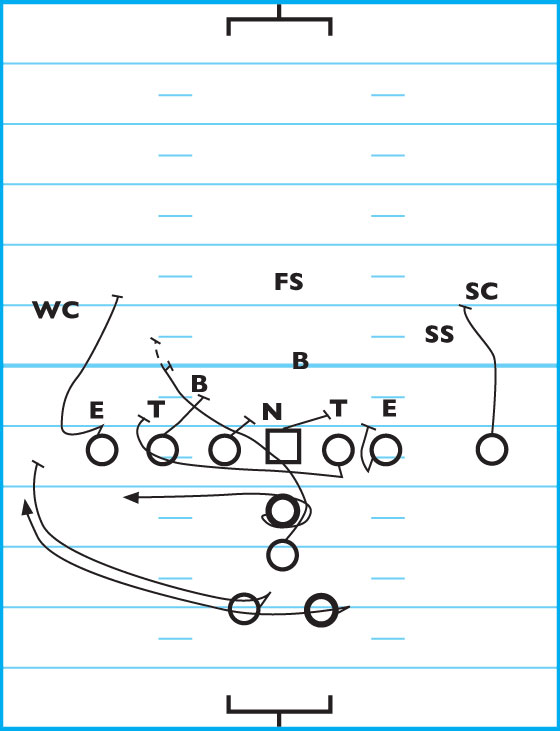
A good coaching point for the QB is to sneak a peak at the pitch key on the first step. The whirlybird action allows the QB to accomplish this, since he doesn’t have his back to the pitch key on the first step. This is particularly helpful to the open end side!
The pitch back can also assist the QB by recognizing hard pressure and making a call to the QB as the stunt is recognized. The line blocking is identical to the trap — on the trap option, we “log” the same defender who is trapped on the trap play. This has the potential to create conflict for the defensive lineman.
The trap option gives us a misdirection type of option play that has an excellent “freeze” effect on the LBs and free safety. It’s imperative to establish the FB trap in order for the trap option to be successful.
Trap-Option Pass
This is an excellent series because the pass look is identical to the trap and trap option. When we throw off the trap-option series, we have specific ideas in mind—we want to control the pitch support on the option and take advantage of a fast flow LB. Two routes that accomplish these objectives are shown in Diagrams 6 and 7.
DIAGRAM 6: Trap-Option Pass Slant To The SE.
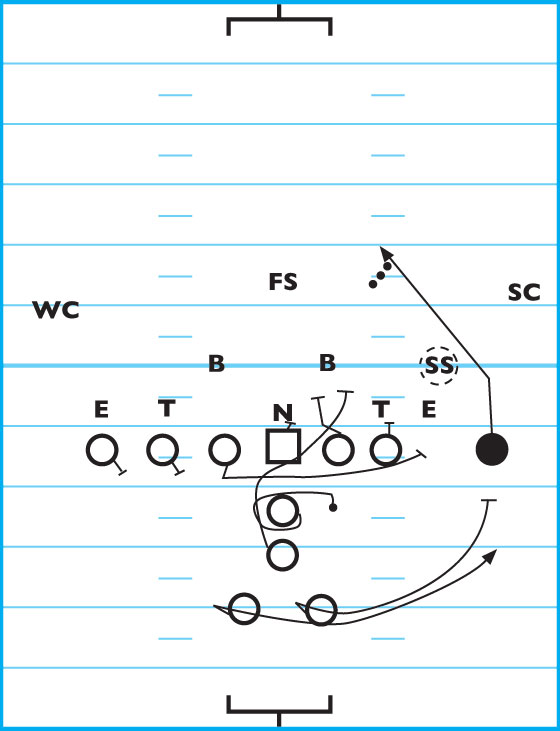
DIAGRAM 7: Trap-Option Pass Throwback To The TE.
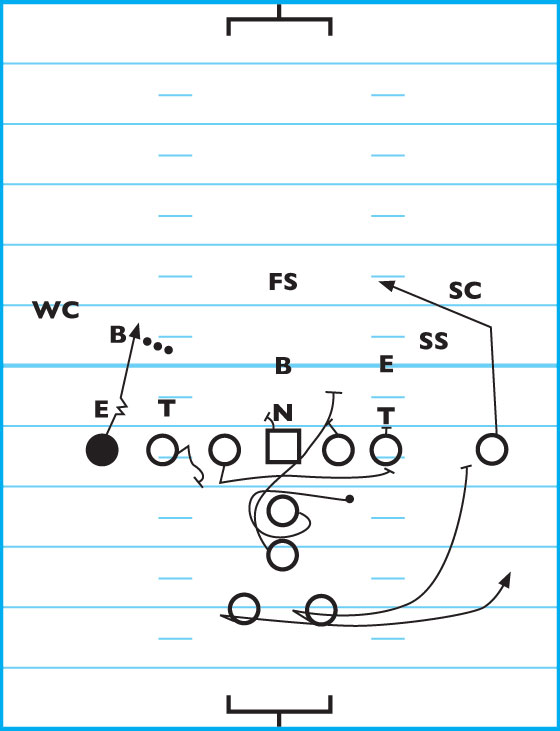
This series has been a supplement to our Wishbone triple-option attack. The trap has kept our fullback as a threat in the offense; the trap option provides a misdirection option with tremendous freeze potential on the LB and FS, and the trap-option pass has taken advantage of a secondary which aggressively supports against the option phases of the series.
__________________________
Taaffe was Maryland's offensive coordinator and quarterbacks coach from 2001-05. Prior to Maryland, he served as the head coach of the Montreal Alouettes in the Canadian Football League (1999-2000) and The Citadel (1987-96). Taaffe additionally held collegiate assistant coaching positions at Army (1981-86), Virginia (1976-80) and Albany (1973). He was a graduate assistant at NC State (1975) and Georgia Tech (1974).