Every football team in America does the same thing when they have to score at the end of the half or at the end of the game. They go no-huddle, play out of one personnel group, and play as fast as they can. Why wait? Why wait until the end of the half or end of the game to give your offense its best chance to move the football and score points?
Defenses are getting smarter and more complicated every year. They are better at understanding what the offense is attempting to run based on personnel groups or formations being used. The offense must do something different to keep the defense off balance and to gain an advantage. We believe that playing fast helps to create that advantage.
In 2010 we had one of the best offensive seasons in school history. Tusculum College led all of college football (all NCAA divisions) in passing yards per game with 424.8 and we were nationally-ranked in almost every major category. We led our conference in per-game averages for total offense, passing yards, scoring, first downs, red zone scoring, and third down conversions. Our dedication to playing fast-paced has helped us to become much more effective as an offensive unit.
2010 National Rankings in Division II
Passing Offense 424.6 #1
Total Offense 484.6 #5
Scoring Offense 39.9 #5
1st downs per game 25 #5
Red Zone Scoring 91.1 % #5
3rd Down Conversion 45.9 % #13
In 2007, I joined the staff at Tusculum and we immediately became a fast-paced, no-huddle team. Even though playing with almost the exact same personnel on the field, the improvements were immediate and significant. There was over a 1,500- yard improvement in total offense and we scored almost 10 points more per game in the very first season. But short-term gains are never enough. By continuing to push the pace, we have maintained those improvements over the past four seasons.
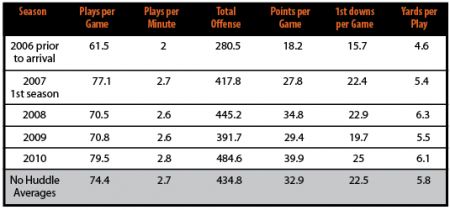
The benefits of the no-huddle offense are simple and well understood.
1. Limit defensive substitutions. The defense is just as personnel-dependent as the offense. When you can limit what personnel group the defense has on the field, then you can limit what different looks and blitzes the defense can run, giving the offense an advantage.
2. The defense has less time to react. By going quickly on offense, the defense has less time to make its adjustments. The defense must play as quickly as the offense. The defensive coordinator must anticipate instead of reacting to the offensive personnel group. Also, it is much more difficult for the defense to disguise coverages or bluff their pressure looks because they are worried about how quickly the offense will snap the ball.
3. Helps tire out the defense. Another huge advantage is to tire out the defense, especially the defensive line. We all know that the game is won and lost in the trenches, so whatever the offense can do to tire out the defensive line will be a benefit that grows as the game goes on. A tired defense will make both physical and mental mistakes which leads to giving up points.
4. Control the speed of the game. Generally, coaches recognize the offense has two major advantages – they know where they are going and they know the snap count. But I believe the offense’s ability to control the speed of the game is just as important. By playing fast the offense always puts the defense in a catch-up mode. They must hurry to get lined up, hear the defensive call, etc. This creates mental fatigue as the game goes on.
5. Practice is on your side. An offense has a much easier time simulating game speed during practice than the defense. Therefore, the offense has a much greater advantage come game time when it plays at a fast pace.
Communication is key.
When you go no-huddle, then the offense must be able to communicate quickly and effectively. Regardless of how plays are called, the information must get to the each offensive player as quickly as possible. Each no-huddle team has their own way of getting it done whether it is signals, wristbands, or picture boards. Find your best way to get the information to the players as quickly and succinctly as possible. Everybody must be on the same page.
But how do you practice no-huddle while being able to simulate game speed?
The scout team defense must be able to line up and play as quickly as the offense. We have our scout defense working off of wristbands. Each defensive player has a wristband that tells him what to do on each given play. He is told where to line up, where to blitz, or what type of coverage is being run. Normally 16-18 different looks can be created on a wristband. One of the coaches is responsible for calling out the corresponding number on the scout wristbands to get the defense lined up correctly.
During a normal 20-minute team period, our offense is able to run 50-60 plays. Our goal during a game is to run 2.75 to 3.0 plays per minute off the game clock, so we are pushing to create that level of game speed during each scout team period. In order to keep that pace going, the coaching staff cannot stop practice to make corrections to individual players. If there is a problem with multiple players, then make the corrections. But if the correction only deals with an individual player, pull that individual player out and make the correction. During a game, you cannot stop to make the correction, so why should it be done in practice? Isn’t our primary goal during practice to teach the players how to play during games?
Every coach wants more practice time. The best way to gain practice time is to practice at the no-huddle pace. Since the offense and scout defense are moving so quickly they are able to get more reps during the practice. Also, there is not as much of a need for conditioning. The players are able to work themselves into playing shape as they take actual reps instead of dedicating time solely to a conditioning period. Finally, by getting more reps during practice, you have more time to focus on specific game situations such as third down or red zone offense. The more these specific situations are practiced, the better the offense will be able to handle them during the game.
What about time of possession?
This is the most over-used and over-discussed stat in all of football. Time of possession only matters in the fourth quarter. Obviously, you have to be able to control the clock late in the game when you have the lead, but that is the only part of the game where time of possession matters. Which is more difficult for a defense to play against - an offense that takes its time or an offense that runs a lot of plays? Being on the field is not what tires out a defense. Having to defend a lot of plays is what creates a tired defense and eventually leads to defensive confusion and mistakes.
Don’t be afraid - be aggressive.
The safest way to play is to be like everybody else. Unless you are blessed with far superior athletes than your opponent, you have to take some well-calculated chances to be successful. By playing fast and operating in a no-huddle, you give your offense a chance to build confidence, move the football, and score points. It does not matter if you are a run-first no-huddle team, balanced no-huddle team, or a passing no-huddle team because the offense is ultimately judged by one primary criteria – how many points did you score?
About the Author:
Marc Kolb is in his fifth season as OC at Tusculum College. He was promoted to assistant head coach in 2008. Last fall, Kolb led Tusculum to the #1 passing offense in the country (among all NCAA divisions). He previously coached at Missouri-Rolla, Fairfield University, Curry College and Framingham State. Kolb is a 1994 graduate of Brown.