WHEN RUNNING THE DOUBLE WING, you know guards are critical to the success or failure of your offense. However, the opposition knows this as well. An opponent who knows your squad runs the double wing uses the week leading up to the game to practice, drill and strategize against this offense, especially the use of the guards in it.
That puts the onus back on you to develop wrinkles and variations to the double wing that keeps the defense guessing. After a week of preparation, making the defenders rethink their reads and keys puts them on their heels and has them questioning what the coaches taught them.
Try these four plays to plant the seed of doubt in your opposition, which then sets up your standard play-calling in the Double-Wing Offense.
32 guard trap influence
The 32 Guard Trap Influence is a great play because of the motion by the left wing along with the perimeter pull of the right guard.
DIAGRAM 1: 32 Guard Trap Influence. There are five keys to this play to make it successful against an unsuspecting defense. Be sure your players are well-versed in these keys before trying to perform the play during a game.
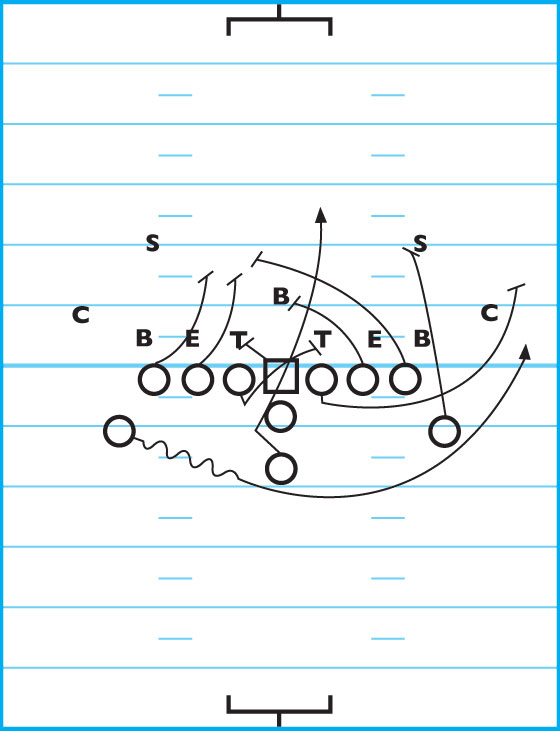
1. There needs to be full-speed aggressive motion by the left wing along with a great ball-fake by the quarterback. The left wing needs to “rock the baby” (pretend to tuck the ball) and keeps his eyes on the defense.
2. There is full-speed pull and attack by the right guard. Have him yell “Sweep!” as he pulls.
3. There is aggressive downfield blocking at the second level on the linebackers and safeties.
4. Your left guard makes a great kickout path and finish.
5. Preach patience by the fullback. Then, the FB explodes and stays tight to the wall. This is a north-south play.
After discussing the keys to the play, make sure every player knows his role for making this play successful.
Quarterback: Opens away from the play side getting off the mid-line. He hands off to the FB, takes one step, fakes the sweep handoff to the backside wing in motion, drops back over the play-side guard and fakes an 11/12 Nitro Pass.
Fullback: Takes a jab-step downhill away from the play. Receives handoff with play-side arm up, hits the hole and gets vertical finding daylight ahead of him. One note: Against an odd/50 front, the play “bends” harder.
Play-Side TE: Blocks the first backer inside. If there is no one there, moves to the next level.
Play-Side OT: Blocks first backer inside.
Play-Side OG: Pulls outside, attacks the defense with his body and eyes, and yells “Sweep!”
Center: Blocks the backside defensive tackle.
Backside OG: Pulls and kicks out the first defensive lineman past the center. If pulling to the left, hit to the left. If pulling to the right, hit to the right. Against an even/40/60, the front trap is short; against an odd/50, the front trap is long (kick-out must be inside-out with great pad level. He runs through the block and dominates.
Backside OT: Blocks the first backer inside. Hits and hustles.
Backside TE: Against two safeties, he runs a corner route. Against all other looks, he takes an inside path while checking the second and third levels. This sets up the QB to throw a Nitro Pass if the TE runs a great route.
Play-Side Wing: Tries to block inside LB, then works through the defense to the safety. This player needs to find someone to block, hit and hustle through the play.
Backside Wing: Goes in motion and gives a great sweep fake. Continues the chicken-wing fake by attacking the perimeter hard. The success of this play is dependent on this fake.
47 reverse guards away
This play involves a double handoff along with two influence pulls by the guards.
DIAGRAM 2: 47 Reverse Guards Away. There are three keys to making this play successful.
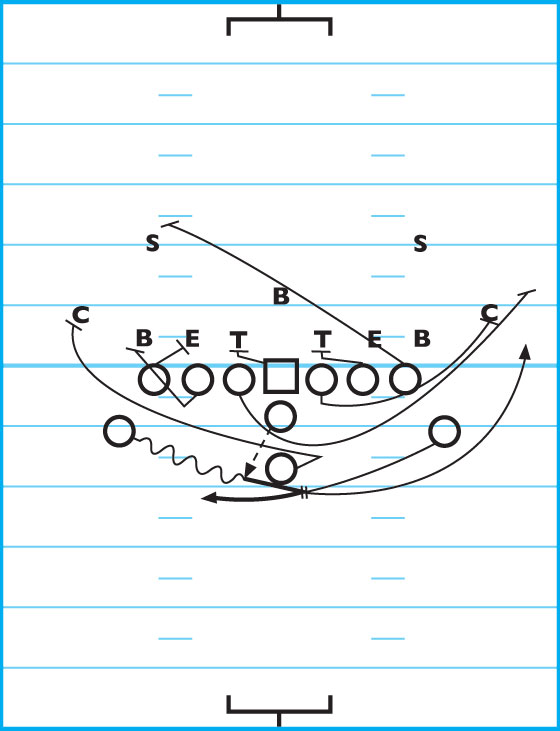
1. You need great mechanics in the backfield between the left wing and the right wing on the double handoff.
2. The fake continues with the left wing and both guards.
3. You need great play-side movement by the OT and the TE.
After understanding the keys, make sure each player knows his responsibility.
Quarterback: Opens to the play side and softly tosses to the play-side wing. he boots to the play-side flat and hooks the corner inside if possible. If not, he kicks out the corner. The most important part for the QB is to stay engaged.
Fullback: Takes a lateral step away, then flattens off QB’s hip and hits the first opponent inside if possible.
If not, he kicks out toward the opposition. The most important part of the block is to stay engaged.
Play-Side TE: Secures the play-side edge. Gets his head to the play side and doesn’t stop his feet. This is a critical block to the success of the play.
Play-Side OT: If covered, reach on play side. If uncovered, pull around the play-side TE and hit the first opposition he sees. This player’s head must be on a swivel and he must be aggressive while keeping his feet moving.
Play-Side OG: Pulls away, attacks the defense with his body and eyes, and yells “Sweep!”
Center: Reaches on play side (reaches hard to the next level if no one is on the line of scrimmage).
Backside OG: Pulls away, attacks the defense with his body and eyes, and yells “Sweep!”
Backside OT: Reaches on play side (reaches hard to the next level if nobody is on the line of scrimmage).
Backside TE: Reaches on play side (reaches hard to the next level if nobody is on the line of scrimmage).
Goes and gets the touchdown block and cuts off the second- and third-level defender. Gets across and down the field to lead the parade to the endzone.
Play-Side Wing: Goes in short motion at the depth of the FB’s heels. Receives the pitch (handoff) on top, behind the backside wing. Continues with a great chicken-wing fakes and attacks the perimeter to take the defense with him.
Backside Wing: Leaves at the snap and runs 2 yards behind the FB’s heels. Receives handoff behind
play-side wing and attacks the perimeter. Reads the blocks. Gets vertical if players execute kick-out blocks.
28 sweep left side away
The keys are great tight fakes in the backfield to confuse the attacking defense. Great fakes sell this play.
DIAGRAM 3: 28 Sweep Left Side Away. These are the player responsibilities for the 28 Sweep Left Side Away.
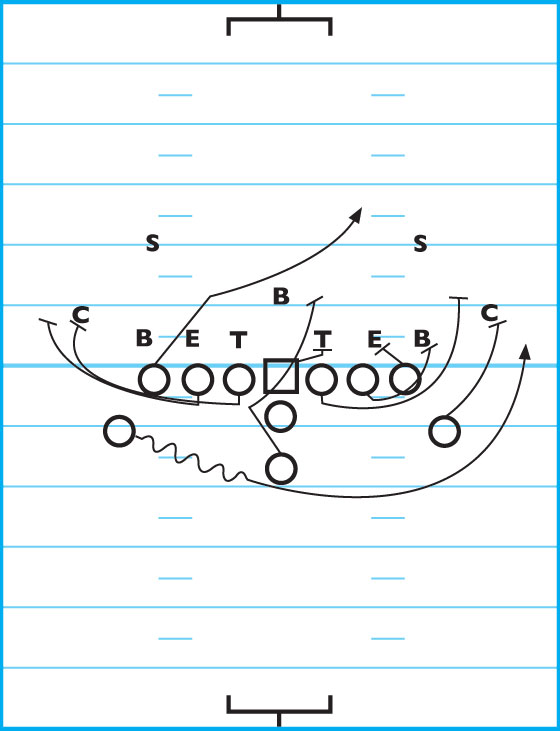
Quarterback: Opens away from the play side getting off the mid-line with a hand-fake to the FB. He takes one step, hands off to the backside wing in motion, drops back over the play-side OG and fakes Nitro Pass.
Fullback: Takes a jab step downhill away from the play, then fake traps. Continues to fake trap until reaching the second level of defense, then blocks the first defender he sees.
Play-Side TE: Gap, down and reach on play side. Uses alerts (6 Call tells wing the TE is blocking gap or down. 9 Call tells wing the TE is reaching). Communicates with play-side wing (6 Call tells wing to cover you).
Play-Side OT: Pulls deep around play-side wing (must get 2 yards of depth) with head on a swivel and hit the first defender who approaches. Keeps feet moving and is aggressive.
Play-Side OG: Pulls deep around play-side OT (must get 3 yards of depth) with head on a swivel and block first defender who approaches. Keeps feet moving and is aggressive.
Center: If uncovered, reaches on play side to play-side OG’s man. Cuts him if need be. Doesn’t allow penetration. If covered and the play-side OG is uncovered, then stays on path and reaches the second level of defenders.
Backside OG: Pulls away, attacks the defense with body and eyes, and yells “Sweep!”
Backside OT: Pulls away, attacks the defense with body and eyes, and yells “Sweep!”
Backside TE: Throws the touchdown block by staying on path and attacking second- and third-level defenders.
Play-Side Wing: Reaches first threat to the play. Uses alerts (6 Call tells the play-side TE he is blocking gap or down. 9 Call tells the play-side TE he is reaching). Prepares to block down and covers the play-side TE on a 6 Call.
Backside Wing: Goes in motion at 90 percent speed. Steps at the depth of the FB’s heels and receives handoff. Moves at depth of 1 or 2 steps behind the play-side OT and attacks the sideline if hooked. If kicked outside, turns at 90-degree angle and gets vertical immediately.
32 wedge guards outside
This is just a base wedge play. It is great against an aggressive, to-the-perimeter 50 defense or a 2 inside linebacker defense.
DIAGRAM 4: 32 Wedge Guards Outside. These are the player responsibilities for the 32 Wedge Guards Outside.
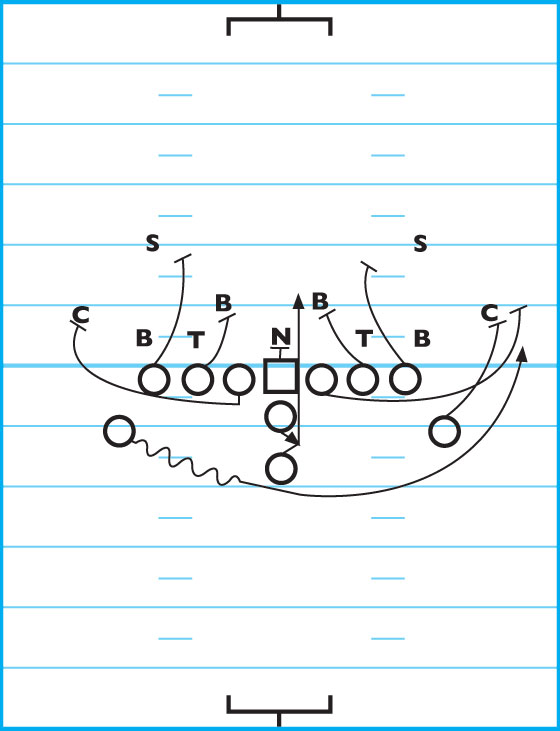
Quarterback: Opens to the FB play side and gives the FB the ball over the designated hole call (0, 1 or 2). Boots to the play side with a great chicken-wing fake and attacks the defender.
Fullback: Dives to the play-side hole. Receives the ball. Keep shoulders square. Drives feet. Stays low. Finds daylight and goes. Gets vertical. Note that the play might open up backdoor.
Play-Side TE: Reaches to the point of attack keeping shoulders square to the line of scrimmage.
Play-Side OT: Reaches to the point of attack keeping shoulders square to the line of scrimmage.
Play-Side OG: Pulls away. Attacks the defense with his body and eyes, and yells “Sweep!”
Center: Reaches to the point of attack keeping shoulders square to the line of scrimmage.
Backside OG: Pulls away. Attacks the defense with his body and eyes, and yells “Sweep!”
Play-Side OT: Reaches to the point of attack keeping shoulders square to the line of scrimmage.
Backside TE: Reaches to the point of attack keeping shoulders square to the line of scrimmage.
Play-Side Wing: Shifts up (this is optional). Reaches man away from the play (like a sweep reach).
Backside Wing: Goes in short motion. Gets over the top and attacks the perimeter with a great chicken wing fake. Looks for the first defender and hits him.
These are just four ways to deceive the defense and to keep defenders on their heels. Use some of these strategies to build your own group of variations to keep the defense guessing. You only are limited by what your players can learn and what you can teach. You need to dictate what happens during the game. Don’t let the opposition plan and strategize to beat you the day of the game.