As mentioned in the previous article, this package may look extensive and complicated to implement, but in reality the repetitive nature of the series allows for consistent teaching and understanding of concepts throughout all personnel. The routes are repetitive, the reads and throws for the quarterback are consistent, the quarterback’s processing of information is progressive, and the language and terminology are neatly packaged for adjustments and flexibility.
The “Drive Concept” itself is consistently packaged and will enhance not only your passing game, but also your entire offense. The system is limited only to one’s creativity, imagination, and ability to execute. Most importantly, the players will enjoy the continued development and evolution of the system. The beauty of the series is that regardless of the creative formations in which a play can be run, the concepts remain the same and the terminology and quarterback’s progressions are similar throughout the series.
PROTECTION:
The installation of the series starts with the 5-step protections (“Mike Protection”). The front 5 linemen are responsible for the 4 down defensive linemen and the Mike linebacker. The fullback is responsible for the Sam linebacker. The Will linebacker is the “Hot” pre-snap and post-snap read for both the QB and the H Back (Diagram 1).
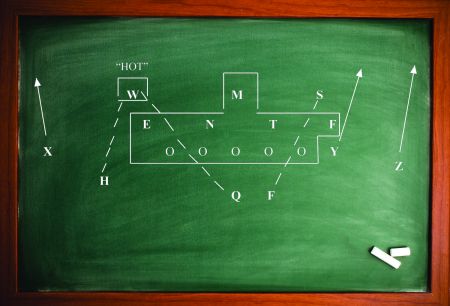
Diagram 1: Protection
QB PROGRESSION: DRIVE SERIES
1. FULLY UNDERSTAND SERIES CONCEPTS
• Routes of receivers.
• The QB has 2.5 seconds to release the ball.
• After 2.5 seconds, the dig route may come open.
• Choice route receiver to “Triangle – Triangle – Triangle”.
2. PRE-SNAP INFORMATION
• Protection.
• “Gimme Throws”.
• Read overages.
• Footwork.
• Snap count.
3. FIRST READ
• Choice receiver - 7 step stop/10 step out/fade route.
• Know alignment of CB and OLB.
• Patterns are dependent on defensive scheme.
• Basic rule of thumb - near hash – out or fade; middle of field
– stop or fade.
• Signals - 7 step stop – helmet; 10 step out – hip; fade – face mask.
• Choice route is the QB “HOT” pattern with pressure.
4. SECOND READ
• Drive route - then to triangle.
• QB reads the triangle progression - drive route/stick route/dig
route triangle.
5. DIG ROUTE READ
• Read free safety in cover 3.
• Split zone vs. cover 2.
• High low read on dig route and vertical post route.
• Throw to window on dig route (keep the ball low).
• Throw just inside hash to post route (overthrow the deep ball).
Here are the specific routes and assignments on a few of our
passing plays:
ACE RIGHT 55 Y DRIVE (Diagram 2)
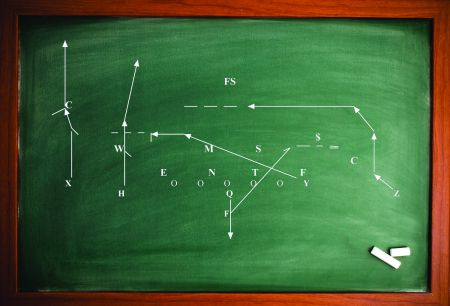
Diagram 2: Ace Right 55Y Drive
Vs. ZONE:
X – Choice Routes - 7 step stop – signal touch - “helmet” - when LB is aligned in the box; -10 step out – signal touch - “hip” - only when ball is on near hash; - fade / go route – signal touch - “mask” - corner pressed.
H – “Down the Tracks” – hash mark to inside the hash post route.
Y – “Drive Route” – climb to 6-7 yards to 3 yards outside the opposite tackle box – vs. man coverage.
Z – “Dig” – 12-14 yards over the ball between the LBs – vs. man
coverage.
F – Read strong side LB stunt – “Chip Technique” to “Stick Route” or
- 4-5 yards over tackle box opposite the drive route – vs. man coverage.
Vs. MAN:
Run man technique route.
QB PROGRESSION:
• 2.5 seconds to release the ball.
• X route to H route to triangle Y – F – Z.
• Dig route is after 2.5 seconds.
• “Hot” read is the H or X.
ACE RIGHT 55 H DRIVE (Diagram 3)
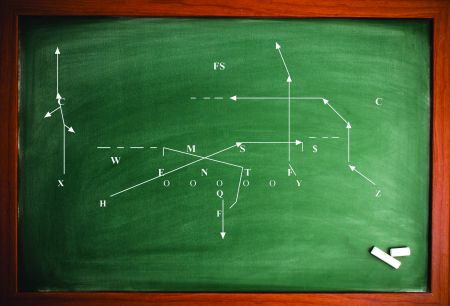
Diagram 3: Ace Right 55 H Drive
Vs. ZONE:
X – Choice Routes - 7 step stop – signal touch - “helmet” - when LB is aligned in the box; - 10 step out – signal touch - “Hip” - only when ball is on near hash; - Fade / go route – signal touch - “mask” - corner pressed.
H – “Drive Route” – climb to 6-7 yards to 3 yards outside the opposite tackle box – vs. man coverage.
Y – “Post Route” – inside release, down the tracks, center of the field.
Z – “Dig Route ” – 12 – 14-yard dig route between the LBs – vs. man coverage.
F – Read strong side LB stunt – “Chip Technique” to “Stick Route”.
- 4-5 yards over tackle box opposite the drive route – vs. man coverage.
Vs. MAN:
Run man technique route.
QB PROGRESSION:
• 2.5 seconds to release the ball.
• X route to triangle H – F – Z.
• Dig route is after 2.5 seconds.
• “Hot” read is the X.
ACE RIGHT 55 X DRIVE (Diagram 4)
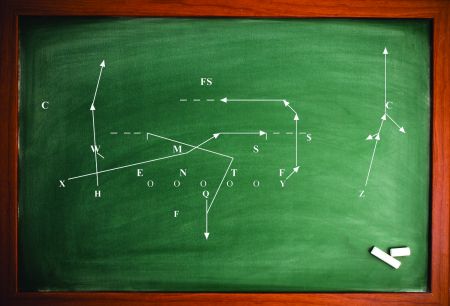
Diagram 4: Ace Right 55 X Drive
Vs. ZONE:
X – “Drive Route” – climb to 6-7 yards to 3 yards outside the opposite tackle box – vs. man coverage.
H – “Down the Tracks” – hash mark to inside the hash post route.
Y – “Dig Route” – 12-14 yards over the ball between the LB’s – vs. man coverage.
Z – “Choice Routes” - 7 step stop – signal touch - “Helmet”- when LB is aligned in the box; 10 Step Out – signal touch - “Hip” - only when ball is on near hash; Fade / go route – signal touch - “Mask” - corner pressed.
F – Read strong side LB stunt – “Chip Technique” to “Stick Route”
- 4-5 yards over tackle box opposite the drive route – vs. man coverage
Vs. MAN:
Run man technique route.
QB PROGRESSION:
• 2.5 seconds to release the ball.
• Z route to triangle X – F – Y.
• Dig route is after 2.5 seconds.
• “Hot” read is the Z or H.
ACE RIGHT 55 Z DRIVE (Diagram 5)
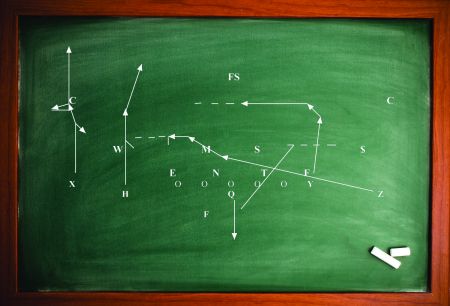
Diagram 5: Ace Right 55 Z Drive
Vs. ZONE:
X – Choice Routes - 7 step stop – signal touch - “Helmet” - when LB is aligned in the box; 10 step out – signal touch - “Hip” - only when ball is on near hash; Fade / go route – signal touch - “Mask” - corner pressed.
H – “Down the Tracks” – hash mark to inside the hash - post route.
Y – “Dig” – 12-14 yards over the ball between the LB’s “Drive Route” – vs. man coverage.
Z – “Drive Route” – climb to 6-7 yards to 3 yards outside the opposite tackle box – vs. man coverage.
F – Read strong side LB stunt – “Chip Technique” to “Stick Route”
- 4-5 yards over tackle box opposite the drive route – vs. man coverage.
Vs. MAN:
Run man technique route.
QB PROGRESSION:
• 2.5 seconds to release the ball.
• X route to triangle Z – F – Y.
• Dig route is after 2.5 seconds.
• “Hot” Read is the X or H.
As mentioned in part 1, the “Drive Series” can be run from the I formation utilizing “iso” play-action look, trips formations, Wing-T with 4 eligible receivers, or even no-back formations. The quarterback can either be under center or in shotgun formation.
The responsibilities, assignments and progressions throughout the package remain consistent for both the quarterback, the receivers and the linemen in their protection. The foundation, as well as the building blocks, form a fun and exciting passing attack that is simple and repetitive. The distinct beauty of the system is one that is only limited to your creativity and imagination. It is also a system that everyone, coaches and players, can rely on when the determination of a game is at hand.
About the Author: Greg Christodulu is currently an assistant coach at Shenendehowa High School (NY). He has coached on the college level at Albany, James Madison, and Susquehanna University. Christodulu also coached at Gloversville High School (NY). He lettered at both Syracuse and Delaware and was recently inducted into the Capital District Hall of Fame.