BEING A WIDE RECEIVERS coach in an option-based offense, I am often asked, “Why do you bother spending time coaching pass catching and why don’t you just have your receivers work on blocking?” Because option offenses that don’t commit to the pass usually struggle when they’re behind or when they need a 2-minute offense.
Passing Is An Option
Teams that seek to make the passing game an integral part of their option offense are blessed with many alternatives throughout the game. In our program, we sell our quarterbacks and receivers on the fact that if we execute the option successfully, we may not have the same number of completions or receptions as passing schools, but the total yardage will be very close.
When we do pass, our team hits the deep ball more successfully than most pass-oriented teams because our opponent’s secondary must be an active part of run support. Over the past couple years, we’ve had several games where we have rushed for over 300 yards and passed for over 300 yards. The best thing about these numbers is while passing offenses may throw for 300 yards, it usually takes them twice as many completions.
Developing a Passing Philosophy
Most often, a coach who runs the option does so because his team’s strength is an athletic QB. This QB may or may not possess the best arm. The trend in most option offenses is to no longer just plug in the team’s best athlete at QB, but find someone with passing skills. This trend is in direct relation to the problems of playing catch-up and executing the 2-minute offense.
When a coach wants to install the pass into an option-based offense, he must make several key determinations.
1 What Are The QB’s Strengths? An option coach committed to the pass must first decide what the strengths of his QB are and how those strengths might be incorporated into the passing game.
For instance, a QB with speed but a suspect arm might better serve the offense with a sprint-out attack. This would give the QB momentum when passing, which would allow a longer throw and give him the option to keep the ball if the pass isn’t there.
One of the things our team does to allow options in the passing game, besides the normal play-action package, is to use 5-step, 3-step, sprint-out and boot-leg packages to attack with.
2 Allow Practice Time For Passing. Spend as much time throwing in practice as possible. If you limit your passing time to only 10 to 15 minutes in practice, it will be hard for your QBs and WRs to develop the timing and consistency that’s needed to have a successful passing game.
This presents a dilemma because to have a successful option attack, you must dedicate substantial practice time so that your QBs and RBs can develop timing and consistency. You can get around this by having your WRs and QBs out on the field before everyone else. While the rest of the team stretches, you’re working on the passing game.
Try to get them out early enough to do some stretching and arm warmups, but most of this should be done through throwing touch passes at progressive distances. After the QB is warm, move to the short passing game and work on the long passing game.
Within 10 to 15 minutes, before the entire team begins practice, you’ll have covered a lot of the passing game and have given your players much-needed reps for gaining timing and consistency.
When individual practice starts, the QBs can get with the RBs for option steps and WRs can block or work on their releases. If the individual aspect of practice lasts 30 minutes, you’ll have spent 12 to 18 minutes on the option or running game and, overall, have committed a great deal of individual practice time on your passing game.
3 Integrate Passing Into Your Option Work. Even when you do option drills against the defense, work on option and play-action passing. This demonstrates to both players and coaches (and more importantly defenses) that the pass is an important part of your offense. When you work on perimeter or other passing drills against the defense, mix in some option work. A good drill to do with WRs and DBs is a 1-on-1 perimeter-blocking drill.
DIAGRAM 1:
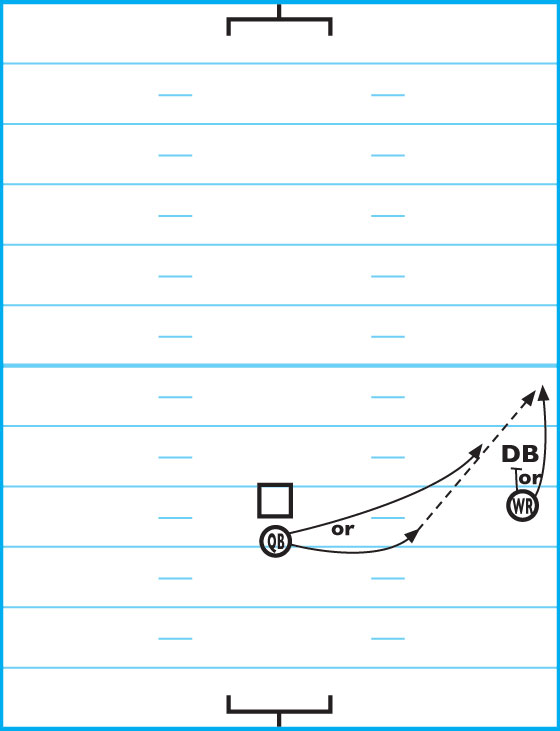
1-On-1 Perimeter-Blocking Drill. Have your QB run out of the triple option so that your players can work on timing. Initially, we had a problem with this drill because the DBs knew it was the option and therefore didn’t take any drop steps. The receivers were engaged in the blocking long before the ball got outside, and thus had to hold the block for a long time. To make this drill more realistic, and to convince our WRs that both blocking and route running need to be at full speed, we mix in an occasional play-action pass.
- Do Drills Where Your QB Must Make Decisions. Everyday we do 2-on-2 passing vs. the DBs.
DIAGRAM 2:
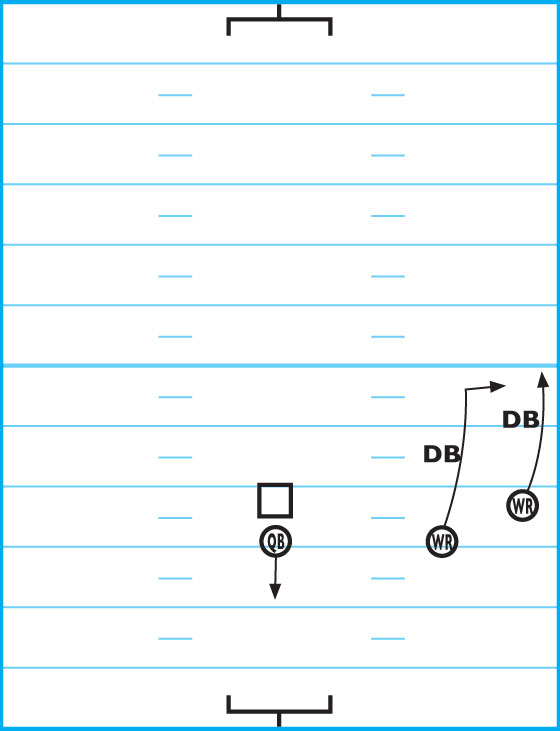
2-On-2 Passing Drill. This drill gives your QBs the opportunity to make good decisions in the passing game and read their passing progressions.
Option coaches should often try to place QBs in difficult situations when working the option, so that they’ll be prepared for pressure situations during games. When option coaches work the passing game, the tendency is to work on air and make it as easy as possible.
This tendency puts the QB in an awkward situation, where he’s prepared to run the option but is not ready to pass. By allowing the QB to throw against a defense, he builds the same patterns of consistency that he gets from doing read drills for the option.
Adding To Your Passing Attack
There are many ways to attack a defense if you can use both the option and the passing game efficiently. The fear of most option coaches is the dreaded eight or nine defensive men in the box. In this scary situation, the inside game is limited and you’ll face considerable pressure before your team can move the ball outside. Here are some ways to counter this problem.
Î Utilize Multiple Formations. Limit the number of plays you run so that the emphasis is on play execution. In addition, use many different formations from two tight ends to three or four wide-receiver sets. In our attack, in any of these formations we can run any of our plays with very few blocking changes.
So if we only have 10 running plays in our offense, with multiple formations it appears as though we have hundreds of plays. This helps the passing attack by having DBs not only thinking about the option, but also evaluating the many number of ways that we may attack.
Î Use Multiple-Receiver Sets To Remove An Extra Defender From The Box. Playing with a slot and a split will force your opponents to play with a four-man secondary, and if they don’t, there will be an open receiver.
This tactic also gives the appearance that you’re committed to the pass and forces secondary players to think pass first and run support second. You’ll find that both the inside game and option game open up because there’s less clutter inside.
Î Add An Extra Receiver To Your Sets. Don’t be afraid to break up your backfield to add an extra WR. Most option coaches fear that doing this will hurt the option attack; however, doing so enhances it! By moving a back to the wing or another slot, he’s still a viable pitch back and you don’t need motion to get him into position.
DIAGRAM 3:
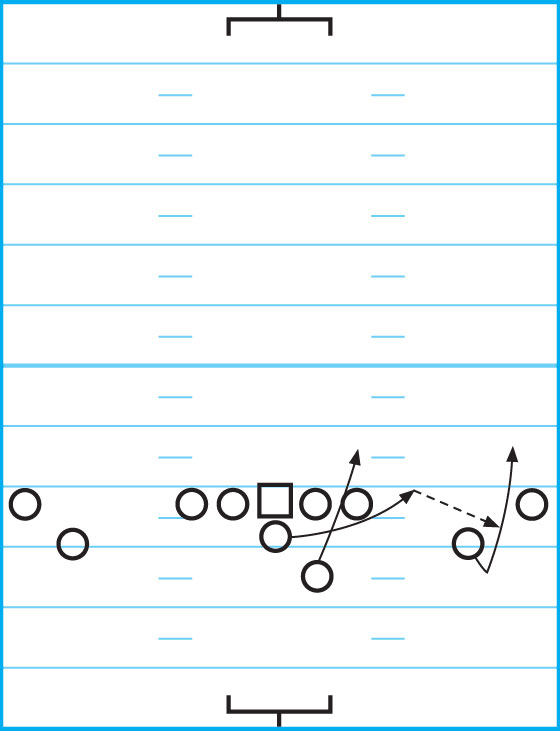
2 WRs In The Slot. At times, our team has removed a back and played with two WRs in the slot positions and pitched the ball to them. The beauty of this look is that you’ll appear to be in a passing set (with two slots) and will have forced your opponents to play with a five-man secondary. If you do choose to pass, you can place multiple WRs in the attack.
Î Use The Back In Your Throwing Attack. Line up the back in the formation or use motion to put him in a favorable position. By moving the back around, you’ll confuse defenses and force them to think more about their assignments and less about attacking.
DIAGRAM 4:
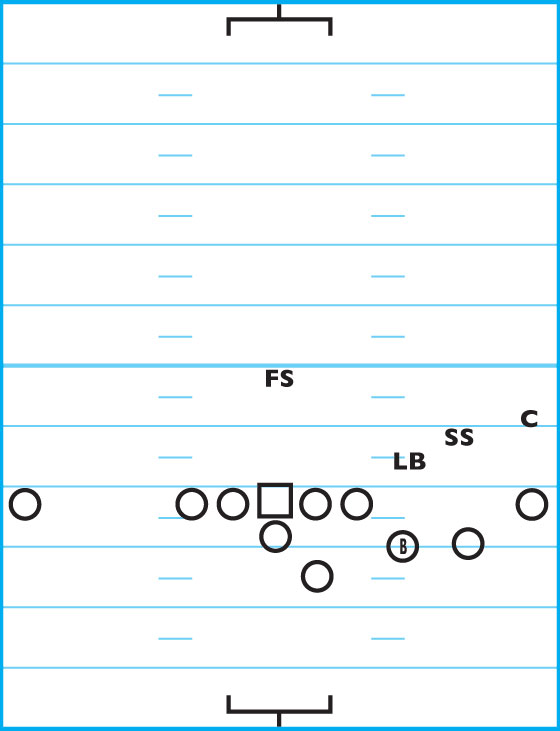
Back Used In The Passing Attack. In option offenses, backs tend to be good athletes and when they’re used in the passing attack, they’ll often be matched up against the third-best coverage man, who is usually a linebacker or an end. This will create a mismatch.
If defenses try to counter this threat with a nickel or dime package, you’ll be able to run all day.
Be Creative
The option is one of the most exciting plays in football, because it gives you choices. To expand these choices, a strong passing game with multiple threats provides you with a deadly combination. With the option and a strong passing game, you force opponents to play the whole field and put them in a bind since defenders have too many responsibilities.
A player who has to think about his responsibilities is less likely to attack and is more likely to be forced to react, helping you to maintain your team’s advantage. Incorporating a strong passing game into your attack gives new meaning to the phrase “option football.”