MANY TIMES, YOU’LL hear commentators during pro or college football games express amazement when a team uses a trick play. They act as if this is such an odd part of football. For as much time that’s spent on the development of quality offense, defense or special teams, so is the creativity expressed in the trick play.
We’ve developed a term for the philosophy of using trick plays called “trickology.” Trickology is the study and development of a team’s trick plays within the framework of its offensive philosophy. It’s a concept that's been in the hearts, minds and playbooks of coaches at all levels for a long time.
The development and use of trickology can change a game’s momentum, win or lose a close game and even give a less talented team an edge against a team with superior talent. Used correctly, these are the types of plays that make highlight reels and are shown repeatedly in coaching clinics and staff meetings across the country.
Developing Trick Plays
Many coaches feel as though they do not have enough time to spend practicing and developing trick plays that they may only use a few times a season. Why should a coach have trick plays as part of his playbook or gameplan?
There are a number of things to consider when you decide to add a trick play — whether for special teams, offense or defense. The following seven points should be considered when developing and using trick plays.
1. How much time will it take to teach and for the student athlete to understand and execute it correctly?
2. When will be the right time to use it and against which teams?
3. Which personnel allows for the greatest chance of success for the play?
4. Is it a trick play one that can be used more than once in a game?
5. Is the theory behind the use of a particular trick play designed to force your opponent to practice something extra during their week of preparation and to counter the trick play? Or is it used to gain an edge or momentum in the next game you will be playing?
6. How will you evaluate the success and effectiveness of the trick play?
7. How will you handle the sudden change that may occur if this play fails?
Blending Trick Plays Into Your Schemes
For any trick play to be effective, it must look similar to a play that is already in a team’s playbook or one that is used regularly by them.
Schemes to run fake punts, onside kicks, fake extra points, 2-point conversions and special kick-block calls are considered trick plays for special teams and should be a part of any coach’s playbook. They should be used during key situations and must look like something that a team already does.
The following plays shown in this article are some of the trick plays that we’ve incorporated into our schemes.
Muddle Huddle
DIAGRAM 1: Muddle-Huddle. Our team uses the “swinging-gate” formation, otherwise known in our team’s terminology as the “muddle huddle.”
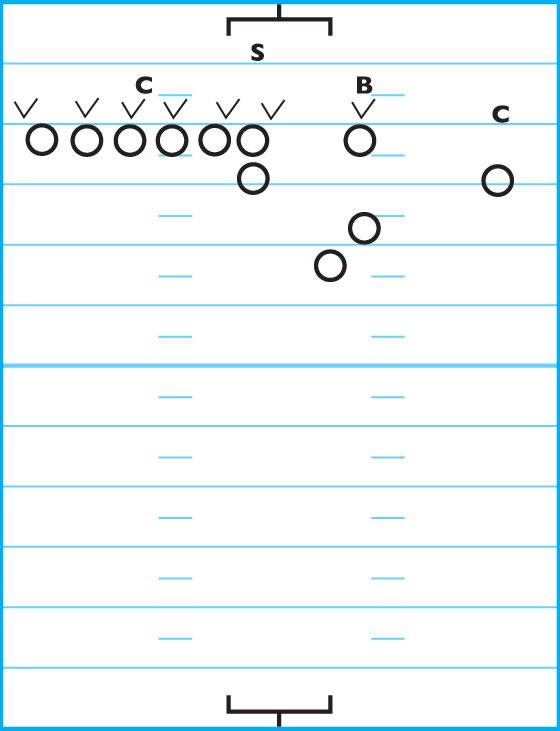
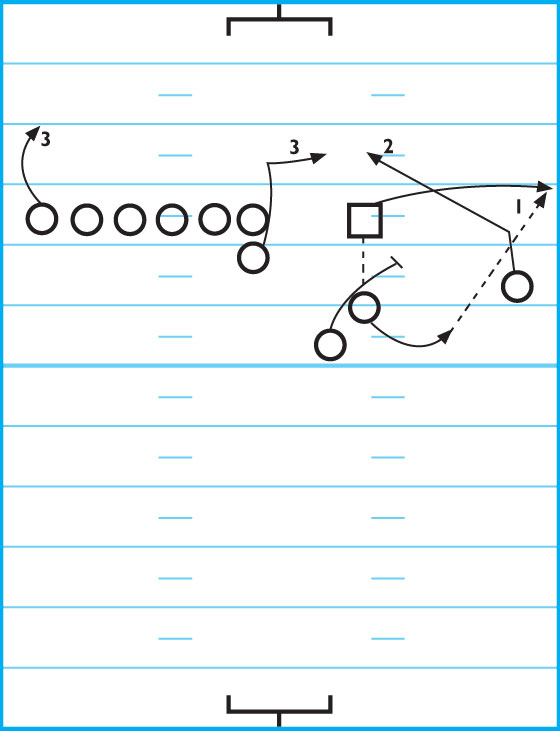
We can either kick or run trick plays out of this formation and opponents need to prepare for both. This versatility puts added pressure on a defense in key game situations.
DIAGRAM 2: Muddle-Huddle Pass Play. Our team runs a wide receiver reverse as part of our regular package. Many teams at the high school, college and pro levels make the reverse part of their normal look so that when run, it keeps the defense guessing and off balance — giving it an even greater chance of success when it is used.
Familiar Looks
Offense isn’t the only area where you want your trick plays to mirror your regular calls. Defenses that use stunts or schemes that look familiar to the offense — and then throw trick calls into the mix — can be highly effective. A timely called defensive trick play can mess up an offense’s best blocking scheme and can neutralize its most effective calls.
The closer that your trick plays look to your regularly called plays, the more effective the trick play becomes. It’s the benefit from spending time developing your creative trickology.
A trick play based on another trick play that you use on a semi-regular basis can also be extremely effective. If you run a reverse, for example, and then add in a twist such as passing out of the reverse, you can catch the defense completely off guard. This is creative trickology at its best.
The following two diagrams (diagrams 3 and 4) illustrate our “36 Reverse” call and then the “36 Reverse Pass” added to it. This is otherwise known as “a trick play housed within a trick play.”
DIAGRAM 3: 36 Reverse Vs. 40 Defense. This call has been a regularly used trick play within our offense that keeps the defense off balance.
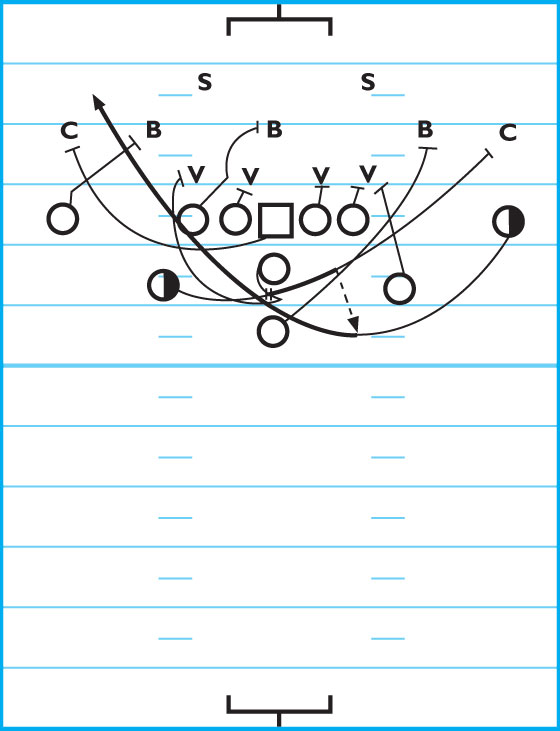
DIAGRAM 4: 36 Reverse Pass Vs. 40 Defense. The passing play call out of the reverse is an effective play against teams that play man-to-man in the secondary and use 8-man fronts.
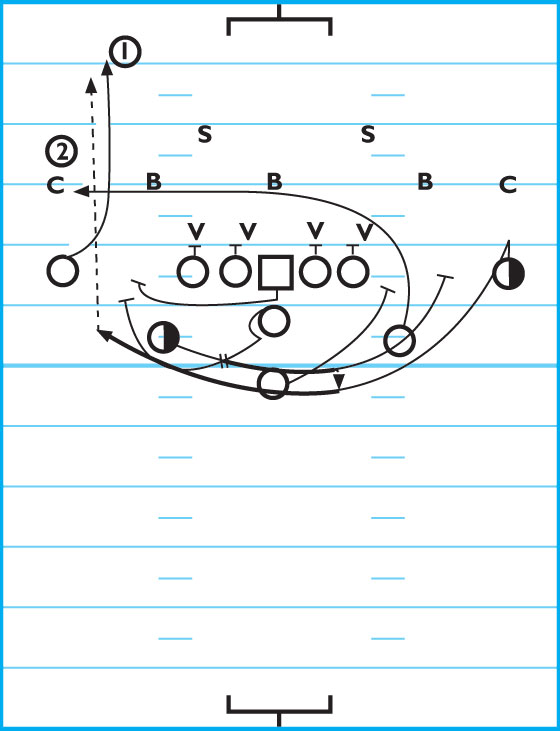
Like any trick play, the success of the call often depends on whether or not you have the right personnel on the field to use it. In one season, our personnel was so effective at properly executing the “36 Reverse Pass” that in one game we used it three times and gained positive yardage each time it was called.
Keeping Defenses Off-Guard
As a program, we have used trick plays against our opponents not only when we needed an edge, but also to force teams who are scouting us — whether on film or in person — to expose and prepare their team to the trick play. This forces the team who is scouting you to spend valuable practice time showing their players the trick play, the possible counters off it and the best ways to defend against it. Even if you don’t call that trick play in the next game, you’ll have succeeded in forcing your opponent to waste practice time worrying about it.
The best examples of how to incorporate trick plays into your regular attack can be seen in the following three plays. The following plays are designed to cause defensive miscues, gain positive yardage and force future opponents to scout and practice for the trick play contingency.
DIAGRAM 5: “Mish-Mosh” Vs. 40 Defense.
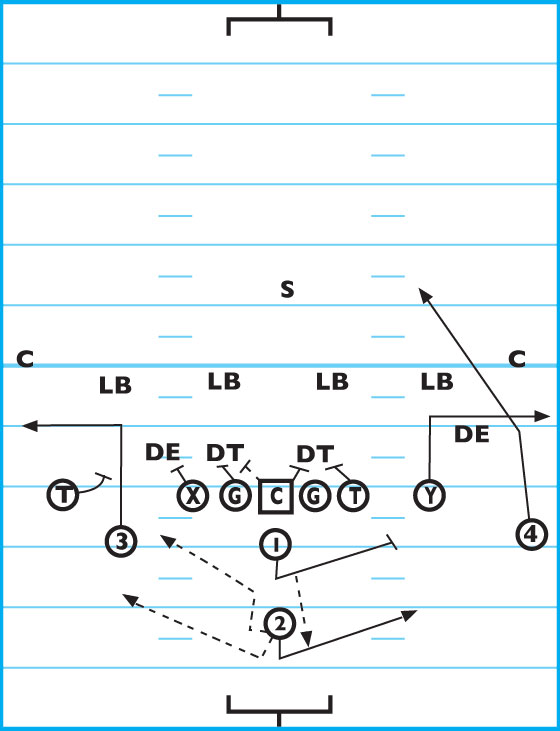
Receiver X: Steps to the play side and wedge blocks the man over.
Left OT: Aligns 10 yards wide of X on the LOS and blocks the man over.
Left OG: Steps to the play side, wedge blocks the man over.
Center: Steps to the play side, seals the play-side help and blocks to the play-side A-gap.
Right OG, OT: Steps to the play side, wedge blocks the man over.
Receiver Y: Runs a 5-yard out pattern to the right.
QB (1-Back): Makes an option pitch to the 2-back and blocks for him running either right or left.
2-Back: Secures the option pitch and runs either right or left.
3-Back: Sets up behind X and runs an out pattern.
4-Back: Sets up 10 yards wide, 2 yards deep and runs a deep-post pattern.
DIAGRAM 6: “Wild Circus” Vs. 40 Defense.
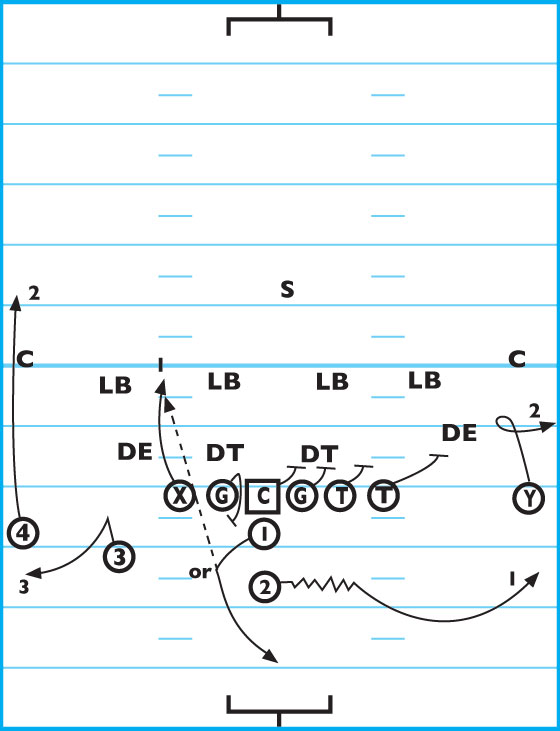
Receiver X: Runs a seam pattern.
Receiver Y: Aligns next to the right OT and runs a zipper pattern.
QB (1-Back): Looks for the pop pass to X first, then looks for the 4-back or 3-back going left. Looks for the
2-back or Y if going to the right.
2-Back: Either motions out on the first sound or sets up wide. Runs a cowboy pattern to the right.
3-Back: Sets up next to the 4-back and runs a cowboy pattern to the left.
4-Back: Sets up 10 yards wide and 2 yards deep and runs a fade pattern.
DIAGRAM 7: “86 Wild Cowboy” Vs. 40 Defense.
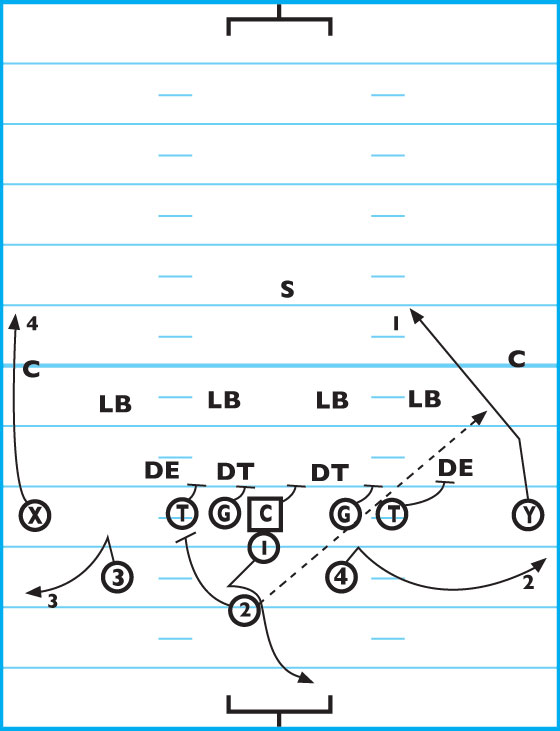
Receiver X: Runs a fade pattern.
Receiver Y: Runs a slant pattern and is the hot receiver on this call.
QB (1-Back): Fakes a handoff to the 2-back and throws a quick slant pass to Y. If Y isn’t open, looks to hit either the 3- or 4-back.
2-Back: Fakes running the “21 Yo-Yo” and seal blocks the backside.
3-Back: Runs a cowboy pattern and looks for the ball.
4-Back: Runs a cowboy pattern and looks for the ball.
Evaluating Trick Plays
The success of a trick play and the subsequent evaluation of its effectiveness may vary from game to game. An entire game plan can’t be based on trickery, but a trick play can enhance the game plan. Lack of success on a trick play can be a haunting experience, but if you never try it, you’ll never know whether it can succeed. Trick plays must be well-planned, calculated risks and not insane attempts of desperation.
As a coach, how you introduce a trick play, the techniques used to teach it and the use of it in games demonstrates to players and coaches that you have the desire to find any means necessary to gain an edge on your opponent.
As the game becomes more sophisticated and situational, you’ll find that there’s always room for trickology.