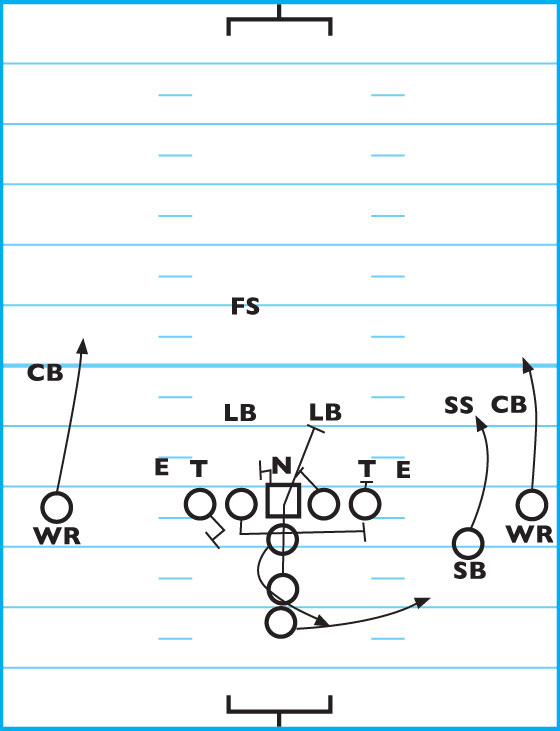
DIAGRAM: This play is especially effective after you’ve established a trap option, in which the DBs begin to cheat up and show run support. If the three receivers sell the run, they can get open for the pass. Down and distance isn’t as important as how the defense reacts to the run. You’ll really be able to take advantage of overaggressive DBs.
Wide Receivers: Both WRs run 8-yard stop routes.
Fullback: Steps with his play-side foot, aims for the middle of the center and fakes a run to daylight while looking to block the play-side LB.
Tailback: Freezes until the QB has taken his second step. Sprints to a point on the LOS 10-yards outside the play-side OT’s alignment.
Quarterback: Opens to the play side, clears the midline and fakes the ball to the FB. Takes 3 steps parallel to the LOS and throws to the first open receiver — looking from the inside out. If all of the receivers are covered, he pitches the ball to the TB.
Split Back: Splits the distance between the play-side OT and the SE, runs an 8-yard stop route.
Line calls are often necessary to make this play work. The play-side OT gives the call if blocking gap, the play-side OG gives the call if blocking inside and the center gives the call if the pulling backside OG and center are both covered. The backside OT blocks zone if the backside OG is covered.
All three receivers must establish eye contact with the DB over them and show their hands as if blocking for a run.
If all three receivers are covered, the TB must be alert to receive the pitch from the QB.
—Joe Kinnan, Head Coach,
Manatee High School,
Bradenton, Fla.