OUR TEAM RELIES heavily on running the option. We utilize the mid-line option, inside veer and lead option.
To do these things correctly, we devote a large amount of practice time to option drills (mesh-and-read drill, pitch drill, half-line drill) and fundamentals. Needless to say, we don’t have much time to work on a dynamic passing attack.
With a strong running game, you can continually move the chains, run down the clock and wear down the opposing defense. But if you really want to keep the defense on their heels, you must also be able to gain explosive yardage by passing.
Passing can be hard for an option-orientated team since it can easily feel out of its element when it needs to throw. The tight end screen will give your team the ability to gain big yardage through the air and doesn’t require the time and risk involved with more complicated passing schemes.
Huge Gains, Momentum Swings
The TE screen has been a great play for us. Last season, our team completed 5 TE screens for 126 yards—a 25.2 yard average. Although we did not score on the play, every time we ran it, our team experienced a huge momentum shift in our favor.
Four out of 5 times, the completions enabled us to get the ball inside the 5-yard line. Remember, this is a TE screen and TEs usually get caught from behind.
Reasons To Use
1 It’s A Safe Throw. In general, all screens are safe, but we like the TE screen because the quarterback does not have to throw to the middle area of the field and it doesn’t require him to throw a “downhill” pass into traffic.
DIAGRAM 1: On a screen that calls for the QB to drop straight back, there’s always a possibility of the defender hanging out at the line of scrimmage, getting a hand on the ball, causing a tipped ball, an interception or both.
Many times the defender who causes the problem simply got tangled up at the line or fell to the ground and deflected the ball after getting back up.
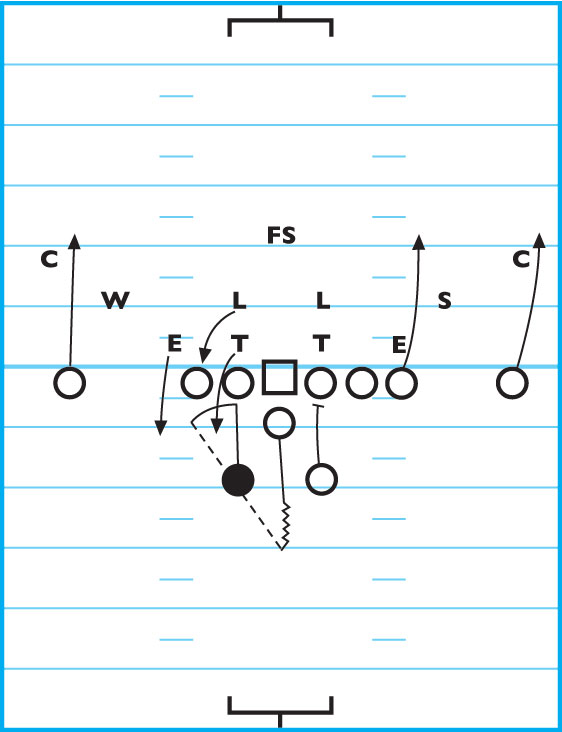
DIAGRAM 2:
Our version of the TE screen allows the QB to throw away from the defenders.
The QB needs to be instructed in two areas. First, he needs to make sure he gets 7-yards deep. If he doesn’t get deep enough, you run the risk that the pass will become a lateral.
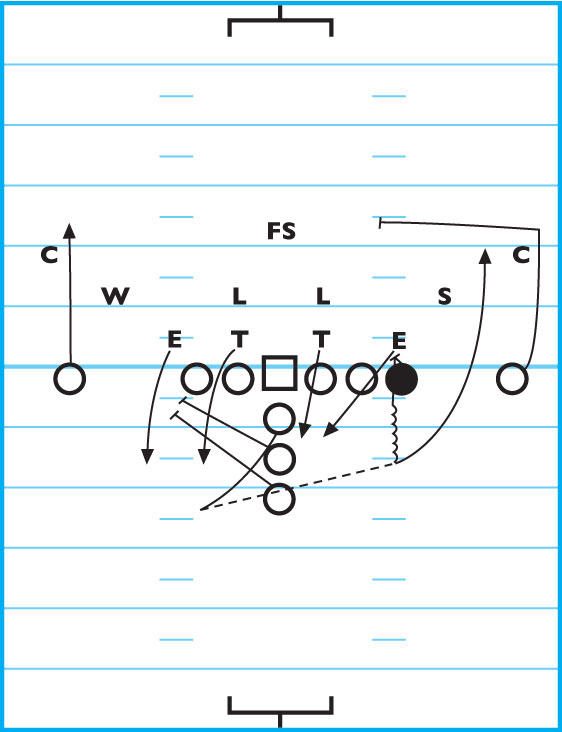
Second, if the QB sees any defender sitting on the TE, he must throw the ball at the TE’s feet. This greatly reduces the chance of the ball being intercepted.
2 Outflank The Defense. We run the TE screen off our sprint-out pass game. After we’ve run a couple of sprint outs, it’s hard for a well-coached pass defender not to adjust his pass drop as the launch point of the QB changes.
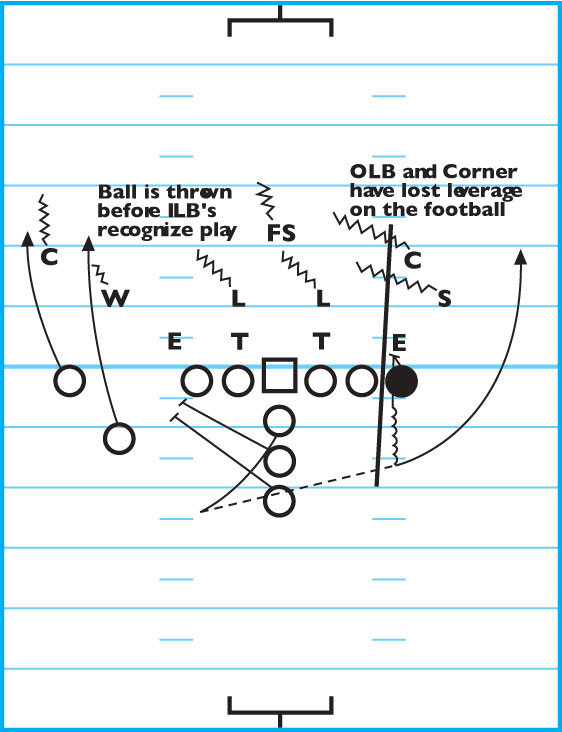
DIAGRAM 3: When an outside linebacker or a cornerback loses leverage on the football, you have a chance for a big play.
3 It’s Not An Easy Read By The Defense/LBs. Traditional screens require the running back to fake his pass block and turn his back on the LOS (See Diagram 1). The back is never out of the LB’s field of vision, and if the RB’s fake is half-hearted, the defensive linemen may be tipped off as well.
The TE screen forces the LBs to react to the outside flow, then to a sprint-out pass.
If the playside LB is responsible for the C-gap, he may have contain responsibility as well. Try to throw the ball just before the LBs have settled into their drops and have begun to get their “heads on a swivel” (see diagram 3). The late reaction will provide your team with big play potential.
4 More Linemen Downfield Without Disrupting The QB. Here are screen rules for your offensive linemen:
Î Allow no defender to beat your players on the play side.
Î Everyone pass blocks for two counts, then releases.
Î End Man: Engage man over him and stay with him. Run him upfield.
Î Second Man: Run straight down the LOS until he clears the end man. Look to kick out.
Î Third Man: Run straight down the LOS until he clears the tackle box. Look inside to seal.
Î Fourth Man: Run straight down the LOS until he clears the tackle box. Look to lead downfield.
Î If there are no defenders in the immediate area, move up field and keep head on a swivel.
On screens to the RBs, the end lineman is usually the tackle. He is responsible for engaging the man over him. This makes the backside guard the fourth lineman involved in the play and he does not get down the field very consistently. By the time he blocks for a two-count and runs down the LOS, the RB is usually past him.
DIAGRAM 4: On the TE screen, have the TE engage his man briefly and release.
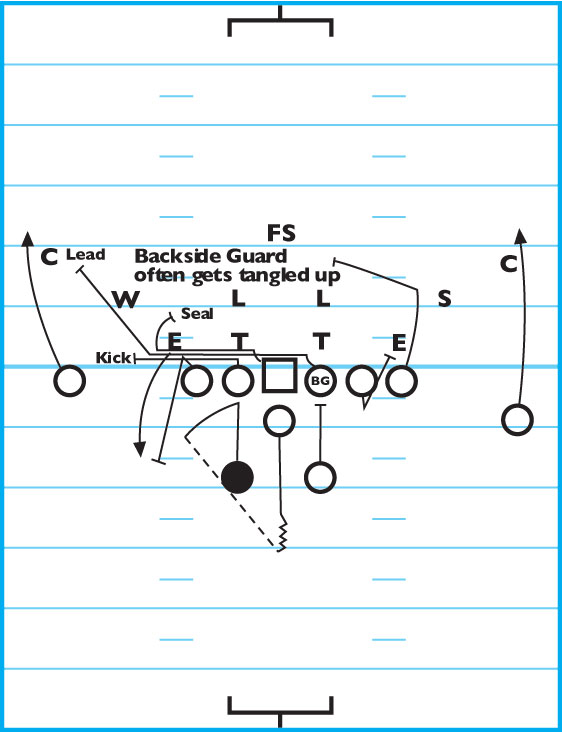
DIAGRAM 5: The TE does not have to stay with the man very long because the DE has a larger distance to cover to cause a disruption.
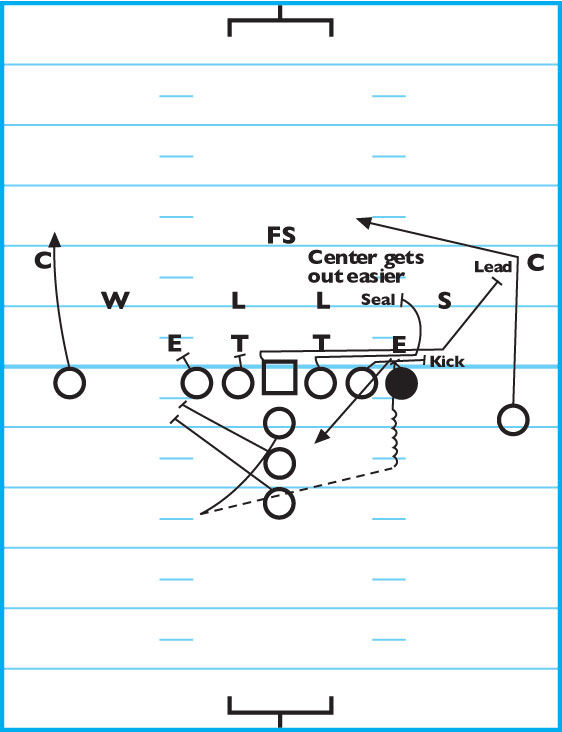
The other 3 linemen are the play-side tackle, play-side guard and center. All 3 linemen usually get downfield and escort the TE.
Mix Up Your Looks
Last season, our team had only one incompletion using the TE screen. The reason was that we ran the play from the same formation and motion as the previous week. The defense was able to read our alignment and the outside LB was sitting on the TE. Our QB did the right thing and threw the ball away (toward the TE’s feet.)
After this, we did not run the play again from the same formation or same motion twice in a row.
DIAGRAM 6: One back with motion.
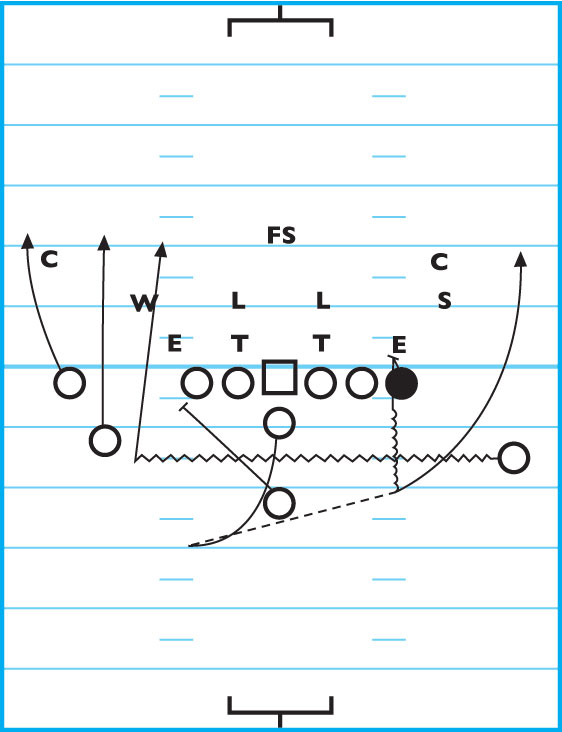
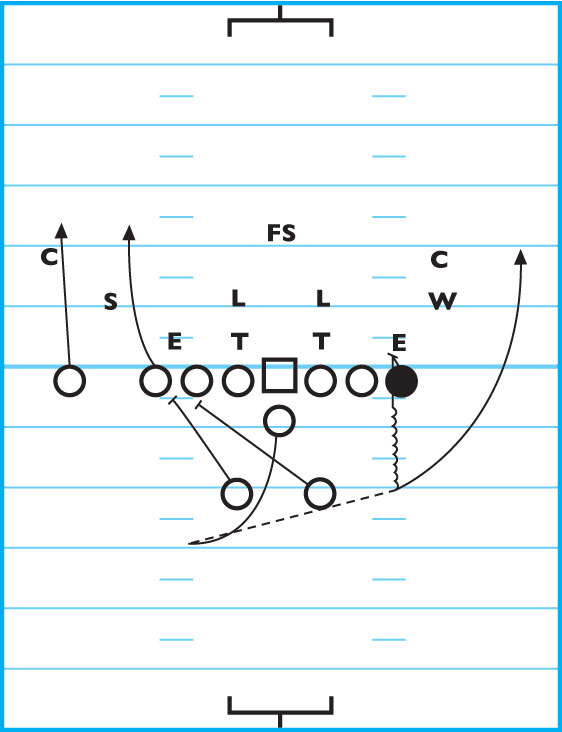
DIAGRAM 7: Double tight.
The screen package has been a great complement to our option game. It has a lot of carry-over value because the blocking is the same every week.
Considering the limited amount of time that we devote to non-option plays, the TE screen has been a highly productive play.