One of the true strengths of the Spin Offense is that it is a four back attack. The quarterback, either slot back, or the fullback, could potentially carry the ball. In order to provide more balance and keep the defense on their heels, we are going to be expanding the role of our fullback.
When we first installed the Spin Offense in the play-offs of 2001, we primarily used our fullback as a lead blocker or someone to fill for pulling linemen. He would occasionally receive a direct snap from center to run a hard dive. In addition, we installed a Spin Screen in which the fullback slid backside to protect the QB's blind side, then released for the screen pass (See Diagram 1).
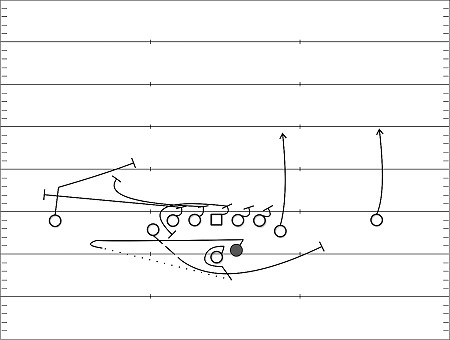
Both of these plays were effective complements to the sweeps, reverses, counters, and power plays that were the hub of the attack.
Meanwhile, as the Spin Offense began to grow in popularity, many coaches applied plays from their own offenses that included more fullback running plays. Through e-mails, phone calls, and face-to-face discussions at AFM University clinics this past winter, we became aware of other great plays that allow the fullback an opportunity to attack defenses. We are planning to install many of these plays for the fullback in our offense. Wing-T coaches will recognize two of these plays.
The new additions for the fullback in our Spin Offense are: The Spin Trap, the Spin G, and the Spin Draw. Let's look at each play.
The Spin Trap
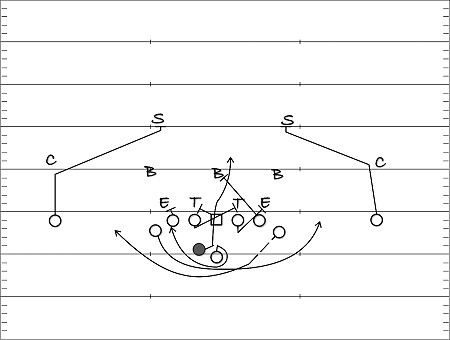
The Spin Trap (See Diagram 2) is literally just a blocking adjustment for the Spin Dive. The ball is snapped directly to the QB, but is intercepted by the fullback. On Spin Trap right, the right slot takes off in jet motion. He, of course, is aiming for the near hip of the QB. As he passes the QB, the slot will fake the Spin Sweep left. The QB will jab step with the left foot and execute the Spin Blast fake into the left B gap. The left slot will execute a spin reverse right fake. The fullback receives the direct snap and hits the midline patch as he hugs the trap block of the left guard.
This is a quick trap play for the line. The right guard gives a false key and blocks the first defender outside. The right tackle down blocks on the inside LB. The left guard traps first man play side. The center fills for the trapper. The backside tackle scoops play side. Both wideouts push vertical to the near safety.
The Spin G
The Spin G is an off tackle play for the FB when run to the tight end side. It will hit in the B gap when run without a tight end (See Diagram 3).
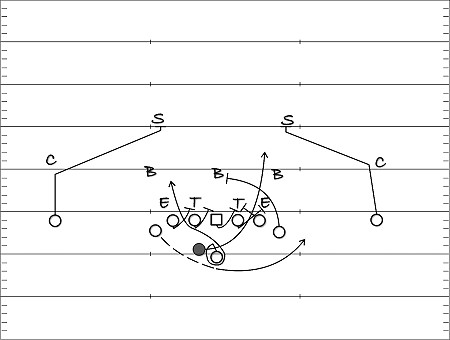
In this illustration, we are running Spin G right in the double slot formation. The left slot is in jet motion right. He is faking the sweep in order to occupy the over hang defender to that side. The QB is actually performing a 360-degree pivot back to the left B gap. This simulates a QB counter play. The right slot seals down on the first LB inside of him. The fullback intercepts the snap and hugs the block of the play side guard.
The play side guard is pulling and kicking out on the end man on the LOS. The play side tackle is coming down hard on the guard's man. If a tight end were being used, he would down block on the first man inside of him. The center is scooping play side, as are the backside guard and tackle. Both wideouts push vertical to the near safety.
The Spin Draw
The Spin Draw is a great way to take advantage of over aggressive pass rushers. This play looks like a Spin Pass Right. It really gets the defense pursuing one way with the ball going the other. We would like to run this play with one or two tight ends. This spreads defenders across the front and adds a blocker.
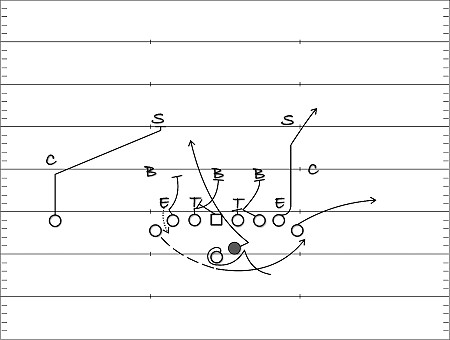
On Spin Draw Left (See Diagram 4), the left slot goes in motion to fake Spin Pass Right. The FB takes two steps to his right and pauses. The QB jab steps and executes a spin right. As he passes the FB, he uses his left hand to stick the ball into the fullback's right hand, which is positioned on the FB's right hip, palm side up. The QB then pulls up deeper to his right. The tight end on the right will release on a corner route. The right slot will release on a flat route. This sells pass to the near safety and corner back. The fullback can run to daylight from the center to the play side tackle.
The right tackle blocks the man over him or doubles down. If he is uncovered, he doubles down and then releases up on the LB. The right guard has the same rules as the tackle. From the center to the left tackle, the rule is to block man on, or fold block to the LB. If the left tackle has no tight end to his side, he pass sets on the rushing end, then clubs and rips to the LB. Any uncovered lineman has his eyes on a LB over him to take on a blitz. The backside WR pushes vertical to the near safety.
In addition to the plays in which the fullback runs the ball, moving his alignment and path on various plays affects the ability of the defense to key on the fullback as an indicator of where the ball is going. In this way, the fullback becomes a critical player in the success of the Spin Offense.
WHAT IF?
Q1. What if you’re facing a blitz by both outside linebackers? What adjustments, if any, would you make?
We have found that a play that really punishes the double safety blitz from both sides is the Spin Screen. It sets up spin pass, but when the fullback steps across to protect the backside edge, he bumps the rusher and sets up outside for the throwback screen. We've hit some big plays with that call.
Q2. What if you face a 3-Man Stack defense (rather than the four-man front in the diagrams)? How would you adjust?
We see a lot of the 3-3 stacks in recent years. First of all, we're probably going to be using sets with a true tight end. That would include our black (tight end wing to one side with slot opposite), our double wing, the wing end over, and perhaps some trips sets using a tight end. The other thing is we're going to use our FB as a lead blocker to that tight end side. This will be for the blast and power play.
Q3. What if your opponent is successful with a series of stunts and slants? Would your blocking assignments change?
The stunts and slants question is something we deal with on a regular basis. We will typically make a “Zone” call on perimeter plays against teams that are hurting us with slants and stunts. We want to secure the front and not allow the run-throughs, so we block our perimeter game like we would for a stretch play out of the off set I. Now the fullback is really important because he is the lone lead blocker coming out of the backfield. This season, we will also run some traps inside with the fullback to take advantage of penetrating linemen.
Dale Weiner is the Head Coach at Catholic High School in Baton Rouge, LA. He can be reached at DaleWeiner@GridironStrategies.com.