The 3-step boot game has been a staple of offenses I have been a part of since 2003 and has spread throughout the country. It is a simple concept and, once installed, is easy to adjust to fit offenses at every level.
The basic concept of the play is to have two pass plays in one. Lining up in a 3 x 1 formation, you have the single receiver run a choice route into the boundary. The quarterback (positioned in the gun) catches the snap, sets his feet to throw the boundary pass. If he doesn’t like it, then he goes naked out of the pocket to the field with another route concept.
The pass protection scheme is simple, as the offensive line slides to the boundary with each man blocking the gap to the boundary side. The running back aligns to the field and on the snap of the ball, he steps and pins the outside shoulder of the defensive end.
The reason for it being a great play for most offenses is that you can isolate your best receiver and give him freedom. With young quarterbacks, it gives them the ability to know one receiver without having to make a series of pre snap reads.
Overview
When we game plan as an offensive staff, we look for boundary numbers or soft defenders. In a 3 x 1 formation, if we get a corner on an island or a soft corner with a flat defender trying to help defend the run and the flat, then we know that this play will be in our game plan for that week. We feel that we can be more aggressive in calling this play since, if the QB doesn’t like what he sees, he can naked back to the field to his next progression.
When we first started running this play the receiver into the boundary always had a hitch. As he developed, we started to give him freedom to run any route he wanted. He would communicate via hand signal to the QB what he was going to do. This became the choice route part of the play.
To the field in a three-receiver set, we start with a general flood concept. The #1 receiver runs vertical, #2 has a deep out route and #3 slams down and then runs to the flat. Most teams have a flood concept in their playbook, so it’s easily re-used from practice. If we feel this route combination will be ineffective in that game, then we change it to another sprint-out route combination.
Coaching the Quarterback
The quick passing game is easy to teach to the quarterback from the gun. The QB should catch the ball and snap his feet to the boundary side. There is no drop because the first part of the play is a quick concept. We tell the QB, if the choice route is open, throw it. If it’s covered or there is a chance a defender can make a play on the ball, then pump fake and work back to the field. When throwing the choice route to the left, it’s fairly easy for most right handed QBs just to open their hips and sprint back to the field. However, when throwing the choice route to the right, some QBs prefer to flip their hips and come back around the long way to get back into a good throwing platform. The naked part of the play is always thrown on the run. The key coaching points are not to fade away from the receiver and attack downhill as you get later in the progression.
Coaching the Choice Receiver
If you have an inexperienced receiver, then just have him run a five-yard hitch. If there is a push from a flat defender (not the corner) then have the hitch gain some width so that the throw is a little wider. If there is a hard corner, then the hitch would convert to a fade. Early in the season, we tell the QB to bypass this throw because it’s a low percentage pass. As he gets better at it, he can work the back shoulder fade. As you get more experience with the QB and receiver being on the same page, you can involve more routes from your playbook.
Coaching the Offensive Line
We have the OL full slide to the choice receiver. We teach them not to give ground as the QB is not taking a drop. I emphasize being aggressive and keeping the hands down on the DL. The tackle to the field side cannot touch the defensive end. This is the running back’s man, so he has to slide and angle his shoulders away and protect his inside gap.
Coaching the Running Back
The running back has the hardest job when blocking for this play. He aligns to the field and on the snap of the ball wants to gain a little width so he can influence the defensive end inside on a direct course for the QB. He then pins the outside shoulder of the defender allowing the QB to escape back around this block.
Variations
As with all plays, you can create variations with ease. You can run the play from a 2 X 2 set just by crossing the #2 receiver across the formation as he would on a naked play-action pass.
Here are four specific plays out of this offense you can add to your offense:
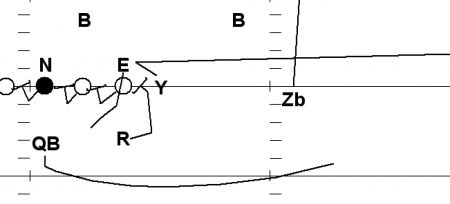
Diagram 1 – RB Block - The back should cheat for width in his alignment and on the snap, gain a little more width to invite the inside rush from the DE. This allows him to hit the outside shoulder of the DE, giving the QB a clean edge.
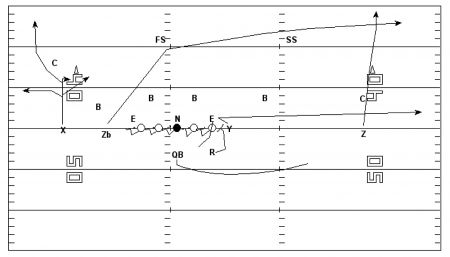
Diagram 2 – 2 x 2 Hitch Naked - The naked rules are followed and have multiple variations.
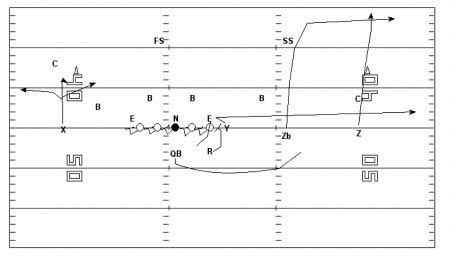
Diagram 3 – 3 x 1 Hitch Naked - The cleanest way to install this play is from a 3 x 1 set that allows the quarterback a good look pre-snap at the flat defender.
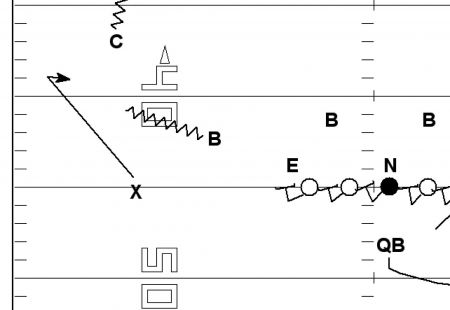
Diagram 4 – Hitch Route - This allows the choice receiver to gain width and widens the throwing lane for the QB away from inside flat defenders. Against a hard corner, the play is converted to a go route.
The hitch naked series is a simple concept and a great way to have a quick passing game without a lot of teaching in terms of reads and progressions. p
About the Author: Rich Worsell is starting his second season as the offensive coordinator at the University of La Verne. He previously spent three seasons as the offensive coordinator at Illinois College. Worsell also coached at Millikin University and Lakeland College.