Tale of the Tape
Tanner Engstrand
University of San Diego
Offensive Coordinator
- 10 years on USD staff
- Serves as Assistant Head Coach, OC, and QBs Coach
Ned Panfile
Mendham High School (NJ)
Defensive Coordinator
- Coached for 31 years - 29 at Mendham High School
- Been a part of 6 conference championships at Mendham
Do you have a general philosophy or strategy for your goal line offense?
Engstrand: We consider the goal line to be from the +4 yard line in. My general philosophy on the goal line is that we want to be a physical team and be able to move the LOS to gain the few yards needed to run the ball in. We generally like to be in a heavy set inside the 4-yard line. We use ‘U’ personnel (22) often in these situations.
Do you have a general philosophy or strategy for your goal line defense?
Panfile: Yes, we teach goal line defense as a penetrating/ attacking defense with press man behind it. We only use our goal line defense from the 2-yard line in and we avoid it on two-point plays. We tell our kids we have to re-establish the line of scrimmage at least a yard behind where it starts. We are locked on receivers once we find who we are covering.
Do you have a set offensive scheme that you use for goal line situations?
Engstrand: We like to use gap schemes in a myriad of formations to get the desired defensive look and result that we want. However, if we do not feel we are having success running the ball, we will go ahead and put the ball in the air by finding a good one-on-one matchup or quick play-action pass.
Do you have a set defensive scheme that you use for goal line
situations?
Panfile: We call the scheme “Smoke”. We are still a gap control defense in Smoke. There are four D-linemen positioned in the weak A gap (the tilted nose pushes the center into opposite A gap), B, and C gap, either side. We teach them to “submarine”. Stance is having the facemask as low to the ground as they can get and rear end is high in the air, elbows bent to the outside. They are to attack the shins of their gap offensive lineman and then rise up from the ground. Our Sam LB is in the strong A gap, playing QB sneak and then run. His depth is in direct relation to the distance to the goal. The closer they get, the closer he gets. Mike LB is in weak B with the same rules as Sam. Mike LB is what we call the adjustor LB. If in one-back, he goes to cover, while Sam stays inside. The outside linebacker and free safety are coming off the edge, attacking the near leg of the near back. Corners are locked on #1. The bandit (Strong Safety) is going to #2 receiver to the strength side and is in his face and sits inside shade. His job is to lock up on #2 so as to control the gap he is in.
Do you use an up-tempo, no-huddle offense when you’re at the goal line
or a more traditional huddle?
Engstrand: We have been more traditional down on the goal line to minimize mistakes by our players. However, we have been known to occasionally run in extra offensive linemen rather than WRs or TEs down there and go as fast as we can.
How do you stop an up-tempo, no-huddle offense when you’re at the goal line as opposed to a more traditional huddle team?
Panfile: We pressure from the edges. Unless it’s a zero backfield, we are able to bring two edge players in every situation.
On a third down play from the three-yard line or further in, what are you looking for from the defense?
Engstrand: When we break down a defense in this type of situation we look for a couple of things. First, are they a blitz team playing man coverage or are they a zone team using specialty coverages such as cover 7 (picket fence). Secondly, do they change personnel to match our personnel and run a goal line 6-2 defense or do they keep base personnel in. From this information, we will formulate what our best course of action will be. Do we have better matchups throwing the ball or running the ball? (Included is a run and pass play we use - Diagrams 1 and 2).
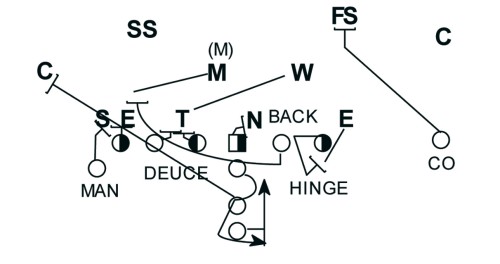
Diagram 1: Run Play - (U) Green LT West 93 Power King
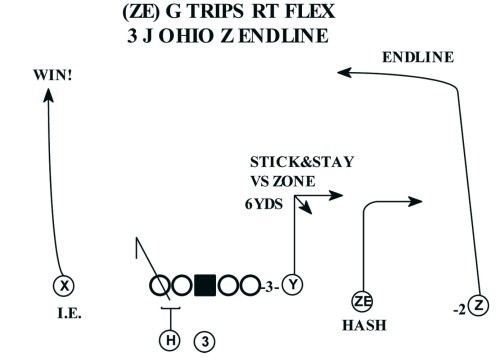
Diagram 2: Pass Play - (ZE) G Trips RT Flex / 3 J Ohio Z Endline
On a third down play from the three-yard line or further in, what are you looking for from the offense?
Panfile: It depends on the team. I tend to look for mainly what they do best. I feel in high pressure situations, coaches revert back to what they feel their team is most comfortable with, whether it is a run, play-action pass, option, spread play, etc. On third and short or goal to go, they will run a play that is in their comfort zone because the advantage for fourth and goal shifts to the defense and kicking a field goal is a win for the defense.
Assuming you have to go for the touchdown on fourth down, what are the keys for your quarterback and offensive line?
Engstrand: To start, this is basically a passing situation for us assuming we are not on the one-yard line. Keys for the QB will be to first identify the coverage. Are they playing man or zone? From there he must decide which side of the pass concept to work. We will generally have a man side and a zone side down on the goal line. After that, he has to play the play and not force the ball or turn the ball over. He must know that he can extend the play with his feet if he gets fooled or things don’t go exactly right. A key for the offensive line are that they must be ready for a heavy blitz and twists up front. They must be gap sound and know their assignments.
Assuming the offense is going for the touchdown on fourth down, what are the keys for your D-Line, linebackers and defensive backs?
Panfile: Nothing changes on fourth and goal. The less we think about, the more we get after them. I believe fourth and goal is an advantage for the defense. I don’t want them thinking a lot at that point. I want them to play on raw emotion and effort.
With a first and goal situation, would you consider using a trick play? What about on second, third or fourth down.
Engstrand: First and goal is a great position to be in. I am not generally a trick play guy inside the 10-yard line. So we will generally just operate our Low Red Zone (+9 to +5) and goal line (+4 in) offense. If I were to use a trick play I would rather do so on first or second down to make sure I have another down to get the score if the trick play does not work.
With a first and goal situation, how would you defend a trick play such as a double reverse? Would your strategy change on second, third, or fourth downs?
Panfile: This again plays out on the position of the ball and goal. We will try to practice all red zone areas – 10-20 yard line, 7-9 yard line, 3-6 yard line and finally, 1 and 2 yards out. The further out, the more likely we are going to go to our Red Zone Package to defend them. That is where the cover people don’t pedal and play at half the distance to the goal. We practice at least three trick plays every time we have team defense and emphasize the obvious trick play rules That is, play your position, find work, and don’t chase to the other side. On the goal line, we teach our blitzers, if they see the QBs back to idle down, look for a counter or reverse and then run up the QBs chest for the boot play. The blitzers are also taught that if the near back opens to you, they must collision him. We are locked with all other cover people.