The ‘Power’ running game series, popularized by former Washington Redskins Coach Joe Gibbs, is still dominant in the NFL and major colleges today.
To this day, the leading single game rusher in Super Bowl history is Timmy Smith who ran for 204 yards and two touchdowns in Super Bowl XXII. All of his yards came on the ‘counter’ which is the key play in a Power series. The third leading single game rusher in Super Bowl history is John Riggins who ran for 166 yards in Super Bowl XVII in the same offense.
In teaching offensive line play in this series, the following must be stressed:
1. WHO (who to block) and
2. HOW (how to block)
You must spend as much time on ‘Who’ as you do on ‘How’ because a poor block on the right man is better than a good block on the wrong man!
Here are some coaching points to remember when teaching the Who aspect of the Power run series:
The blocking on all five plays is constant from on tackle to off tackle. Only the TE (Y) halfback, and off guard change men according to the play. The rules for on tackle to off tackle are as follows:
A. On Tackle and On Guard: If the inside teammate is uncovered, combo with your outside teammate from man on you to the backside LB. If your inside teammate is covered then combo block with him from man on him to the backside LB.
B. Center: Block the first man on the LOS away from the point of attack.
C. Off Guard: On the counter play, pull and trap the EMLOS. On all other plays in this series, pull and turn up through first daylight to seal the playside linebacker.
D. Off Tackle: He squeezes the B gap and hinges back on pursuit.
The following are the five basic plays in the ‘Power Series.’ Each will be shown vs. an ‘over’ (reduced strong) and an ‘under’ (reduced weak) look which constitutes about 75% of what you will see on most levels. The ball handling and steps for both the quarterback and running back are the same on all five plays.
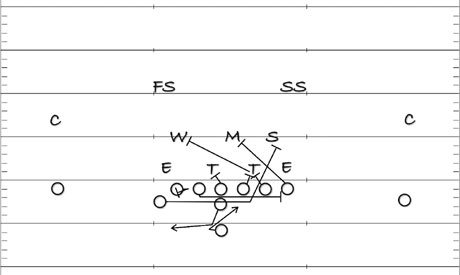
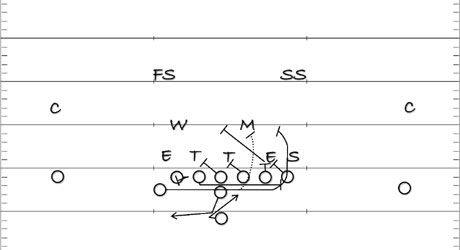
#1: 60 Counter
(See Diagrams 1A and 1B)
|
Diagram 1A: 60 COunter (over)
|
Diagram 1B: 60 Counter (under)
In this play for the tight end, if the on tackle is covered, he down blocks the defensive end. If the on tackle is uncovered, the tight end goes through to the offside linebacker. The halfback pulls and turns up to seal the inside linebacker. If the linebacker runs through, trap him. The off guard in this play pulls and traps the EMLOS.
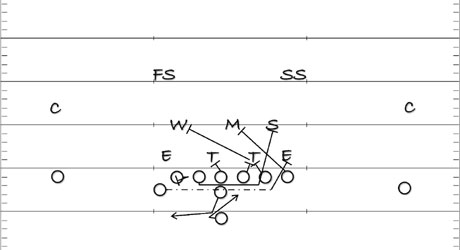
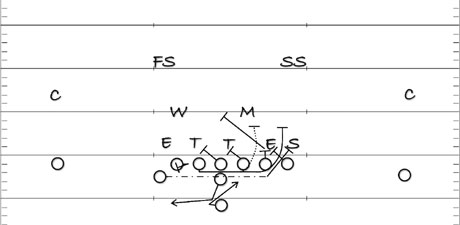
#2: 60 KIK
(See Diagrams 2A and 2B)
|
Diagram 2A: 60 KIK (over)
|
Diagram 2B: 60 KIK (under)
The blocking assignments for this play are the same as for the counter except for the off guard and halfback. In this situation, they trade blocking assignments.
#3: 60 Power
(See Diagrams 3A and 3B)
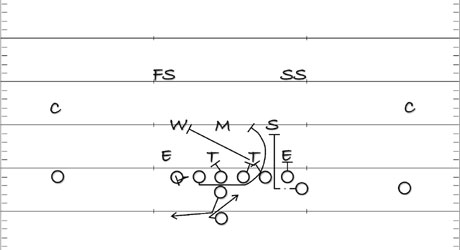
|
Diagram 3A: 60 Power (over)
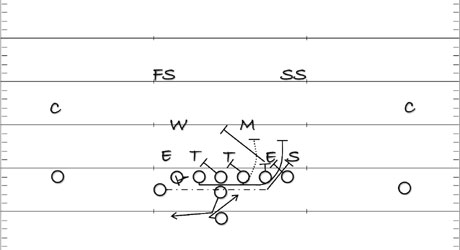
|
Diagram 3B: 60 Power (under)
All the blocking assignments are the same as 60 counter and 60 KIK except for the following: the tight end blocks the defensive end wherever he lines up; the halfback blocks the playside linebacker; and the off guard pulls and seals through the first daylight looking inside to block.
#4: 60 BIM
(See Diagram 4)
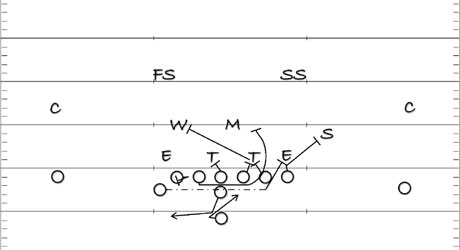
|
Diagram 4: 60 Bin
All blocking assignments are the same as in the three previous plays except for the following: the tight end bluffs the defensive end and turns out on the outside linebacker; the halfback blocks the EMLOS; and the off guard has the same assignment as in 60 Power.
#5: 60 Power-Load
(See Diagrams 5A and 5B)
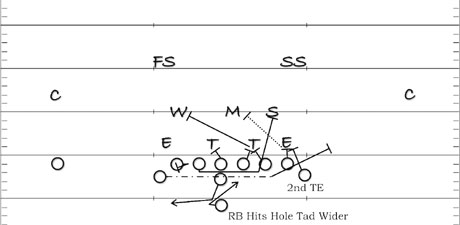
|
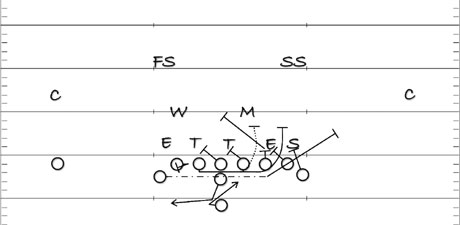
Diagram 5A: 60 Power-Load (over)
|
Diagram 5B: 60 Power-Load (under)
The blocking for this short yardage and goal line play is the same as 60 power except for the following: the flanker blocks the EMLOS but if the on tackle is uncovered, he combos with the tight end to hit the offside linebacker; and the halfback kicks out for run support.
These five plays have been drawn from both double and trips formations but can be run from any set whether a one-back or two-back set. Along with the zone series it gives you a simple but complete running game.
If you have any questions you can email the author at: BillMountjoy@GridironStrategies.com.
Game film supplied by Holy Spirit High School
in Absecon, New Jersey.
WHAT IF?
Q1. What if there is a safety blitz against the ‘60 Counter Play?’ Do your blocking assignments then change?
Whatever gap (A/B/C/D) the safety comes through is accounted for – since you are “Building a Wall to the Outside”; that is, the front side from the TE back to the center is the “blocking back.” The safety will get “caught up in the wash.”
For an onside situation, if the safety blitzes the A gap, the on guard gets him; if he blitzes the B gap, the on tackle gets him; if it’s the C gap, the On TE gets him; and if it’s the D gap, the kick out man gets him. If it’s offside and the safety blitzes the A gap, the center gets him; if the B gap, the off tackle gets him and so forth.
One of the factors that helps our offense vs. all blitzes, twists, etc., is the fact that our O-Line lines up as far off the ball as possible (helmets on the center’s belt). We also split only 18” (which limits the size of the gaps we have to block). We feel that big splits allow for big penetration.
Q2. What if, for whatever reason, the defense is smothering your running game and you need to install an option pass. What would be the individual assignment routes?
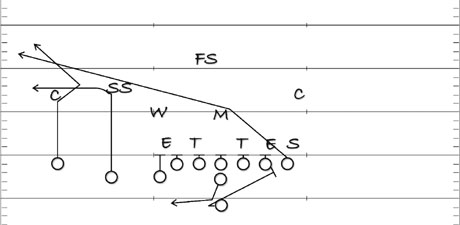
I’ve included a diagram of the best pass off of the Power/Counter running offense. In this play the quarterback has the option of throwing : 1) to X; 2) To Z; 3) To Y; 4) or running with the ball (See Diagram).
|
Counter Pass Left
Q3. What if you face a 3-3 Stack defense? What would be the blocking assignments for the counter or power play?
The TE is on the tackle and ‘treys’ from a 4 technique to the MLB. After two quick steps getting hip to hip and shoulder to shoulder, they vertically double team the 4 technique. Then, if the 4 pinches inside, the on tackle takes him and the TE will come off for the MLB. He takes the stacked LB beyond the 4 only if he crosses his path to the MLB. If the 4 loops out, the on tackle comes off to the MLB (taking the LB stacked beyond the 4 only if he crosses his path to the MLB). The TE stays on the 4.
The on guard blocks down on the nose if the nose goes offside, the on guard picks up a possible MLB blitz in the gap as you ‘build a wall’ to the LB stacked behind the 4 technique.
The center blocks back offside to whomever is in the stack as the off tackle comes inside aim for the 4 technique and then adjusts.
The off guard pulls and wraps around the TE’s block for the LB stacked behind the 4 technique on the on tackle. If someone from the stack on the tackle penetrates outside the TE’s block, he is trapped. This play often becomes a double trap.
The off tackle steps to the B gap to in case the 4 technique. Or, if the LB behind him blitzes, the off tackle gets a quick shot at him and gives the center time to get there.
The ‘H’ motions to the playside B gap. He kicks out the first man to show outside stack on the TE side; that is, the most outside LB on the tight end.
Q4. What about the ball handling for the quarterback and running back?
It’s the same on every play in the series. Or the QB, if the play is called right, he opens out at 7 o’clock and hands off to the running back. He then fakes a bootleg opposite the point of attack. The running back takes a jab step opposite the point of attack. He hits downhill to the butt of the playside guard. He then looks to cut from the A gap to the B gap to the C gap while following behind the butt of the ‘wrapper.’