The “Perfect High School Offense” is a pretty arrogant title from an offensive coordinator at a 4A school in southeast Missouri that finished the 2008 season at 5-5. My goal is not to be arrogant, but rather to summarize my offensive beliefs after 14 years of coaching, three of those as a head coach, and this past season as offensive coordinator at Sikeston High School. I am also being reflective in what we did well, as well as what we need tweaked in running our fly spread offensive attack. I am thinking about what is the best and most feasible offensive scheme for a high school program.
My Background
If there is anything that qualifies me to talk about this topic, it is my coaching background. I have coached for 14 years and in that time I have moved around several times. In my coaching journey, I have coached in the following offensive systems: pro style, dead T, one back, wing T, veer option, spread, and double wing. During my three years as head coach, I ran the double wing offense and, while I like that offense, I left the experience thinking that at a high level of high school football, it is not possible to just sit in the double wing and be stubborn. This past season, I joined my football mentor, Kent Gibbs, at Sikeston High School. We worked together to put in an offensive scheme that matched our players and fit our personalities. Kent has run the I for most of his coaching career and I am an oddity of sorts, being a double wing, spread, and fly coach.
Which Offensive System is Best
The spread offense is the latest fad and it comes in many different flavors. The wishbone, featuring the triple option, was once unstoppable. The wing T has stood the test of time and forces defenses to defend the whole field. The old Houston veer option is still the basis of many solid high school programs. Don Markham’s double wing holds the national record for points per game in a season. If you have a great I back, solid fullback, and offensive line, you can line up in the I formation and be successful. The NFL has become the West Coast Offense League. The run ‘n shoot pioneered passing offenses. The new A-11 offense may be the next phase of offensive football even though my guess is that it will lead to a rule change before it does. And, of course, everything can be traced back to the old single wing. And the truth is that, if you coach well, get your kids to buy in, and execute, you can win in any of the systems described.
My contention is that the perfect high school offense is a little bit of a combination of all these offenses. At Sikeston, we want to have a scheme that:
• First allows us to run the football (we don’t believe you can win championships without being able to run the football).
• Forces the defense to defend the field both horizontally and vertically. Another way of saying that is to not allow the defense to cheat by adding people in the box or defend just the run or pass.
• Includes high percentage passes.
• Allows us to have balance and put our players in space.
• Can be adapted to our players’ best talents.
• Lets us control tempo.
• That when opponents watch film they say, “How are we going to defend all that and rep it on scout team?”
• Most importantly, gives an offense that puts points on the board.
To accomplish these goals we believe we need to include the following:
• Multiplicity in the run game (fly, zone, power, and counter out of multiple formations).
• Misdirection in the run game (accomplished with fly motion).
• Power in the run game (power and double wing packages).
• Enough option to keep the defensive games to a minimum and steal practice time.
• Play action (boot and flood).
• Easy throws (quick game and screens).
• The ability to stretch the field with a spread passing game (four verticals, smash, and All-American concepts).
• Enough deception to steal points and steal opponent practice time.
I believe that if you can teach, practice, and execute this, you have the perfect high school offense. This is a tough task to accomplish but we believe it can be done. Minus the option scheme, we accomplished this last season and averaged 34 points per game.
There are key points to remember to make this all possible with limited practice time in high school. Two platoon if numbers permit you to do so. We are currently not able to do this at Sikeston but with some success we think we can get to this point. Run the no- huddle. We ran the no-huddle this past season and believe that we have to make some adjustments to help our defense in order to win more games. Just remember that running the no-huddle does not always mean you are at an Indy or NASCAR tempo, but rather that you can slow the offense down or use the look tempo to see what the defense is doing. In my opinion, the best part of running the no-huddle is the reps you get in practice. A third key point is to keep it simple for the linemen.
Just Run It!
The best run play I have ever coached was the double wing power and its cousin, the power O. The best complementary run play is the counter trey scheme which, of course, is a staple in the double wing and the I offenses. The run play that I think is the hardest to defend is the triple option. The run play that allows offenses to be the most multiple is the zone. And the play that allows you to set up all of those other plays plus gives you a home run threat in the running game is the fly sweep. So, our plan at Sikeston will be to implement a little of each. Sounds like a daunting task, but we ran all of the above this year and plan to use zone blocking schemes to allow us to run the option looks off of what we already do.
The fly sweep forces defenses to defend the field horizontally. It also slows down defensive reads when you fake it, setting up the rest of the run game. We choose to operate from the gun most of the time although we will go under center as well. The structure of our offense is based on spread offensive formations which we believe force the defense to be spread thin by alignment (See Diagram 1). 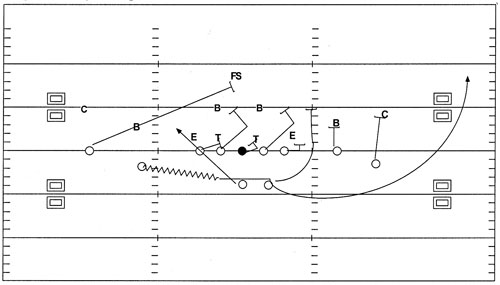
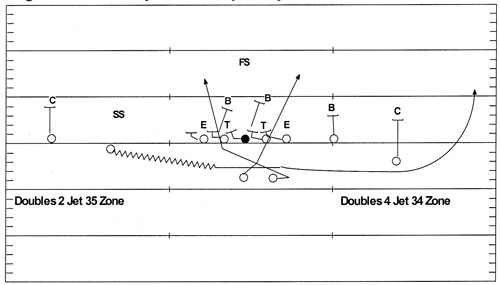
Once you force the defense to adjust to stop the fly sweep, the base play away from the fly sweep will be the zone play. The fly action will hold the backside DE and should prevent the zone from being caught backside (See Diagram 2).
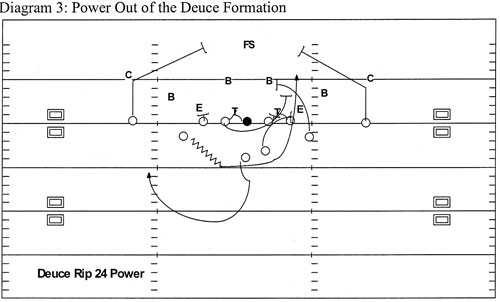
While the fly and the zone are great plays, they are also both finesse plays. Teams that cannot run the ball in a power run game will struggle in short yardage and goal line situations. The mistake a lot of spread teams make is not having a short yardage under center set. So we will use the double tight double wing as our short yardage and goal line set. We will run the power out of several sets and will run it as part of the fly series as well. The power is shown out of our deuce formation (See Diagram 3).
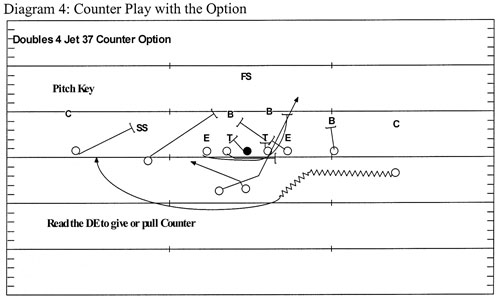
The best play in this offense may be the counter. We run the counter in multiple formations and with multiple motions. Once the defense begins to adjust to what you are doing on offense you can hurt them with counter and hit a big play. In the scheme below (See Diagram 4), we combine the counter play with option.
Airing It Out!
I mentioned earlier that we want to achieve balance. We don’t necessarily define balance as being 50/50 run-pass. In fact, we would prefer to run the ball at least 60% of the time. We want to define balance as being able to get the ball in the hands of all our playmakers. This can be accomplished in our run game, but the passing game allows us to force defenses to defend the whole field while spreading the ball around.
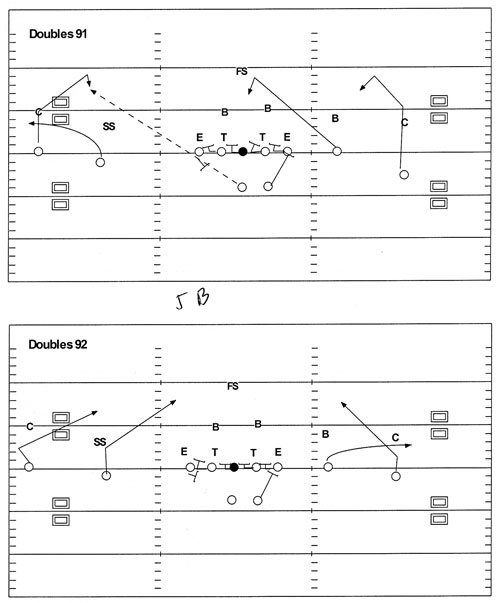
The spread offenses have gotten very good at running passing schemes that are effective against multiple coverages, are easy to teach, and provide both deep shots and easy throws. This is why we have chosen to use the spread packages as our base passing offense. The quick game is all curl and slant (See Diagrams 5a and 5b):
As far as 5-step or 3-step out of gun passing schemes, we use three common schemes. Four Verticals (Diagram 6), Smash (Diagram 7), and All American (Diagram 8) are concepts that most spread teams run in some form.
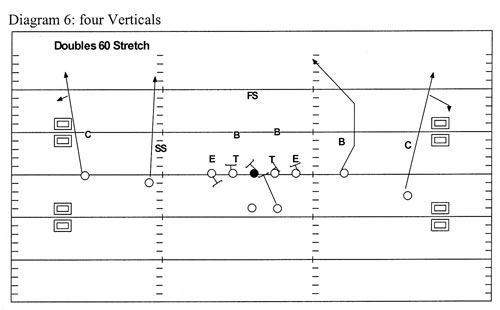
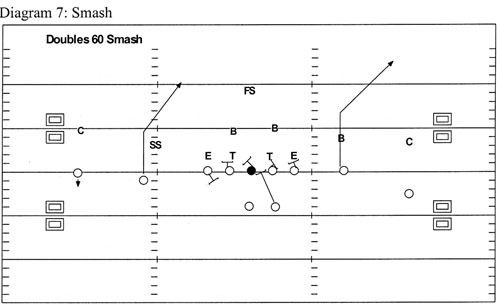
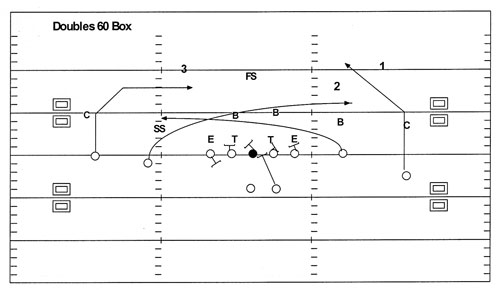
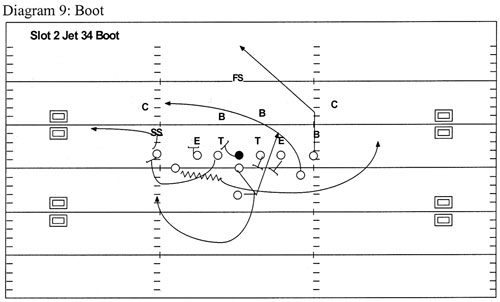
All of these schemes are common and can be learned on the internet. With all that said, our best pass play is the boot. Because of how we run the offense and our run-first mentality, play action is the best way for us to throw the football. Our best play action pass is the boot (See Diagram 9). This is really the wing-T waggle which is a great pass play that has been open at all levels for years.
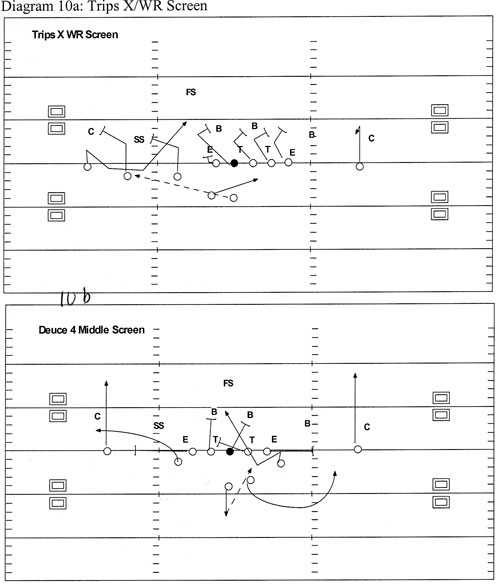
The perfect high school offense has to include a screen game. The ability to screen defenses takes away aggressiveness, gives you an option in hard-to-call downs, and a chance to create big plays on easy throws. Screens tend to be, much like the option, high maintenance plays that take time to be successful. Two of our screens are diagrammed here (See Diagrams 10a and 10b).
In terms of the passing game, there are many ways to be proficient. I do believe that to win at the high school level you have to be able to throw the football. I know the spread passing game well and chose to use it in the design of our offense. My contention is simply that the perfect high school offense contains a way in the passing game to attack the defense down the field, in the flats, and across the middle while handling multiple coverages with simple reads for the QB.
My challenge as offensive coordinator is to be able to do all that we have talked about without doing too much. If we tried to do everything, we may not be good at anything. In order to accomplish this, I will not try to run every play out of every formation, but rather pick the best formations in which to run each play. As the season goes on, we can break these formation tendencies. The use of wristbands that are individualized by position helps make the learning curve easier. Most importantly, we work to get as many reps in practice as possible. As coach Steve Spurrier said, “It’s not what you know, it’s what you can teach your players.”
About the Author: Mark Jackson is currently the offensive coordinator at Sikeston High School (MO) and is in his 16th year of coaching. He previously was the offensive coordinator at Seckman High School (MO) and also the head coach at Center High School in Kansas City. Last fall, the Sikeston offense totaled 5.491 yards and averaged 35.6 points per game.