The most successful plays tend to be plays with an element of deception built in to the design. Like just about all the football out there, these plays are derived from “research” or “stealing” (your choice of words) from other coaches. A lot of this came from the Florida Gator offense of the 1990s. One time Steve Spurrier assistant Buddy Teevens and G. A. Mangus were nice enough to talk football at clinics we attended. The lead draw is a run that looks like our favorite passing package. The value of the lead draw passing game is it puts pressure on the underneath coverage linebackers to stop the run but then bail to depth to cover the pass.
The lead draw passing protection is simple and solid, aided by the threat of the draw slowing down the pass rush. The offensive line blocks double fan, with both guards on the number one defensive lineman to their side of the ball, both tackles on the number two down lineman on their side of the ball, and the center on the MLB. From the I backfield, the fullback will hop step left and the tailback will hop step to the right. Both will count one thousand one as they check the OLB to their side for blitz. If the OLB is not blitzing, they will proceed to a spot about five yards downfield just outside of the tackle box. The tailback will receive the ball fake of the draw on his way into the line of scrimmage. Both backs are told to look for any offensive linemen in need of quick help on their release to hook up.
The QB is coached to look for safety movement on the first three steps, turn for the draw fake, and to look through his fake hand as it follows through with the fake and visually acquire the key defender for the route read. On both routes illustrated, the QB would look through his fake hand to find the depth and movement of the safety to the side of the skinny post. If that safety is not getting depth, then look to throw the skinny post. On the skinny post, we want the wide receiver to win the inside of the corner on a vertical push, and then let the QBs throw lead him to the hash mark. Our goal is for the ball to be caught on the hash about forty five yards downfield.
If the safety is dropping deep, then look for the intermediate route coming across in front of the safety. On the route named “Skinny” (See Diagram 1),
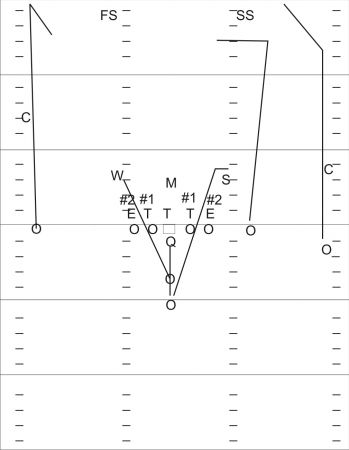
we coach the intermediate route to push to about 12 yards and square in, looking for a window between the linebackers. On the route titled “Bolt” (See Diagram 2),
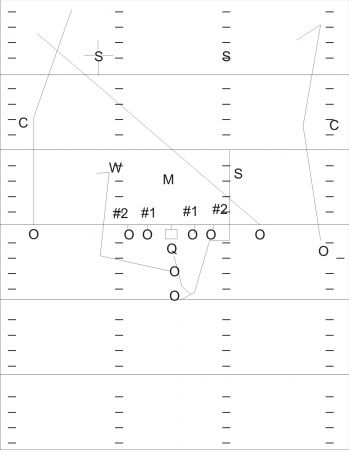
the receiver “bolts” across the formation at an angle that would run him out of bounds at about 20-22 yards downfield. A possible wrinkle for the receiver working across is to have the receiver build a step into the route with a short vertical break to shake any possible man coverage. We tell the QB if there is a defender in the way of the intermediate route, check down to the appropriate back hooking up. The back’s routes can also have tags that allow them to either break to the flat or cross each other to rub off potential man coverage.
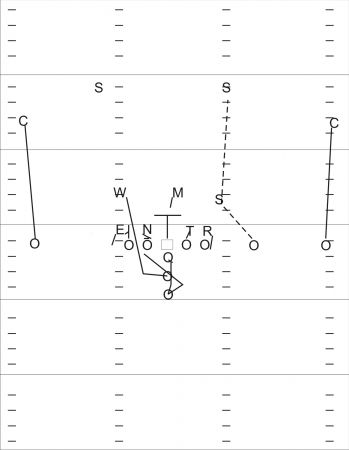
On the lead draw, the OL has the same blocking assignments and pass set posture. On the count of two, the left guard and left tackle take the hand away from the gap of the rushing down linemen and try to punch the near bicep of the rusher so as to widen the running lane for the back. The fullback hop steps to the left, counts one thousand one, then lets the rush of the down linemen open his path to his assigned linebacker. The tailback hop steps right, counts one thousand one, receives the hand off about five yards deep on the QBs right, then cuts back to the open gap on the left side of the line of scrimmage. The QB should try to accelerate a three-step drop off of the mesh point to sell pass to both the linebackers and defensive backs (See Diagram 3).
Q1. What if you face a consistent blitz in running the Lead Draw/Passing Package? Do you make any adjustments in your blocking?
As long as there is a FS deep, we feel we can stay with the blocking package as designed. We tell the backs that if they feel their LB is coming, they can attack them on the snap with the understanding that the point of the fake was to get the linebackers to step up, which their blitzing posture has done. If there is an eight-man blitz (no FS), we will check out of the play (we think screens, speed option, and sprint out).
Q2. What if your opponent runs a 3-5-3 (rather than the 4-3 depicted in the diagrams)? Do any responsibilities change?
As long as there is a FS, we feel we can pick up the seven potential rushers. Against a 4-4, the TB has the inside linebacker to the offense's right, the center has the inside linebacker to the left, and the FB checks the SS/W away from the two receiver side.
Against a 3-5, the TB has the stacked linebacker to the offense’s right tackle, the right guard has the stacked linebacker over the NG, the left guard has the stacked linebacker over the left tackle, and the FB has the “spur” to the offense's left.
Q3. What if the defense is successful with a combination of stunts and twists? How would you adjust?
We find that stunts and twists are a feast or famine deal for the defense in that for every time the defense makes a play, they also can twist themselves into a gaping hole for the offense.