WHEN YOU NEED a play that can get your offense those must-have yards, the “Iso” can be a simple-to-run, yet dangerous weapon for your team.
When we run the Iso, we find situations where it can be run between the guards. Some defenses won’t allow this, so your players must be prepared to deal with anything that’s thrown at them.
We run the Iso mostly from “two tights” (or a slot set) so the defense is forced to balance up its alignment.
DIAGRAM 1: The Iso Vs. Split 6.
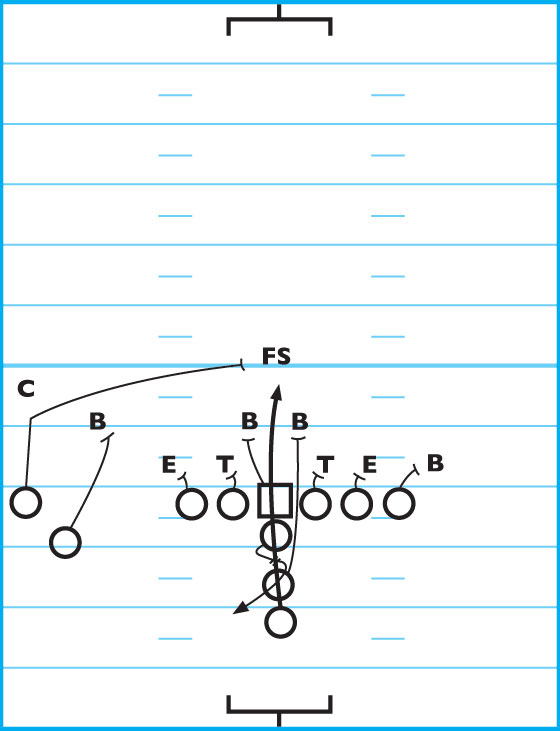
Our team faces many split-6 defenses, which means we see a lot of 3- and 7-techniques. To this type of front, we’d check to a “40-Iso” call to take advantage of the angles.
- Offensive Guards. The OGs block their 3-techniques out (a fan block).
- Offensive Tackles. OTs perform a quick combo with the tight end on the 7-technique and the outside linebacker just in case of an X-stunt.
- Center. The center takes the predetermined inside LB that you feel he matches up with best. Determine this well in advance and teach him his assignment during the week’s practice.
The only exception would be in case of an A-gap blitz (toward either A-gap). In that case, the center picks up the most dangerous threat.
- Quarterback. The QB takes a 7-o’clock step to clear a path for the FB.
- Fullback. The FB must react to the center’s block and be prepared to attack either inside backer, clearing a path for the ball carrier.
Iso Vs. Split-6 Adjustments
The first adjustment the split defense can make to this (and we see it a lot) is to put one of their inside backers down at nose and stack the other behind him. In this instance, we’ll still run the 40 Iso. Everyone’s blocking rules remain the same.
The nose has now become the most dangerous threat to the play, so you must tell the center to take him where he wants to go. The FB reacts to the center’s block and blocks the other backer.
If the split defense gets in a 1- and 3-technique, we’ll check toward the 1-technique. The play-side OT and TE perform their quick combo block on the end and outside backer (if necessary).
The FB is responsible for the play-side LB and needs to be prepared for any blitzing that might put his backer in a different gap than expected.
Iso Vs. Odd Fronts
Against an odd front (we also see quite a few 5-2 and 5-3 defenses) we like to check away from any shade on our center.
DIAGRAM 2: Iso Vs. 5-2.
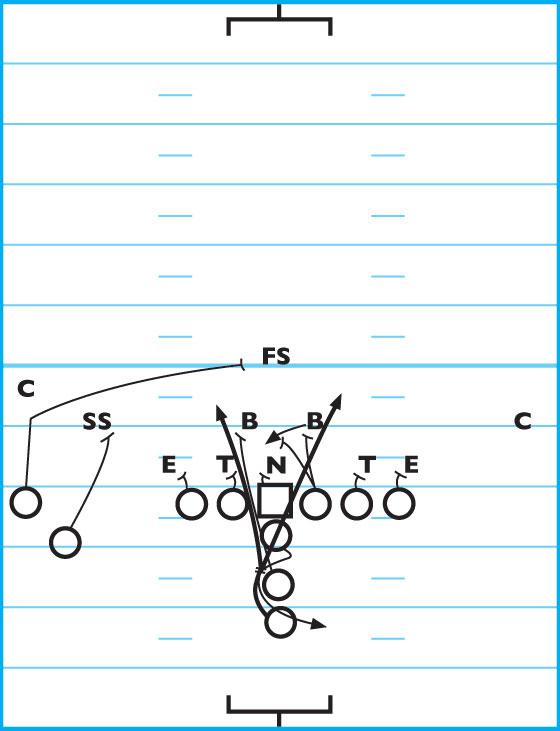
DIAGRAM 3: Iso Vs. 5-3.
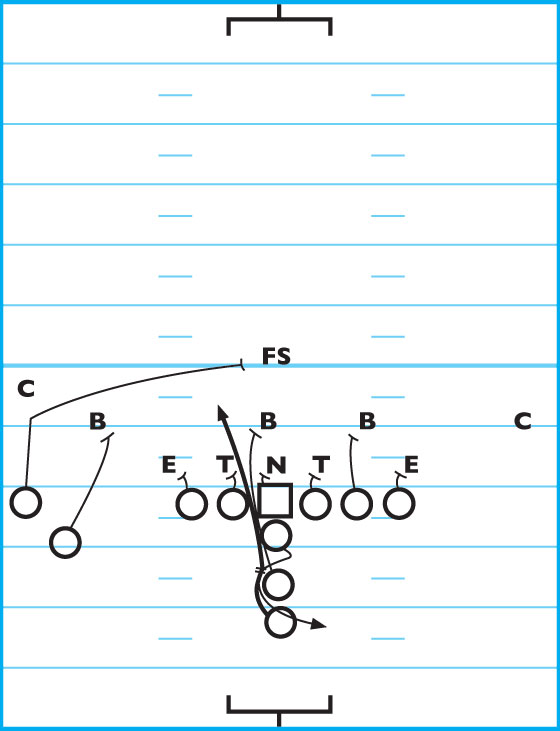
A big key for the FB and tailback is the play-side OT’s block. They must read his block as they approach the LOS. We tell the backs that it may be a wide block if the DT is in a 4-technique.
Something else that’s vital to the success of this play is the TB’s ability to find the seams and hit them while running full speed. Instruct him that the seam may be in the backside A-gap because of an overpursuing LB. He doesn’t need to have the mindset that he must always follow the FB.
If the odd front gets in a head-up nose alignment, then you would check to the stronger side of your line or to a weak point in their front. Everyone’s blocking rules remain the same.