This is a two part series on the inside zone. The first part of the series will discuss the inside zone philosophy and using the number identification system. The second part of the series will discuss specific drills and how to practice the fundamentals of the inside zone scheme.
Using a number identification system helps promote confidence along with the physicality we desire as a football team by allowing us to explode off the ball to and then through a defined defender. It allows us to get a “hat on a hat” to the proper defender vs. any front. Based on the defensive front, there are times when an uncovered lineman on the first level is also uncovered by a linebacker on the second level. As an offense, we are very multiple in formation and personnel, and the more multiple you are, the more looks you will see. The number identification system leaves no doubt as to what defender the offensive lineman is to work to vs. any front. We ran a form of our inside zone scheme a total of 226 plays for 1,197 yards and a 5.3 yard average in 2012.
INSIDE ZONE PHILOSOPHY
• Allows a defense to be blocked many different ways with similar techniques by the offensive linemen.
• Allows an offensive lineman to keep a “tough mentality” without lining up in two-back and running power and iso.
• Stretches the defense horizontally to create inside running lanes.
• Designed to attack more than one hole.
• Forces defense to play disciplined gap assignment defense.
• It is a way to combat line stunts, linebacker blitzes, and overloads.
• It is a run blocking scheme that is extremely flexible out of multiple formations.
• It sets up the play-action package, misdirection pass package, and counters and reverses.
• Allows the covered OL to sell out through a landmark on a defender. This is because the running back is reading zone flow and the OL is protected by the uncovered OL backside.
ASSIGNMENTS & CONCEPTS
• The running back angle is tied directly into the OL angle; they are all on the same path.
• The “zone concept” is an area blocking concept by the OL vs. the different defensive configurations.
• The running back moves the linebackers; the OL moves the defensive line.
• Mechanics and techniques are virtually identical for every position: TE, OT, OG, and C. This creates a consistent unit all doing the same fundamentals over and over again.
• OL almost always has angles and an advantage that builds confidence because of the scheme.
INSIDE ZONE IS TAUGHT AS COVERED/UNCOVERED MECHANICS
• Stretch drive track (lateral playside step with an aiming point of the playside #).
• Covered OL: zone blocking mechanics.
• Uncovered OL: inside zone blocking mechanics.
• Combination: zone blocking co-op.
COVERED MECHANICS
• Vs. outside alignment – stretch drive track.
• Vs. head up alignment – stretch drive track.
• Vs. inside shade – settle, flipper lift/stab.
• Aiming point on defender is the playside #.
• Coaching point – the wider the defender, the more width and depth on first step.
• Coaching point – get your first two steps down – right away.
UNCOVERED MECHANICS
• Vs. near alignment - settle/shuffle and pound track (look to drive DL).
• Vs. head-up alignment – settle/shuffle and pound track (look to drive DL).
• Vs. far alignment – settle/shuffle and pound track (look to climb without movement).
ZONE COMBINATION BLOCKING SCHEMES
(Diagram 1)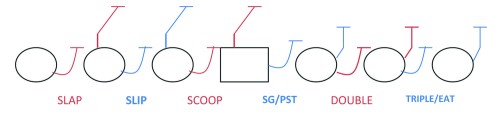
Single – zone combination between C and PSG.
Double – zone combination between PSG and PST.
Triple – zone combination between PST and PSTE.
Post – zone combination between C and PSG.
Scoop – zone combination between C and BSG.
Slip – zone combination between BSG and BST.
Slap – zone combination between BST and BSTE.
ASSIGNMENTS
(Diagrams 2-11)
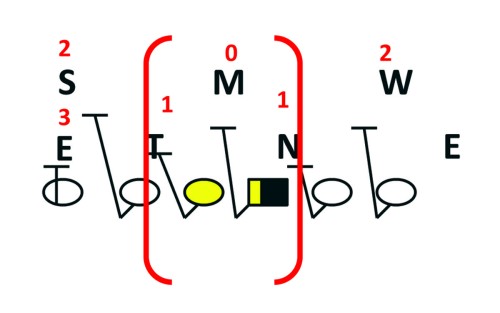
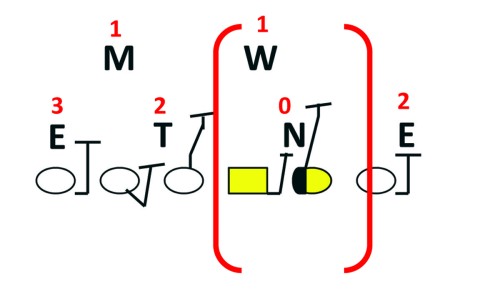
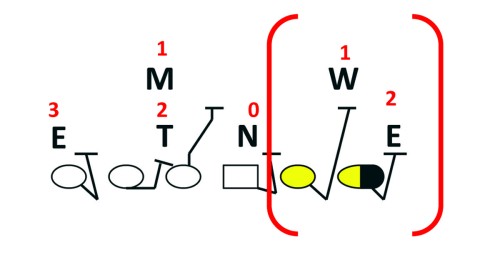
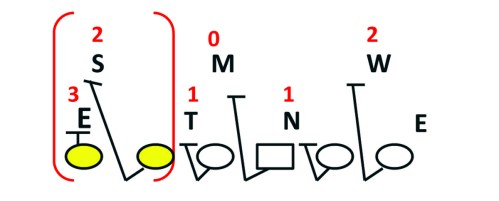
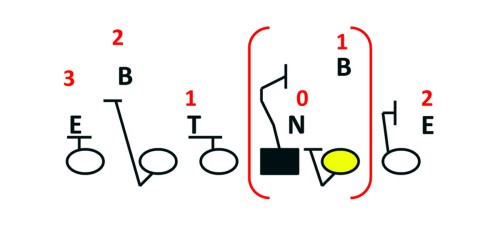
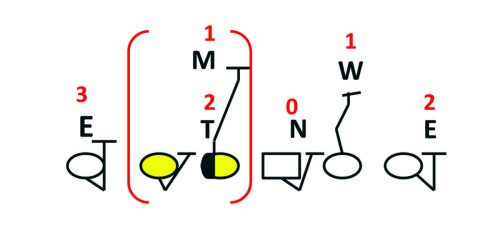
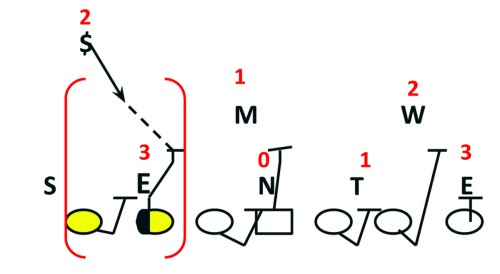
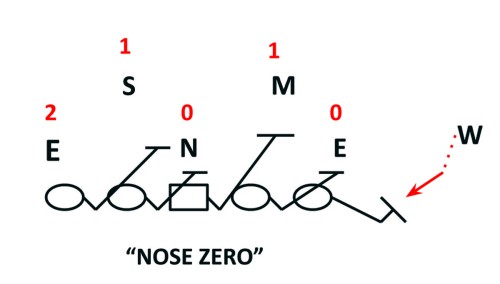
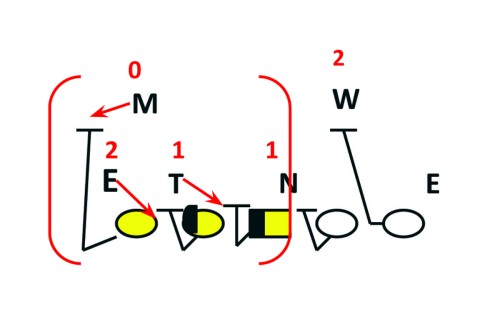
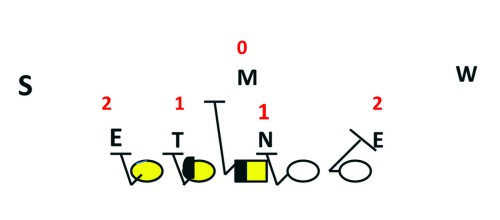
BST – #2 defender removed from “zero”.
BSG – #1 defender removed from “zero”.
C – If TE is on the ball playside, then count four defenders from TE alignment back inside to declare “zero”. With no inline TE play side, count three defenders from the TE’s alignment back inside to declare “zero”. If “zero” is a shade nose guard, declare him by saying “nose right” or “nose left” and if it’s a zero technique nose guard, we say “nose zero”. Otherwise, the center declares zero by the jersey # of the defender.
PSG – #1 defender removed from “zero”.
PST – #2 defender removed from “zero”.
TE – #3 defender removed from “zero.”
About the Author: Chase Harp recently became the offensive coordinator and quarterbacks coach at Arkansas Tech. For the past two seasons, he had been the assistant head coach, offensive coordinator, and offensive line coach at West Georgia. Harp also spent three seasons coaching at Central Oklahoma. He also coached at Gardner-Webb and was a graduate assistant at both Kentucky and Syracuse. A tight end at Kentucky (1998-2001) Harp holds both a bachelor’s and master’s degree from his alma mater.