While looking for an advantage to become a productive offensive team, we wanted a simple run game that allowed the players to play physical and without hesitation. Our inside running game is a very physical concept that allows us to stretch the defense on the simplest of plays. The concept that permitted this to occur is combining the Inside Zone Read with the Midline Option. These two ideas, which are our base runs, tie in with our second most productive run which is the Fly Jet Sweep.
Our entire offense is run from the Pistol. I had never run the Pistol before 2007. With a background from the “I” and Spread offenses and from listening to others, we decided to make the change. After installation and running this offense, I do not see any reason to be in any other alignment. The Pistol allows for a downhill running game while maintaining the advantages of the Spread. Enough about the Pistol; let’s talk schemes in the running game.
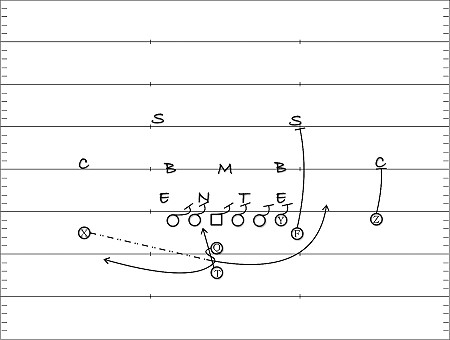
The play that permits the horizontal stretch of the defense is the Fly Jet Sweep with the wide receiver or running back split out. Blocking schemes that can be used are the outside zone and stretch blocking. The unique way we run this play is that the ball is handed off by the quarterback with his back toward the direction in which the motion runner is coming and facing the direction in which the motion runner is going. This allows three things to happen: one, the ball is now hidden from the defense; two, the ball is given to the runner as wide as possible; three, it keeps us in alignment to run the read off either the Inside Zone or Midline Option using the Fly Jet player as the pitch/throw receiver (See Diagram 1).
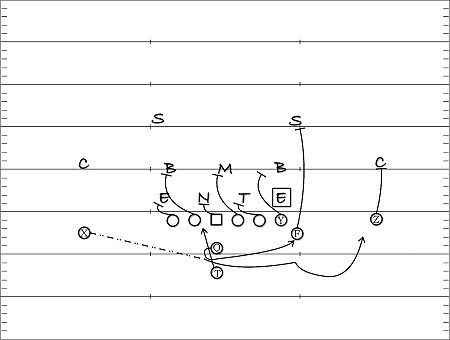
The next phase of installation is the Inside Zone. We used the footwork from Steve Rampy at Blue Valley High School in Kansas. The quarterback opens with his back toward the direction in which we are running the zone and facing the direction of the read key. The tailback aiming point is the front side “A” gap with the read to cut back to daylight. The fly motion player becomes the pitch/throw option. The point of emphasis for us up front is the physicality of the offensive line and the quickness the tailback works downhill. Our linemen do not bucket step or rip/reach/overtake. We immediately come off the ball hard. This is a credit to our offensive line coach, Matt Stanyard. There are many ways to run the Inside Zone. This play is run reading the end man on the line of scrimmage (See Diagram 2).
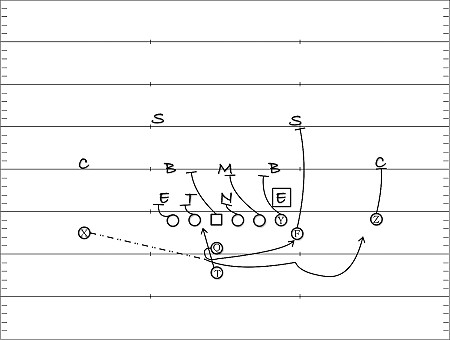
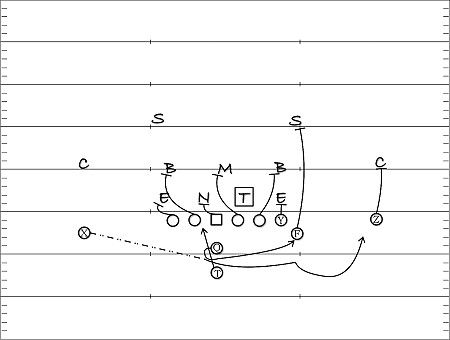
The Midline Option is the other inside run that we implemented. Obviously the Midline is run to the three-technique. This created a major problem for us because we do not huddle and have 114 plays on our wrist cards with multiple pre-determined formations and motions. If we have a three technique, we run the Midline as called. However, sometimes we don’t guess correctly and the defense gives you a three to the other side or perhaps no three-technique. When this occurs, we do not flip the play to the other side. Instead, we simply convert the Midline Option to the Inside Zone Read. The quarterback opens with his back toward the direction in which we are running the zone and facing the direction of the read key. The tailback’s aiming point is the center to front side “A” gap. The fly motion player becomes the pitch/throw option (See Diagrams 3 and 4).
The packaging of these concepts proved to be an invaluable part in winning the Ohio State Championship. The ease of scheme continuity creates a physical, quick hitting play that will also stretch the field.
Q1. What if you’re faced with a three man front (rather than a four man front)? Do individual blocking assignments/responsibilities change?
The blocking rules do not change vs. a 3-man front. The read key remains as the first down lineman outside the backside guard. This look is the typical zone read concept.
Q2. What if you’re facing a blitz by the outside linebacker on the play side? Do you alter any blocking assignments? Who is his responsibility?
The play side blitz does not present a big problem. The blitz is taken care of via the blocking rules or the course of the running back coming downhill and inside the blitz.
The backside blitz is addressed by either formations or alignments or by pitching the ball (option distance) rather than throwing the deep bubble.
Q3. What if in running your midline play you face a stunt by the nose and defensive tackle? How does that affect your blocking schemes?
Movements and interior stunts are handled by blocking scheme rules. The only situation that may arise is that the QB read may occur sooner than normal.
Mike Cook is the Offensive Coordinator at Cincinnati Anderson High School, Ohio Division II State Champions last fall. He can be reached at
MikeCook@GridironStrategies.com.