My first encounter with this offensive scheme was studying the double slot attack. The double slot offered an array of passing attacks, while keeping the power running principles. The position of the backfield allowed us to experiment with some flex-bone principles, while adding in the pistol allowed us to spread the defense. This formation allows for a diverse mix of both running and passing plays. From this set, we are able to execute the belly, buck, isolation, off-tackle, option, and zone running series (See Diagram 1). The option series that we use is based on both the sprint-out and veer. This article will cover our veer option scheme.
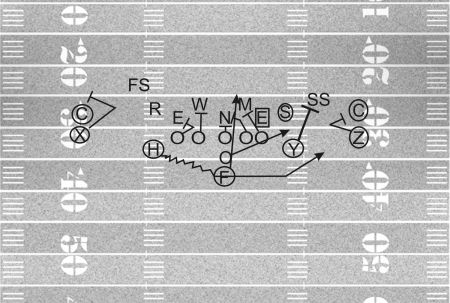
Personnel Groups
Personnel groups are designed to give the offense an advantage. The main personnel groupings are explained in the following table:
When players that are available can fill more than one personnel role, take advantage of the situation. Using the same personnel to fill different roles can help keep the defense off-balance. The best personnel for the option packages that gives us success includes Regular, Power, Quick, and Jumbo.
Motions
(Diagrams 2 and 3)
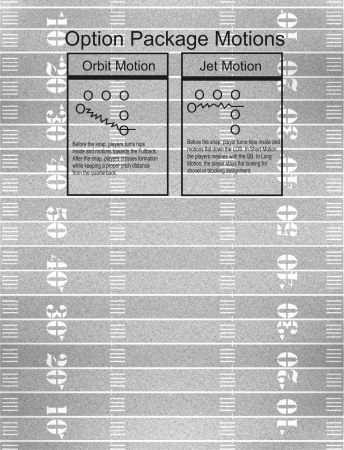
Motion is an important part of any modern offensive strategy. Like many teams we use motion for diverse reasons. Our motion is designed to create mismatches, move defenders, or put personnel in a better position to attack. We can also use motion as a decoy, when defenses key a certain player or type of motion.
The Inside and Outside Veer
(Diagrams 4 and 5)
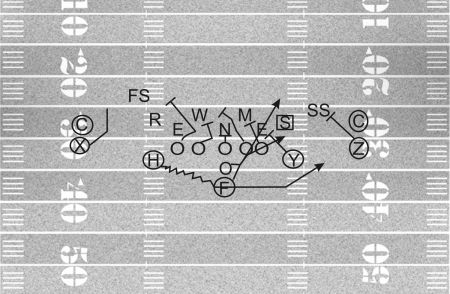
In this offensive attack the fullback is the best power runner. The type of player we envision here is the one that will gain three yards with little to no blocking. Everyone is aware that players like those are not the norm. Therefore we look for backs that are willing to fight for extra yardage. At the snap, the fullback and quarterback mesh is important. Since our QB is in a semi-shotgun position, he reads the C Gap defender. The fullback’s aiming point is inside or outside the Y’s block. Unlike other, more traditional veer schemes, this scheme blocks the strong safety in while reading the cornerback. The theory is that the strong safety is a better run support player and therefore must be blocked.
For the outside veer, the position of the quarterback makes the key reads for both inside and outside plays. However, the blocking scheme differs slightly. The main difference is that the PST and Y use a combo block on the playside E. For example, in diagram 4, without the movement of the DE, there is no fullback threat. This is an important hand off for the fullback because he must be reading the PST/DE while receiving it. If received, the aiming point is the PST’s outside hip. It’s crucial for both the PST and Y to drive the DE off of the LOS. This creates two potential running lanes. The fullback is keying on the PST for lane development. When using the three-man surface against an odd front, strong side defensive slants are common. We adjust by driving the N and M outside and creating an inside cutback.