Attack, Attack, Attack! That is our philosophy and strategy with the Air Raid offense. Our offense has been built around the concept that less is better and that through simplicity and repetition players will be successful. The ability to keep our offense simple enables us to install most of all its parts in just three days. This has always been a key ingredient of our accomplishments since my father, Hal Mumme, began running this offense at Copperas Cove High School (TX) in the mid 80’s. The success of our offense revolves around this quick installation which, in turn, allows our players to have a great understanding of it in a relatively short amount of time. This coupled with our fast break mentality makes for a potent offense.
Rotation
Most coaches and players are amazed at how fast we can actually install the offense and the most important aspect is the small arsenal that we use. So, in order to do this, we break down the entire offense into five major areas. These areas are Run Game, Quick Game, Screen/Play Action, Mesh and Last Route of the Day. On each day of the three-day rotation, a key concept from the offense is introduced into each one of these areas. Then, as we take the field, every concept receives a lot of repetition, ensuring that our players will become extremely effective at their jobs.
By utilizing this three-day rotation, it helps with how the rules of the game allocate time to prepare our players. With 15 practices in the spring, we can technically go five times through the three-day rotation. Of course, this depends on how we break up our scrimmage schedule. In fall camp, we roughly go about 21-24 practices before game week so that would allow us to get at least 6-7 times through the rotation. Again, the key ingredient for our offense is solely placed on repetition. To dissect these further, let’s take a look at how this should break down on the board:
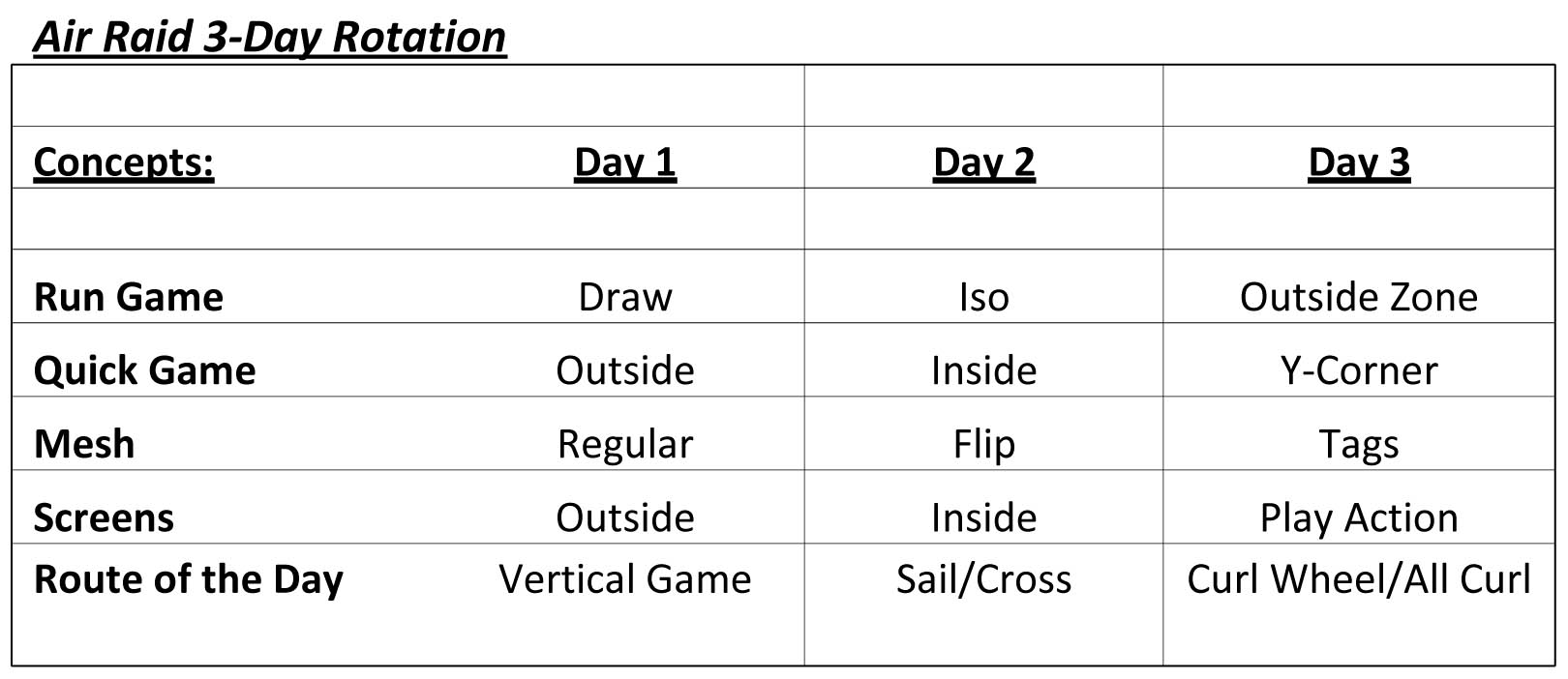
This simple design not only is great for our installation, but also enables us to be productive on our game planning. One of the most successful proponents of the air raid offense, Mike Leach, has a very limited game plan on Saturday and, if you didn’t know any better, you would swear it was written on a cocktail napkin. Most of the air raid disciples all function this way and have been highly successful with this small arsenal of plays.
Practice
In the way we practice, we are trying to achieve the best possible production. Our practices are going to take two hours at the very most. Each part of our offensive practice is dedicated to these concepts in the 3-day rotation. This enables us to make sure that every play we have in our arsenal has been worked on in any given week and then can be used in the game without any worry of execution. Below you will see how we allocate our time in practice. Our pre-practice drill work is included in our overall time allotment.
Pre-Practice
Run Tape – We do have run plays for the air raid offense and we dedicate the first five minutes of practice to covering the run of the day.
Noose – This is a drill we do with QBs, WRs, RBs and centers so we work on throwing and catching and QB-center exchange (10 minutes).
Practice Segments
Pat-n-Go – Warm up drill for offensive skill (five minutes).
Quick Game – (seven minutes).
Mesh – Time dedicated to one of our best plays in the air raid offense (eight minutes).
Screen/Play-Action – Extremely up tempo period that includes the entire offense going through our screens and play-action passes (10 minutes).
Routes on Air – Another up-tempo period in which we are working with the offensive skill players on the route of the day (10 minutes).
One-on-One – Receivers and quarterbacks go against defensive backs. Offensive line and running backs practice an inside drill (10 minutes).
Special Teams – Each day has a different concept (10 minutes).
Skelly – Against the defense or in season we go against the scout team (10-15 minutes).
Team – Typical team period where we work the game plan script (25 minutes).
One of the best things we do with this offense is that we are constantly talking to our players about scoring no matter where they are on the field. So in each of these drills, when an offensive skill player touches the ball, he will sprint to the end zone. If you practice scoring in practice, you will score on Saturday.
At the end of the day, we all have a system that we implement. The most important aspect is giving players the ability to be great at it. By keeping it simple with high repetition, we have achieved this.
About the Author: Matt Mumme was named offensive coordinator at LaGrange College this past February. For the previous two seasons, he served as offensive coordinator at Davidson College. A 1999 graduate of Kentucky, Mumme played quarterback for his father, Hal. He began his coaching career at Southwestern Louisiana University and has also coached at New Mexico State and McMurry University.