I’VE SEEN THE tackle-eligible pass play work since the 1950s. In fact, it has been the game-winning play for many of our team’s biggest victories in recent years.
Be sure to let the officials know that you will be running gimmick plays when you meet them prior to kickoff. Once they understand that these plays are legal, your team will not get flagged for something that looks unorthodox.
The biggest concern is when to use this play. Consider using this play when:
. The game is on the line.
. Your team is trailing and you need a score.
. Your team needs to convert a critical third, fourth down or 2-point conversion situation.
. Your team needs to capitalize on momentum after a big return or turnover.
. Your team has possession of the ball inside the opponent’s 20-yard line.
. Your team needs to create first-strike momentum against a physically superior opponent.
. The offense needs to confuse or disrupt a defense that’s stopping your regular offensive attack.
DIAGRAM 1: Tackle-Eligible Pass.
Shift From T-Formation
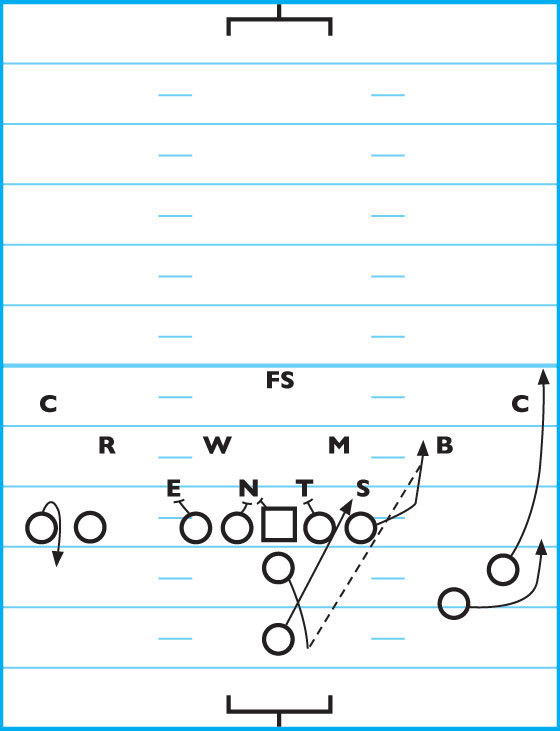
DIAGRAM 2: T-Shift From Double Tight-End Set.
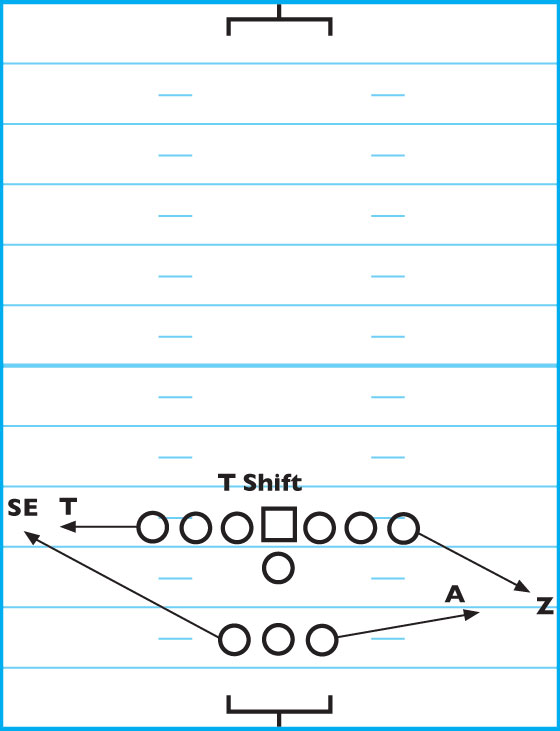
New formations and shifts will add to your opponent’s confusion and will keep them off balance. This play can be very effective shifting from a T-formation with a double tight-end set or by lining up with no huddle after the official has spotted the ball.
Key Points: Decoy Side
- Split End. On the shift, the halfback from the T sprints to the numbers and assumes an upright stance. A good player to use in this spot is your split end.
The SE checks with the official and makes sure he’s on the line of scrimmage. He then lines up with the ineligible offensive lineman.
When both decoy players are in proper alignment, the SE will signal that he’s ready to the quarterback by grabbing and holding his facemask.
The SE keys on the football. On the snap, he executes a quick screen route.
- Offensive Lineman. In this article, we’ll demonstrate this with the offensive tackle that’s being replaced. The OT lines up at the TE position on the side he will shift toward. On “shift,” he hustles to a spot 4 yards inside the numbers.
After communicating with the SE, the OT sets in a three-point stance to allow the SE to see the football and to disguise his ineligible jersey number from both the secondary and opposing defensive coaches.
It’s critical to remember that once a lineman is down in his stance, he can’t move. In fact, he can stay in his stance until the play is over.
Key Points: Play Side
- Flanker (Z). Put your flanker (Z) in the TE position. On the shift, Z sprints to the numbers and lines up in an upright stance 2-feet behind the QB’s heels. Z leans forward to align his helmet just behind the QB’s heels. This positioning makes sure that he is off the LOS.
Z keys the football and on the snap, runs a fade route.
- Halfback (A). On the shift, A hurries to a spot 4-yards inside the Z receiver and places his front foot on Z’s back foot. A should stand erect with no body lean. This gives the illusion that you’re in a twins set to the defense and greatly increases the play’s probability of success.
A keys the football. On the snap, A runs a flare route yelling “Here, here, here!” to draw the defender in his direction.
- Tackle Eligible. For the tackle eligible spot, it’s ideal to use a player who’s a tall, quick receiver with jumping ability.
However, we’ve also used short HBs with the same success.
On the shift, all of the line including the tackle eligible get set in their normal down position. The tackle eligible wears an eligible jersey number and getting down in his stance will help disguise his number to the defense and to opposing coaches.
As he lines up 3-feet from his guard, he reads the linebackers, then the secondary.
On the snap, he takes an outside release looking over his inside shoulder for the football as he runs to the soft spot between the LBs and the deep secondary.
- Quarterback. On the play fake, the QB should wait for the ready signal from both wideouts. The QB executes a veer pass to the tackle eligible.
- Fullback. The FB blocks the outside defender by placing his facemask on the defensive end’s hip.
Practice Makes Perfect
As with any other offensive play, you must schedule an ample number of repetitions in your practices to make this play work its best.