Each year we fight the battle between proper prep and time constraints. So this past season we looked at the purposes of the drills that we do and the reasons we do them. In the end we consolidated a variety of different drills into four concise drills that allow for increased reps, discipline, effort and understanding. This article will break down each of these drills in-depth in order to help other coaches apply them to their own offensive systems and practice plan.
The Tempo Drill
We are a no huddle spread team. For this reason, each of our drills will have a certain flavor that comes from running that style of offense. It is my personal opinion that all teams could do a better job of understanding the advantage of changing and controlling the tempo of the game. We think it is an essential element of a high quality offensive team and therefore must be practiced during the week. Our team runs three basic tempos: base, 2 minute and 4 minute.
Our tempo drill is set up to rep our run game with our offensive two-deep in each tempo that we plan on using for the upcoming game. These plays are run on air with the exception of line coaches playing key defensive linemen. Remember that the goal is to get as many quality reps as possible while stressing the pace at which we snap the ball. Teach the players to ‘keep the pressure on the defense.’
Drill Setup:
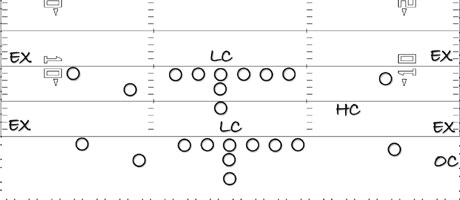
• Place your first team on the 10-yard line and your second team on the goal line (See Diagram 1).
|
• Clearly announce to the teams what tempo you are using, what you expect and what plays you will be repping.
• The head coach should be in between the two groups, blowing the whistle and enforcing discipline if needed.
• The offensive coordinator is calling the plays from the sideline; run your system, but make the team practice like it is a game with plays coming in from the sideline. If the HC is the OC he should delegate the calling ability for this drill and have an assistant call a script for the drill.
• Line coaches should be in charge of setting the ball and playing the key defender to force line talking and proper execution.
• Additional coaches are pushing the drill and monitoring for errors and lack of effort. They communicate problems to the head coach for disciplinary action.
Drill Execution:
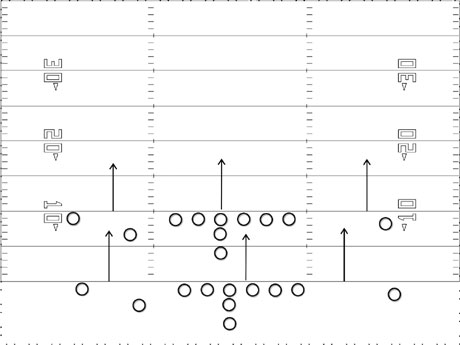
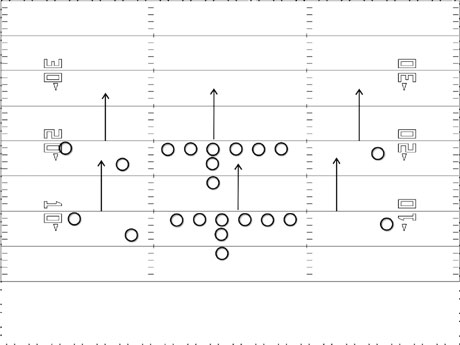
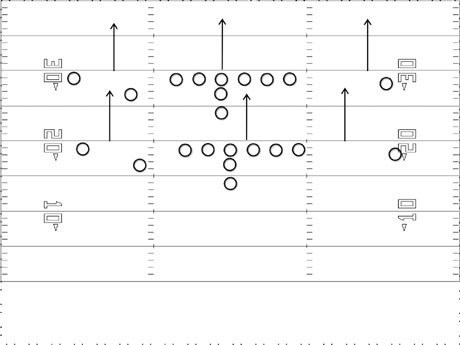
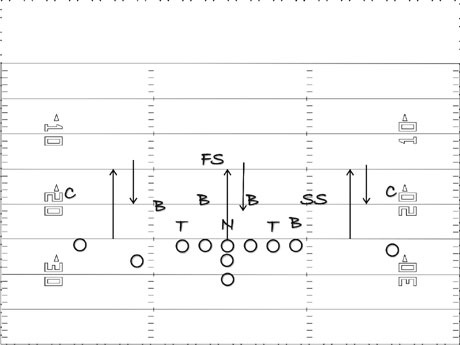
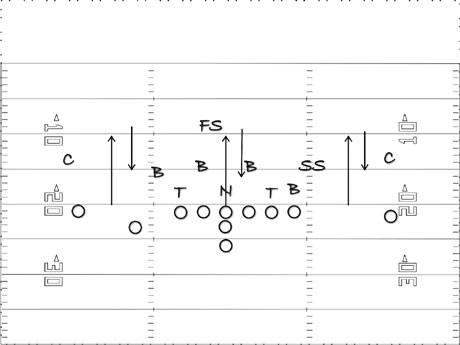
• This is a full speed drill. The first team quarterback will call the cadence for both teams and they will fire off the ball, carry out their assignments and play through the whistle. Once the whistle is blown, the players will jog back to the ball that has been placed 10 yards ahead of the previous play by the line coaches. (See Diagrams 2-4).
|
|
|
• Once the players are back to the LOS, the play will come in and the players should prep for the next play and the tempo that you expect.
• We ask our linemen to find the ball carrier and ‘pick him up’ every single play. This is done to encourage downfield blocking and it gets the linemen to the new LOS faster during the game.
Teaching Points:
• Expect full effort every play. Anything less by one player should result in up-downs for the team. They will quickly get the picture and right the ship.
• Coaches should push communication and execution while coaching on the run.
• The head coach must push the pace to make sure it matches his expectations.
• Players should understand that this is a conditioning drill as well. They are supposed to be tired. We want to test them when they are winded to make sure they are still able to execute the play.
• Since all plays are run plays, all players must be moving forward (blocking air). This is essential to make two (or even three) groups go at once.
• Switch up the players after ten plays and head back the other direction. Use this as a time to rep the #2’s and #1’s together.
The Marching Drill
This drill is used to rep our 10 most important plays against scripted defensive fronts while teaching the offense what it feels like to successfully move the ball. We believe that this psychological preparation connecting success with our most important plays will help the players trust the plays and understand the rhythm in which they will be called that week.
Drill Setup:
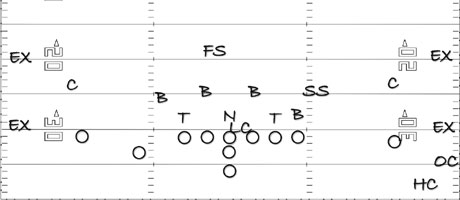
• The first string offense will align on the 50 yard line opposite the scout team.
• Head Coach is behind the QB guiding the drill and talking the QB through progressions and reads.
• The offensive coordinator (or assistant coach) will be aligned on the sideline to simulate game-time situations. He will be working off a predetermined script.
• The offensive line coach is setting the ball, helping the linemen and guiding the defensive box scout.
• Position coaches are spread throughout the field coaching on the run. They are talking through defensive looks and encouraging the players at all times. Praise like crazy!
• Extra defensive coaches will run / guide the secondary scout.
• All extra players are running sprints on the sideline or up-downs behind the offense (See Diagram 5).
|
Drill Execution:
• Each play moves the ball five yards if done correctly. They will ‘march’ toward the goal line and score on the final play (extra point is an option if you want to rep the transition as in a game). When the ones have finished, repeat this process with your twos in the same way (See Diagrams 6-7).
|
|
• Defense plays at 75% to the tackle.
• Success every play. Do not proceed until they have successfully completed the play.
• If you have an extra coach, have him indicate down and distance each play.
• Maintain a game-like pace if at all possible.
• Start over if execution is lacking.
Teaching Points:
• Encourage them all the way through the drill.
• Build momentum and excitement each play.
• This is a good chance for position coaches to coach up the finer points of their position. Be sure the pace allows for quick instruction.
• The defense will quickly figure out what is coming. Use this as a chance to teach offensive players to create doubt through verbal and visual cues.
• Have them celebrate the way you expect them to on Friday night (Score Drill).
The Score Drill
This drill is used to rep our goal line plays and situations against a dummy scout box and a live secondary. The goal is to create confidence scoring in the red zone; familiarity with the plays and adjustments used in this area of the field; practice celebration expectations; and create discipline. I know many of you have already asked the question, ‘Why do you practice how to celebrate a touchdown?’ The answer is quite simple. First, if left to the players, they may see this as a chance to bring praise upon themselves. We want to foster the team concept and want everyone to feel like they scored. Secondly, we have been penalized for ‘excessive celebration’ a few too many times; according to one ref chest-bumping to celebrate is a penalty. In big games these small things can be costly and extra points can be lost. So we think it is essential to set an expectation and teach them to follow through.
Drill Setup:
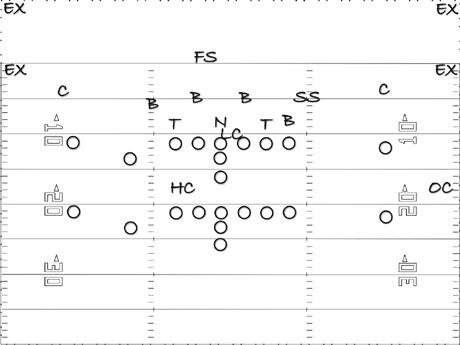
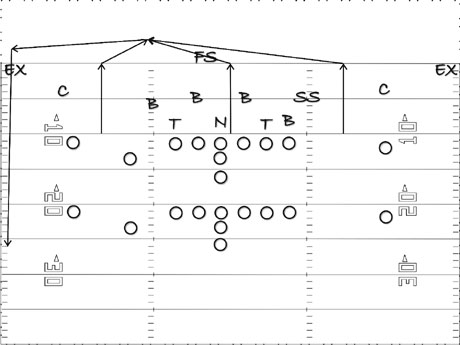
• Put your ones on the 10-yard line with your twos behind them going in opposite a bag holding defensive box and a live secondary.
• Head coach drives the drill from behind the offense.
• Offensive coordinator or play caller on the sideline calling plays.
• Line coach is setting the ball and moving the box defenders.
• Additional coaches are stationed at each front pylon to monitor the end of the play, celebration, and retreat to the back of the line (See Diagram 8 & 9).
|
|
Drill Execution:
• The teams will run scripted plays from each yard line marching into the goal line.
• After each ‘successful’ play, the whole team will get to the end zone and celebrate correctly as a team. (The scorer congratulates the others as opposed to the opposite).
• The players then exit outside the drill to the sidelines and into the back of the line, running the next play from the 9, then 8, and so on.
• This drill can also be run live and even sub for PAT if desired (See Diagram 9).
Teaching Points:
• Create an expectation of scoring.
• We score as a team.
• We must get to second / third level blocks to score.
• Routes must be adjusted due to the depth of the playing field.
• Use all of your goal line subs to make it realistic.
• Urge coaches to coach up the finer points of finishing drives in the end zone.
The Ladder Drill
This drill is run in our group or individual sessions to get high rep volume with a focus on the fundamentals. The goal is to get picky about the adjustments, stance, footwork, and of course effort that they use on a given play. We usually practice our screens, quick passes, and run plays using this drill.
Drill Setup:
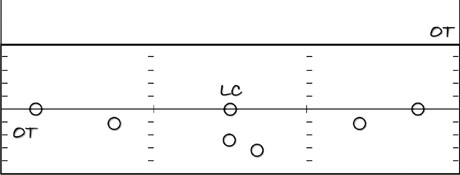
• The lead coach should put a ball on the five yard line with the ones on the line of scrimmage with the twos behind.
• The lead coach also calls the plays for both groups at once.
• Other coaches are near the end zone watching for execution and effort (See Diagram 10).
|
Drill Execution:
• All players run the called play through the goal line every single time.
• If one player makes a mistake, forgets a detail or fails to run through the goal line, the whole drill moves back five yards and the drill continues.
• Half way through the drill take a break and restart from the five yard line. They should do better the second time.
Teaching Points:
• Stress the little things.
• If you want their hands up every play, make sure it happens.
• If you want to focus on eliminating a false step, do it.
• Any other weaknesses that you saw in the film can be addressed in this time period.
• Explain the benefits of being precise and disciplined.
• Don’t allow complaining or put downs for mistakes. Make them suck it up and deal with adversity.
• Push the pace for conditioning and reps but don’t sacrifice execution.
If you have any questions, you can email the author at SamNichols@GridrironStrategies.com.
POINT OF VIEW
Marc Beach is the Head Coach of Seabreeze High School in Daytona Beach, FL and a proponent of the no huddle offense.
“Coach Nichols has some good teaching points on the drills he uses in practice. I particularly like his ideas of being positive and trying to make every play in his practices a success.
“We practice the Tempo Drill as well but do it somewhat differently. I think a lot of how you run it depends on both the number of players and coaches you have. Many schools may not have two complete offensive units. We practice more game situations and can make it just a third or fourth down call as well as practicing our base tempo.
“In their Marching Drill, their teams start at the 50 with the defense playing at 75%. We practice somewhat differently in that both offense and defense go at 100% and we play ‘make five, gain five’; that is, if you gain five yards on a play, you get another five yards and then line up for the next play. If you don’t gain five yards, you move back another five yards.
“We also do a variation to their Marching Drill called ‘Sudden Change.’ In the middle of practice, I may place the ball at the three yard line and tell the offense they have to score on one play. The defense can then win the game by stopping the touchdown. We do plays and situations like that in our practices.
“In the Ladder Drill, Coach Nichols practices fundamentals and screens, quick passes and run plays. Our version is called ‘Routes on Air’ as we concentrate on quarterback reads and progressions and look at the different coverages. I think we both practice proper execution and try to get as many reps in as possible. All of these drills are great for your players’ conditioning.”