Adjusting the traditional Wing-T to meet the demands of the modern spread offense
Today’s Challenge
With the pressure on today’s offensive game plans to spread the field by putting their best athletes in space and create match-up problems for the defense, Wing-T or “Bucksweep” coaches have found themselves having to either adjust their offense or abandon it completely. For coaches who have enjoyed tremendous success with the Wing-T offense, it is hard to change the game plan and philosophy entirely. With this in mind, I have developed some strategies that have allowed us to spread the field and have the same success, without switching entirely to a spread-style offense.
The Wing-T
Much of my offense is based on the Delaware Wing-T. The Wing-T is a progression-based offense. This does not mean that our plays are run in any pre-set order. Rather, within each offensive series the defense is threatened along several points at the snap of the ball. These threats are designed to create conflicts for the defense. If the defense reacts a certain way to an offensive look or play, it then puts itself in a vulnerable position for another play within that same series.
The Wing-T is a four-back system utilizing the quarterback, the right halfback, the fullback and the left halfback. Our base set is traditionally tight and not very “spread” across the field. This formation would be called “wing right” (See Diagram 1).
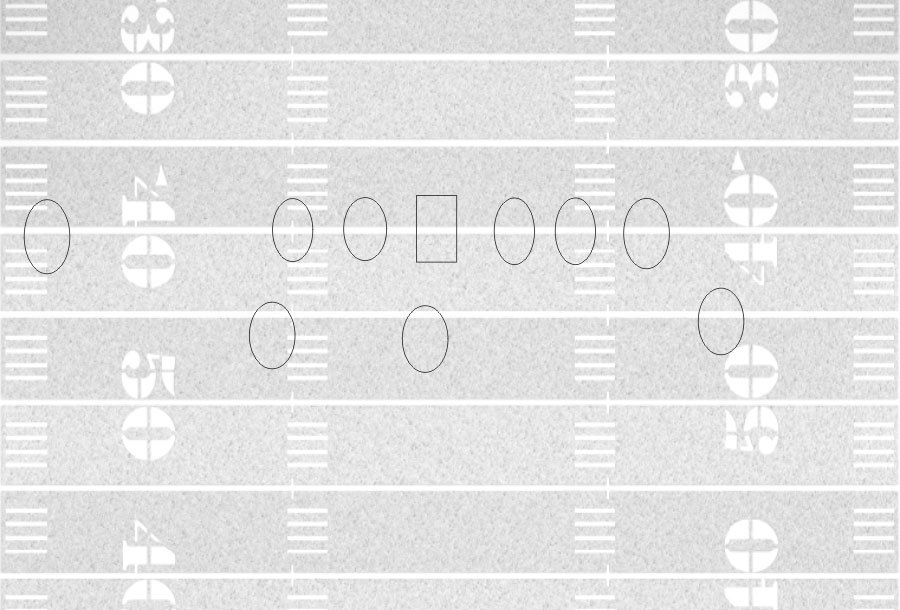
Spacing
SE 3-12 YDS
Wing 1 YD outside the TE and 1 YD
off the ball
TE 3-foot split from the tackle
O-Line 2-foot splits
Align your toes with the heel of the center
Helmet aligned with the bottom of the center’s jersey number
FB Heels at 4 YDS from the LOS directly behind the QB
HB Heels at 4 YDS from the LOS
The inside of the HB’s foot aligns with the outside of the tackle’s
outside foot
Philosophy
Most of the plays we run use misdirection and involve pulling guards and/or tackles. This runs contrary to many of today’s new offenses. However, I am going to explain one way that I have adapted and adjusted our style by making use of the faster and quicker style offenses that we currently play against, while minimizing the changes in alignment, assignments, and reads.
The Bootleg
Let’s take our base set for bootleg. In Diagram 2, you see the traditional set for our “Boot Pass”. This play is brought from the sideline and into our huddle as wing left 288 Boot.
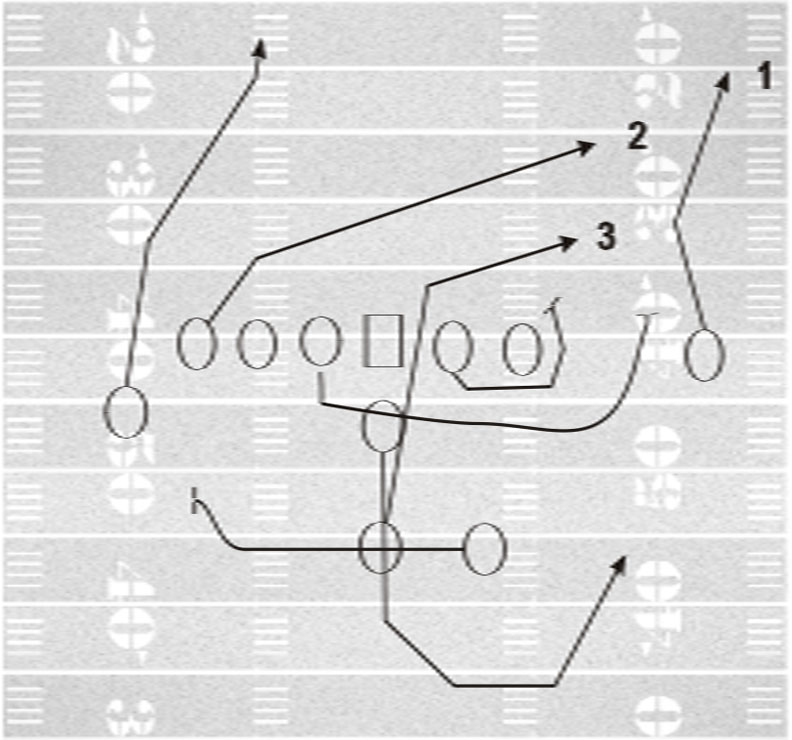
The assignments are as follows:
BSE: Run drag across the field, read LB drops, adjust route
BST: “Pull check”
BSG: Pull, read PSG’s block, become QB’s personal protector
C: Gap-down
PSG: Pull and log block first man outside the PST’s block
PST: Gap-down
PSE: Run an “8” cut or a skinny post/corner; don’t run out-of-bounds
RHB: Fake sweep and block backside
FB: Ball fake, fill for PSG+block; if there is no one to block, release into the flat (no deeper than 5 YDS)
LHB: Attack middle 1/3 (get the attention of the safety)
QB: Open to midline
No ball fake to FB
Sweep fake to RHB
Put ball on hip
Get depth, “eye” the safety, square your shoulders and attack the L.O.S
Follow your progression
1. Deep
2. Middle 1/3
3. Drag
4. Flat
5. RUN
Adjusting to use speed and space
Now, compare that play to the set called Trips Right, TE Left 288 Boot (See Diagram 3).
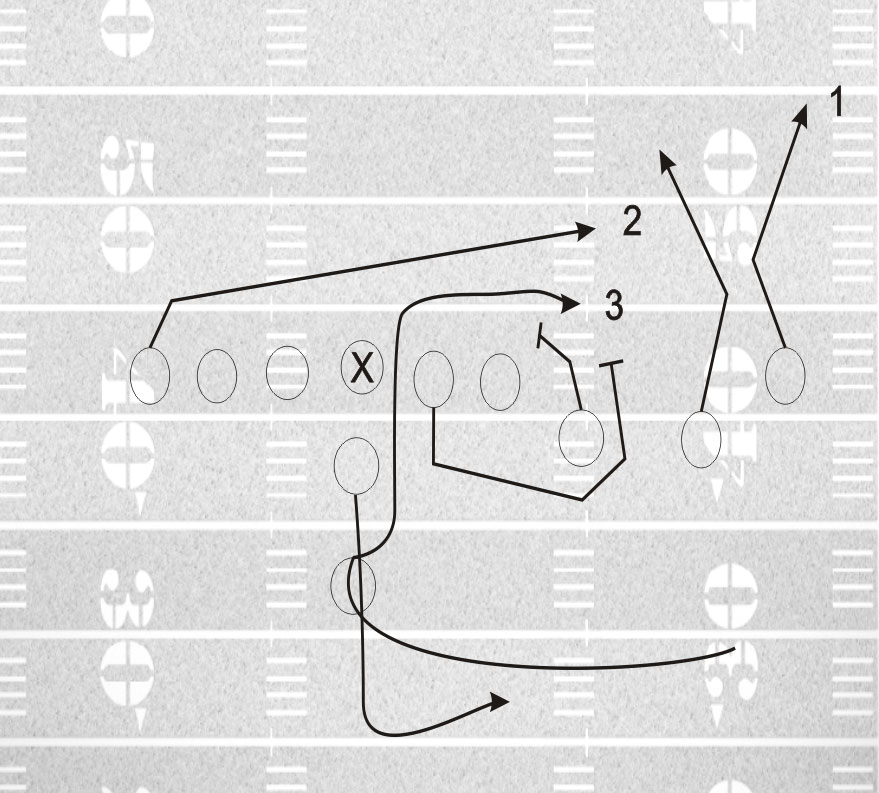
We are running the same play, but we are able to spread the field with our athletes. If you look closely, there is minimal change to the play. The LHB will now “read down” and block the first man outside the play-side tackle and the RHB will now run a post route. I tell my backs to run right at the safety, so the safety will play him and leave the post-corner or drag route open. If the safety jumps this route, the deep route (PSE) is open. Again, the QB’s read progression is deep to shallow, with the priority of the routes numbered. This slight change allows the offense to spread out while still being able to run many of the same plays in the Wing-T offense. From this “trips” set, we also have the ability to run FB trap and belly, two of the staples in the Wing-T offensive system.
Summary
The ability to spread the field using the same personnel will depend on your athlete’s ability to be both a running back and a receiver. These are the same multi-dimensional qualities you would look for in your skill position athletes in a spread-style offense. It also rests with the coach’s ability to be creative while not getting away from what works for you in order to stay abreast with modern day offensive schemes.
How do you assess your talent and put your athletes in the right positions within your offense?
I’m looking for the same multi-dimensional athlete to play any of the four back positions. For example, my halfbacks have to have the ability and athleticism to run and catch as a receiver. Their speed and catching ability is just as important to the success of the offensive system as their running capabilities. Therefore, in practice we take all the running backs and run through many of the same drills we do with our wide receivers.
Our FBs in this offense are more like “athletic” guards. They need to be able to block as well as be able to carry the football. Our fullbacks are even coached and skilled in catching the football because they have pass routes on many of the plays we run.
The QB has to be very multi-dimensional. He has to be able to read and react. I look for an athlete to play quarterback that has great feet. The ability to utilize him as a fourth running back is paramount. We drill our QB’s in the same skills we use with our running backs. Having a fourth and usually “unaccounted for” running back is a huge advantage. Many of the same qualities I look for in a quarterback would be the same qualities as a coach implementing a spread-style offense.
Where do you start in teaching this offense?
I always start with the staple of the Wing-T offense and that’s the sweep. Once we can establish the timing and ball fakes, we then go into FB Trap and then directly into the Bootleg package. One of the first things I stress is the importance of the run game, coupled with the usage of our bootleg.
Do you go into a game with a scripted set of plays?
I pre-plan the first ten or so plays. The Wing-T is designed to threaten the defense in several spots along the LOS. As an offensive coordinator, I always say that if the defense takes away one thing, it will leave another wide open. This is how the Wing-T operates. When the defense adjusts or stunts into certain sets, it automatically opens up another spot of vulnerability in their scheme. For this reason, I will plan out ten plays to run just to see where and how the defense will adjust to certain schemes and then decide where I will be able to attack them successfully. For example, how will the defense adjust to motion? How will they shade our TE? How will they cover twins? Do they stack or stunt over our tackles? Do they choose the open field side as the strength or do they honor the TE/Wing back side as our strength? These are all questions a Wing-T coach would consider when making game day adjustments.
When do you implement this “spread” look in a game? Do you go right into this look right away?
I definitely do not go directly into this look. When I game plan, I will first make the initial adjustments as to where and how the defense is playing us. Find out what they are going to take away from us, and on the flip side, what they are going to give us. I will always start out tight, like in our traditional wing right look, or even go into something like a double tight/double wing look. Sometimes, the more balanced look I give in the beginning of a game, the better idea I have as to what spot the defense may be trying to attack. I will slowly start to spread out the offense – first by going with a twins look or a motion to twins and then into our trips look. This way, once we have established our inside running game, we will spread the defense out and open up more vulnerable areas to attack. We are always able to go back and run FB trap and belly from the trips look, so the threat to run inside is always there. p
About the Author:
Seth Messier is Head Junior Varsity Coach at Garden City High School, on Long Island, New York. As a JV Coach, he has compiled a record of 53-1. In 2005, Seth helped guide the Wing-T to 2,635 total yards rushing with an average of 6.7 yards per carry. They also set a single season school record with 391 points.