You can confuse any defense by implementing this scheme.
Our basic philosophy in our running game is to give the defense two or three different formations and vary our blocking schemes with a mixture of gap, zone, and man with multiple personnel groups. This has enabled us to become a very balanced offensive team which has given us great success in the run and passing game. This past season, the Split-Flow and ISO scheme resulted in a 6-yard average per carry. What was initially a complement to our power game became a main staple in our offensive gameplan, resulting in the Split-Flow and ISO accounting for approximately 30% of our running game. We run the Split-Flow and ISO against any even or odd front defense that has six defenders in the box. If there’s a larger number in the box, we generally throw the ball. We are primarily in a 20-personnel grouping when running Split-Flow or ISO which is consistent with our two-back power game.
First, our blocking rules for the offensive line in the Split-Flow are the same as our inside zone rules. So, for the offensive line, there is nothing to re-teach. The B-back, who is our FB, is blocking in man technique. The RB runs the same path as he does with inside zone.
Blocking Rules
Uncovered OL - step to your playside gap looking to help while pushing up the line of scrimmage with good vertical steps. Key is the near knee of the first DL to your playside gap.
Covered OL - step to your playside gap, flipper the DL with good vertical steps.
B-back - blocks the end man on the line of scrimmage, attacking his inside armpit. The B-back is aligned between the guard and tackle, a half yard away from their heels. We can motion him and even set him outside of the tackle as a wing.
RB - follows the same rules as inside zone. His initial path is the frontside A gap. He adjusts slightly against an odd front with his read now being the center’s buttock. However, his path is the same. He aligns five yards from the LOS with his inside foot directly behind the outside foot of the guard.
Split-Flow Rules
1. When we face a team that gives us a traditional even front with six in the box with the 3 tech to our B-back, this play will hit 90% of the time to the playside A gap. We have two combination blocks with the inside DL up to the Mike and Will linebackers (Diagram 1).
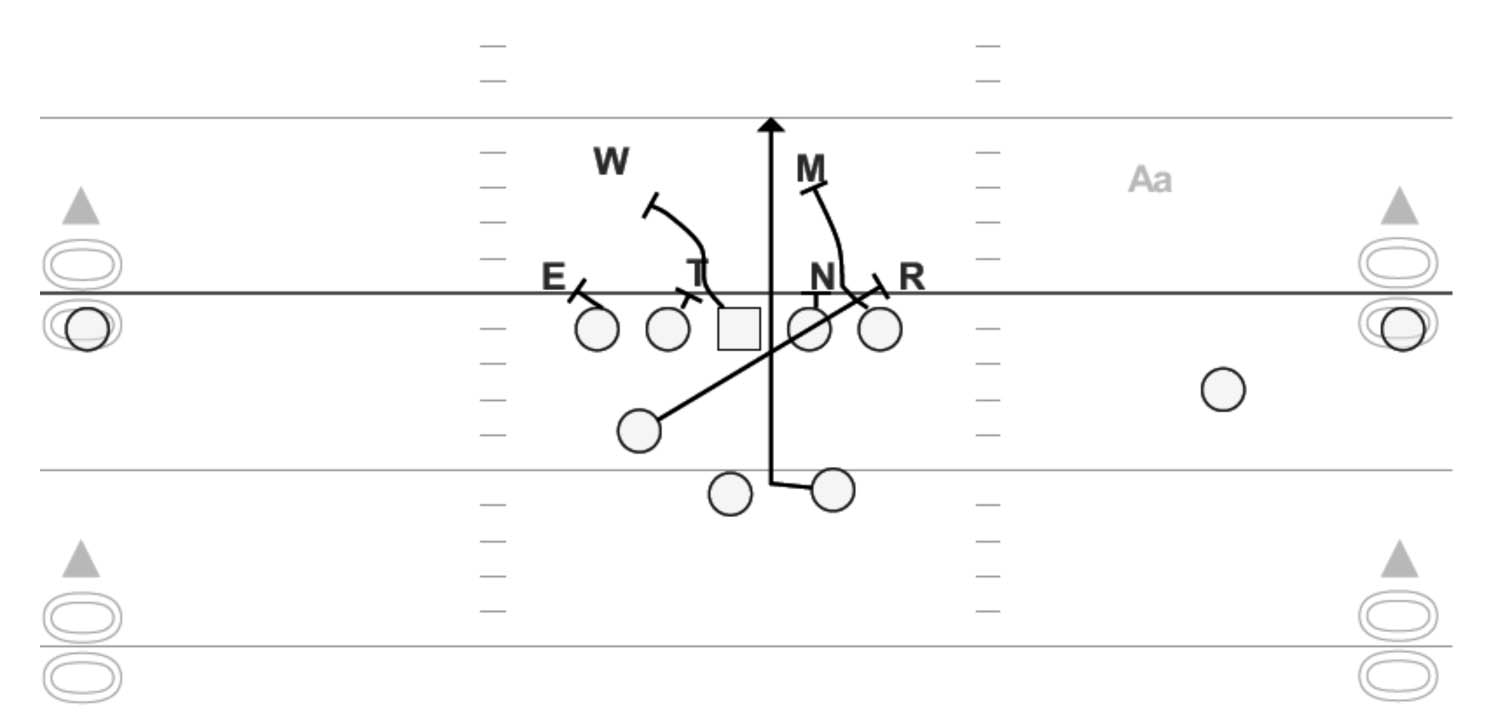
Diagram 1.
Coaching Point – be sure there is a good vertical push, not allowing any penetration and win the two on one contest at the line of scrimmage.
2. If we get a team that plays 2i to our B-back, the play will hit to the playside B gap. The playside tackle will take the appropriate steps to the Mike and the B-back will attack the inside shoulder of the DE (Diagram 2).
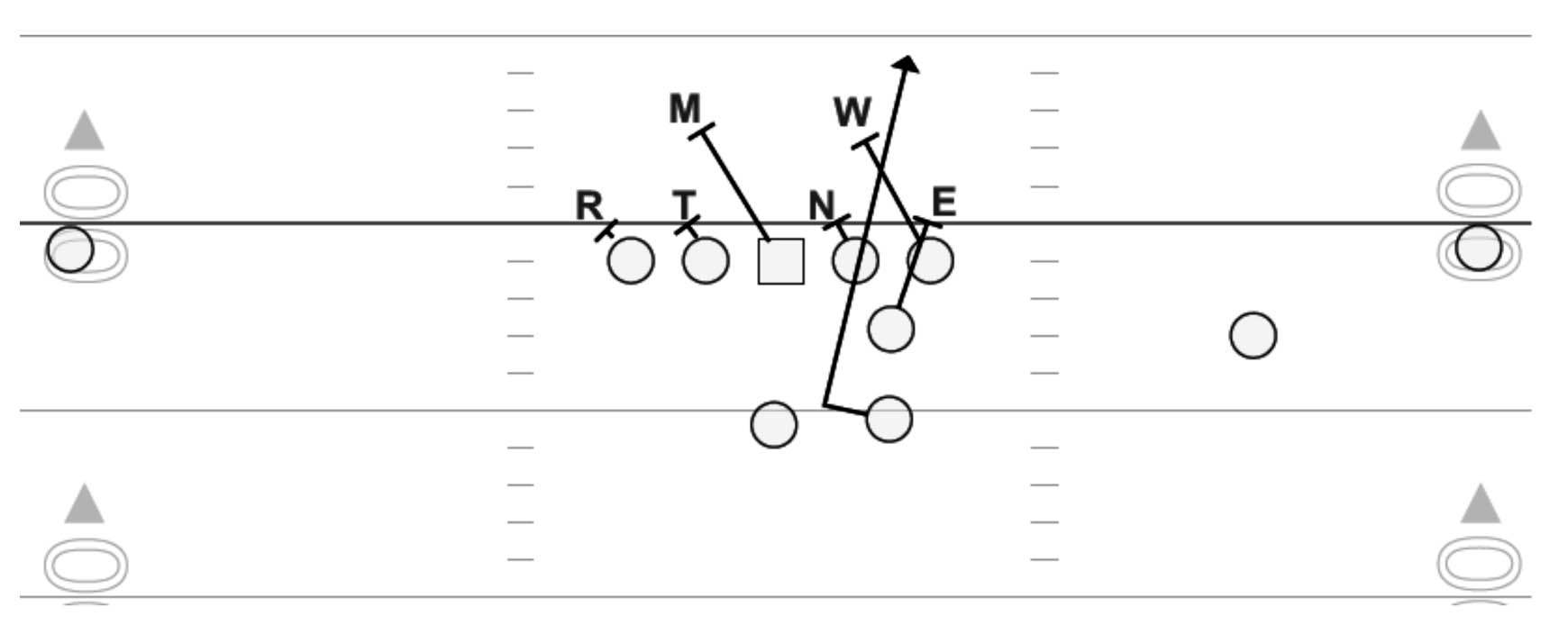
Diagram 2.
Coaching Point - if the DE squeezes off the PST butt, the B-back will have to log the DE, pinning him on the line of scrimmage in order to allow the running back to bounce outside.
3. When we face an odd front team that gives a stack (33) look, the numbers match up well. The PST and B-back are responsible for the playside stack (DE and SB); the PSG and center are responsible for the inside stack (Nose and MB); and the BSG and BST are responsible for the backside stack (DE and WB). The play will either hit the frontside B gap or backside A gap as a cutback (Diagram 3).
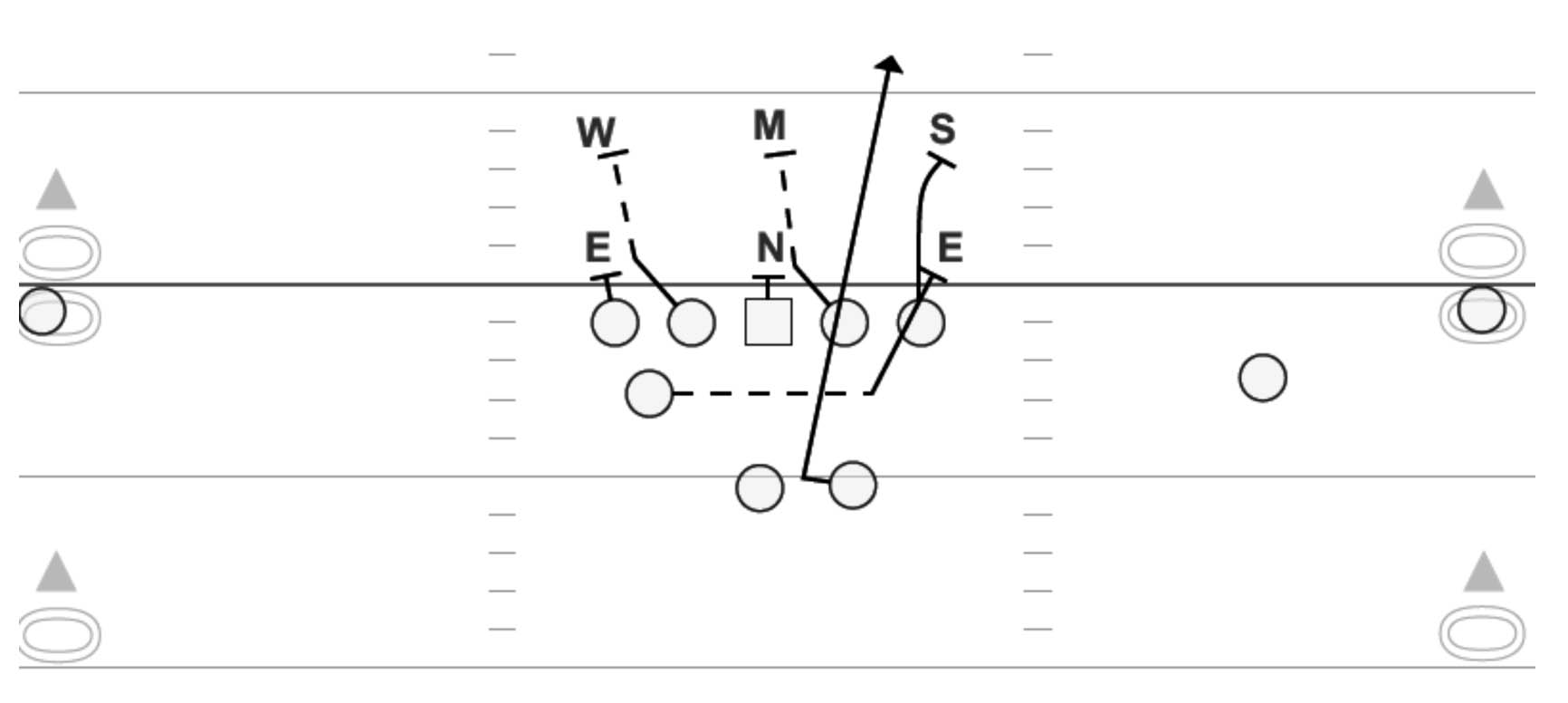
Diagram 3.
Coaching Point - The RB will read the center’s block with a good opportunity for a cutback. Note: against a 3-4 defense (7 man box), in which we are out numbered, we will throw the ball.
The ISO is a great change up that makes this scheme both potent and versatile. Effective downhill blocking is needed from the B-back. Now with all the pieces set, we are able to use this scheme in a variety of ways – short yardage, in the red zone and at the goal line. The Split-Flow and ISO coupled with our two-back running game allows us to dictate our will on the defense by keeping them guessing.
ISO Rules
1. We run our ISO against an even front defense and it doesn’t matter if the defense shows a 2i/3 tech. With our ISO, we will motion our B-back from time to time giving the illusion of either two-back power or Split-Flow. The PST and guard man-block while the other three offensive linemen are blocking with their inside zone rules. The B-back ISO blocks the playside LB, the RB makes initial Split-Flow steps and then reads the B-back’s block (Diagram 4).
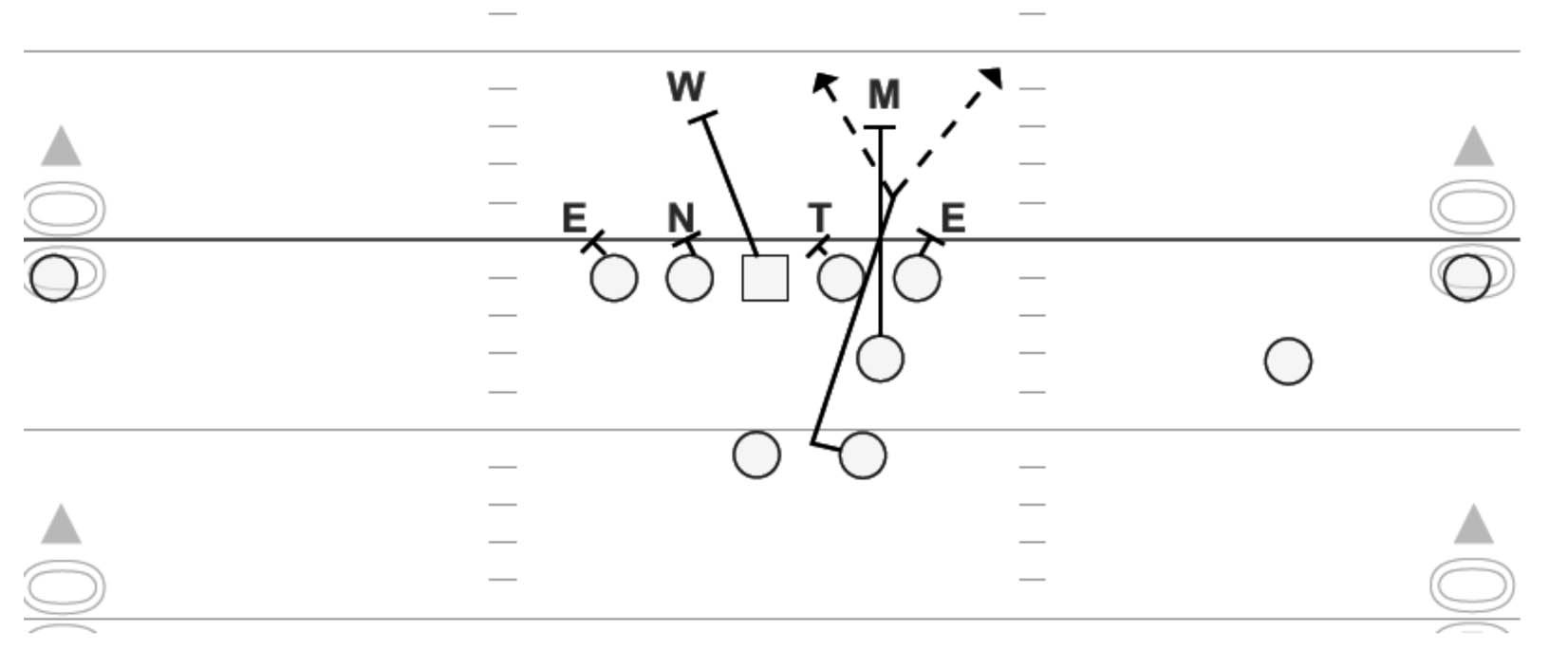
Diagram 4.
Coaching Point – When the B-back is put in motion, he must be patient for the guard’s block. He quickly reads his hip so he can take the proper crease while keeping his eyes on the assigned LB. We have also prepared our B-back to stop his motion with a “STOP” call in the event the DL stems from a 3 tech to a 2i. In that case, he becomes a true downhill ISO block directly to the playside LB.
2. The ISO can be run with motion with the B-back in a wing position against an even front (Diagram 5).
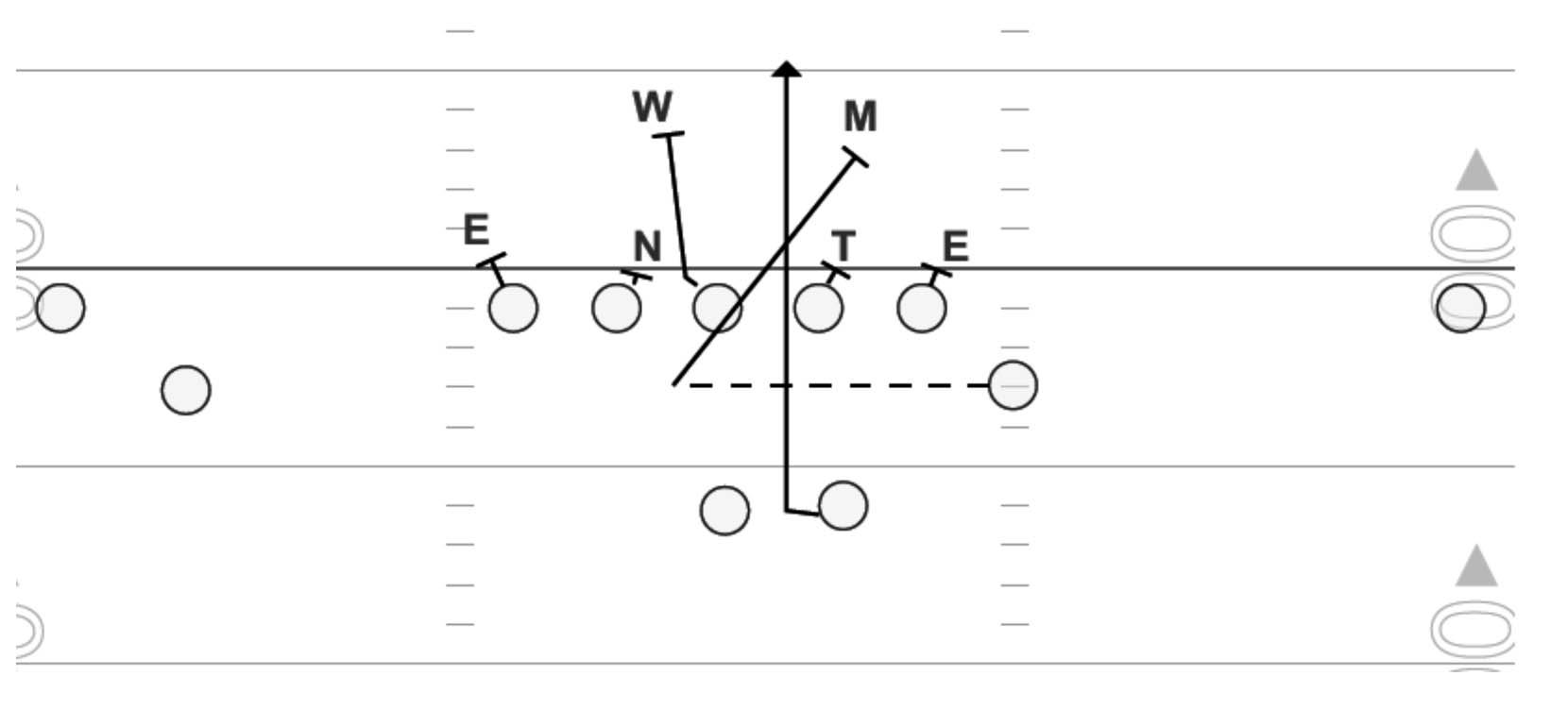
Diagram 5.
3. The ISO can also be run with motion from a two-back set against an odd stack front (Diagram 6).
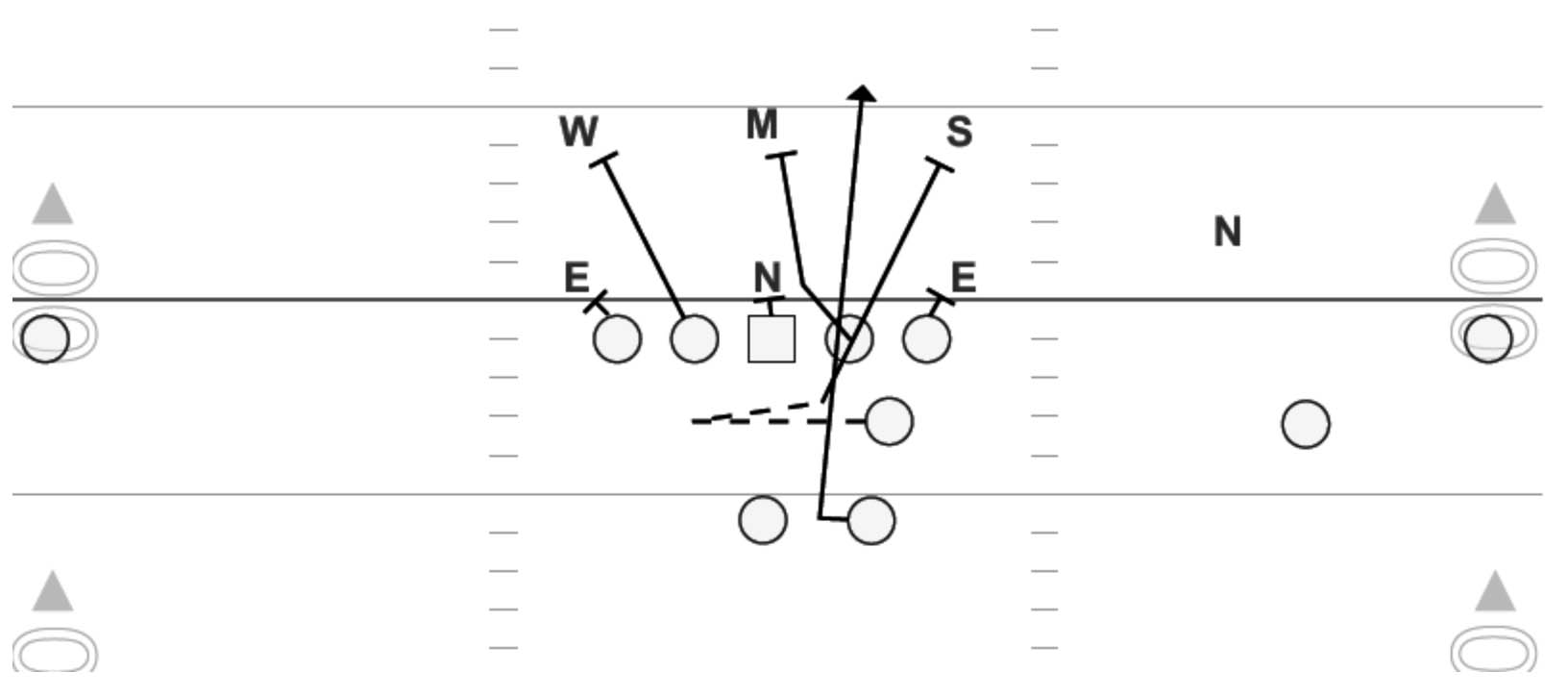
Diagram 6.
The X-factor in this offense is our B-back who is a hybrid type FB/TE player who hits like a LB with the blocking technique of an offensive lineman and has the hands of a receiver. Our B-back is a very important piece of our offensive firepower both on the ground and in the passing game.
The Split-Flow and ISO scheme can be very effective with the two-back game and can be incorporated within the Pistol. It allows your big guys up front to create creases for your RB to get to the second level. For those teams who utilize the B-back, this scheme will have defenses playing tentatively because they must honor that player and if they don’t, it is almost a guaranteed big play for the offense.
About the Author: L.D. Green, Sr. enters his third season in 2013 as offensive line coach at Trinity University (TX). He has 11 years of coaching experience on both the high school and college level. Green also served in the United States Army as a Chief Warrant Officer for 24 years.