IF YOU’RE LOOKING TO up the tempo of your team’s offense, catch a slow defense off-guard or simply control the speed of the game, utilizing a quick-hitting, three-step passing series is a must-run for your team.
Hitting targets after three steps quickly moves the ball while eliminating too many choices for your QB. Eliminating areas of the field to throw lets the QB have a better grasp of his reads and also helps build confidence in your signal caller.
The following series covers the basics of the three-step passing series. It is a staple of first-down passing and easily is run out of any three-receiver set. Timing it critical, which requires some development in practice. But, once the timing is in rhythm, this offense is tough for a high-school defense to stop.
The entire series is based on identifying the flat defender. Plus, all players must recognize if the defense is in a man-to-man coverage. Ninety-five percent of the time, if the QB sees man coverage, he’s going to the backside receiver.
To prove its effectiveness, this three-step passing series has been our team’s most successful series during the course of the last five seasons. In addition, we have never been sacked in this series and it has an impressive 65 percent completion percentage on first down.
The following three plays are the most basic in the series. They consist of a play called Y-Stick and a couple of zone reads (one of which incorporates a motion receiver into the play but has mostly the same routes and principles covered).
DIAGRAM 1: Y-Stick 3-Step Drop. One WR lines up alone to the right (remember, if there is man coverage on this receiver, almost every time he needs to know to get open immediately because the ball is coming his way). Another WR splits wide left. The third WR lines up just outside of the tight end on the left side off the line of scrimmage.
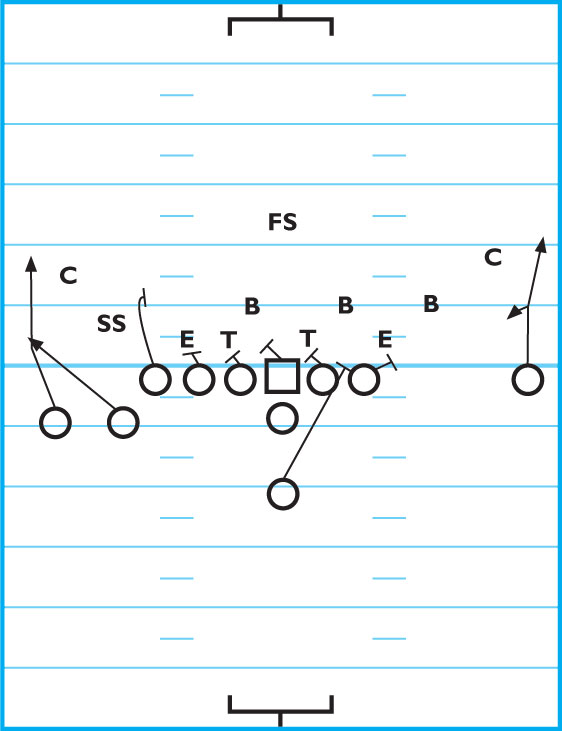
On the snap, the right offensive tackle blocks out against the defensive end. The right offensive guard blocks in against the defensive tackle. The running back fills the space between the OG and the OT and picks up a linebacker trying to come through the hole created.
The WR split left runs an out-and-up to tie-up the cornerback who must follow him. The strong safety is occupied by the TE, who is running a 5-yard pattern down the field. This opens space for the third WR to slip out and run into the flat on the left side of the field just a few yards deep.
If the corner doesn’t run with the far-left WR, the QB hits him on his third step in his dropback. If the strong safety doesn’t follow the TE, then the QB hits him. If both of those defenders do pick up those players, then the third WR should be wide open in the flat.
DIAGRAM 2: Zone Read 3-Step Drop. Your offense lines up in the same formation as the Y-Stick. The WR on the far right once again is the target is he is in single coverage.
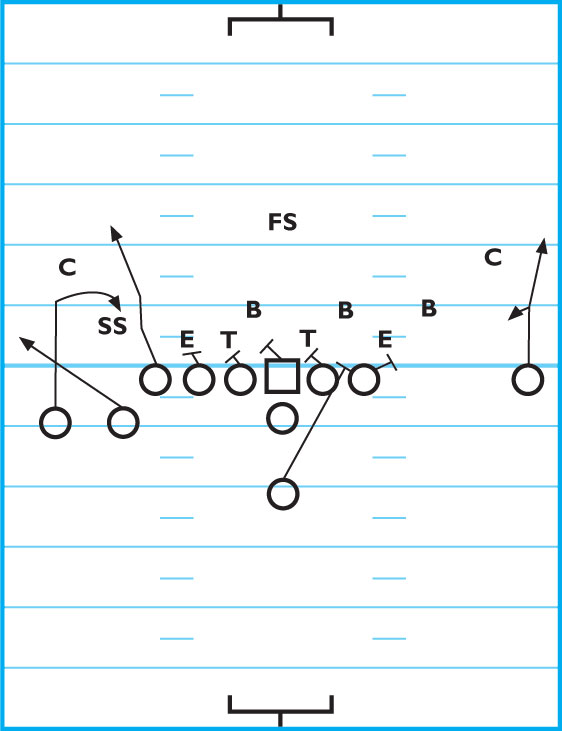
In this instance, the offensive line has the same responsibilities. The TE runs about 5 yards down the field, then breaks to the corner. This should make the SS follow him (if not, the QB hits him with a pass after his third step in the dropback). The far-left WR runs a 5-yard out, then hooks into the spot just vacated by the SS. This should draw the CB (if not, then he’s open for a pass). If both of these instances occur, then the third WR just off the LOS once again has an opening in the flat.
DIAGRAM 3: Zone Read (With Motion). In this instance, the third WR lines up on the right side of the field, farther away from the LOS. All offensive linemen block to their right.
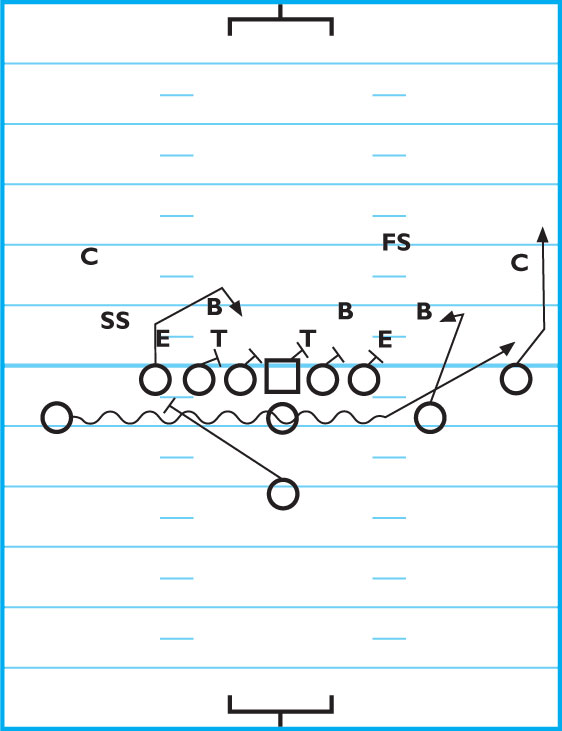
Before the snap, the WR on the left side of the field goes in motion. On the snap, the motion WR runs to the flat. The far-right WR runs an out-and-up to clear the CB out of the flat (if the CB doesn’t go, hit this WR with the pass). The third WR runs a 4-yard hook, which also creates room for the motion WR in the flat. The TE runs a 5-yard pattern settling into the middle of the field to attract a couple of LBs’ attention. If the LBs don’t react, then hit the TE over the middle on the third step of the dropback.