Help your quarterback perform his best in the midst of chaos.
While we spend a lot of fundamental time on throwing mechanics, footwork, ball handling, and timing, we spend more time preparing for the contingencies of playing quarterback than we do when the conditions are “just right”. I want my quarterback to be confident that he can make plays and throw with accuracy in almost any situation.
The following QB tips are critical in developing accuracy and efficiency in throwing the football:
• Practice all throws - this means different trajectories and velocities, balanced and unbalanced, hurried and unhurried, in the pocket and on the move.
• Practice all route types and practice them at different distances from the QB – e.g., to the field and to the boundary.
• Develop a “focal point”. Throw to a spot or area. Avoid watching the ball in flight and using a loose throwing motion.
• Keep eyes downfield. Learn to “feel” the rush, not watch it.
• Develop a “Boxer in the Ring” mentality when in the pocket. Have ankles under the armpits and work with small steps to ensure a balanced, powerful throw.
• Anticipate - throw with confidence to where the receiver will be, not where he is or only when he gets open.
• Stay committed to throws. Emphasize finishing with the throwing side of the body, particularly when on the move.
The following drills are designed to help quarterbacks thrive under pressure:
Distraction Drill
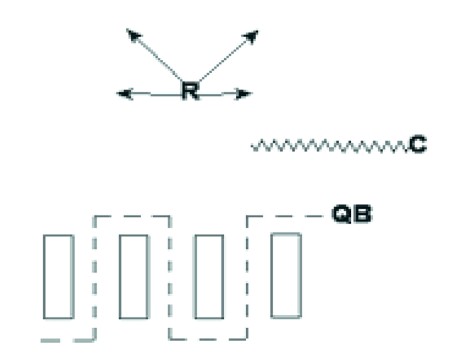
(Diagram 1)
• QB shuffles around bags that are one yard apart.
• He keeps his shoulders perpendicular to the LOS and uses short steps with his feet.
• The coach moves with the QB, providing a distraction and commanding “Ball” at a random point.
• On the “Ball” command, the receiver sprints in one of four directions.
• QB attempts to set his feet as quickly as possible, delivering an accurate throw.
Pocket Drill
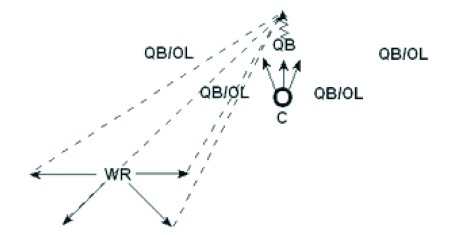
(Diagram 2)
• QBs form a pocket with one QB in the pocket.
• QB takes a designated drop from the gun or under center.
• Once the QB drops, the coach throws or rolls an exercise ball at the QB, causing him to take two or three shuffle steps to clear the moving ball.
• QB’s eyes should remain downfield at all times.
• The receivers are positioned to the top of a designated route (i.e., post, corner, dig, etc.)
When the coach throws the ball, the receiver finishes the route (not before) and the QB completes the pass after reacting to the exercise ball.
On the Move Drill
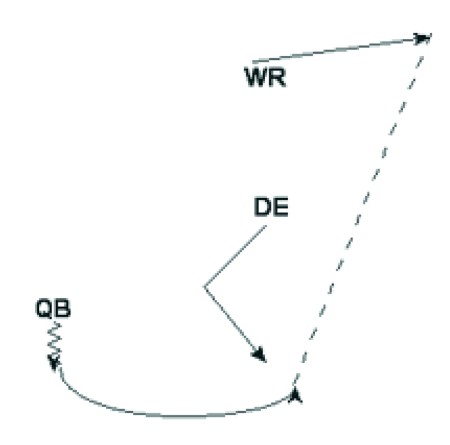
(Diagram 3)
• QB executes a designated bootleg play fake.
• As the QB bootlegs, the coach simulates a DE reacting to a bootleg and gives chase.
• As the QB rolls, the receiver moves, simulating the finish of a crossing route.
• The QB delivers the ball to the receiver on the move.
Point of emphasis – QB’s non-dominant shoulder should be directed at the target area while on the move. His hips should be up while taking short steps. Finish to the target area. Throw the ball so the receiver does not have to break stride or turn. Have his hands out to catch the ball.
Hot Throws (Gun)
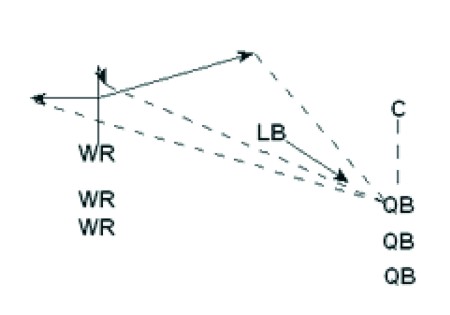
Diagram 4
• Coach rapid fire snaps to one QB after another.
• QBs get the ball out of their hands as fast as possible regardless of having laces or not.
• Receivers run quick slants, outs, or a hitch.
• A second coach can be added to provide distraction to the QB.
• Snapping coach can also sprinkle in some difficult-to-handle snaps.
• Be sure to vary the WRs distance from the QBs.
Escape/Scramble Drill (Version 1)
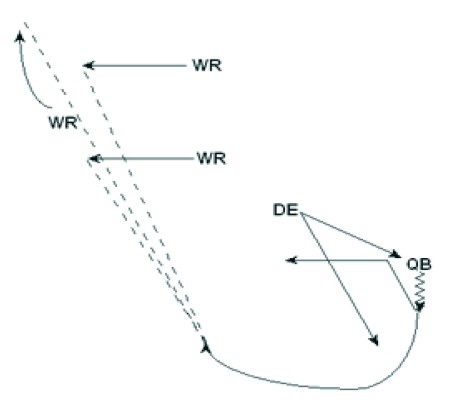
Diagram 5
• QB takes a designated drop and reacts to a simulated DE on a wide rush or an inside move
• On an inside move, the QB escapes outside the pocket by either flipping over his non-dominant shoulder or arcing around the rusher to his dominant side.
• On the wide rush, the QB shuffles up in the pocket and slides parallel to the LOS to escape.
• Once outside the pocket, the QB reacts to a receiver in scramble mode either by going deep or moving with the QB at an intermediate or short depth.
• The coach should teach whatever scramble principles he has for this drill.
Escape/Scramble Drill (Version 2)
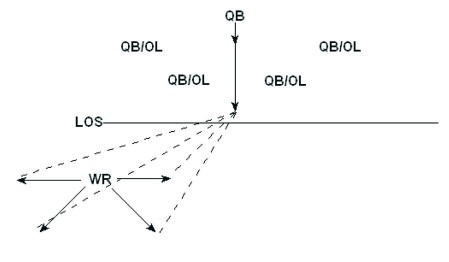
Diagram 6
• QBs form a pocket with one live QB in the pocket in the “Set Up” position.
• QB shuffles three steps and then takes off running as if he is going to scramble.
• When the QB gets approximately one yard from the LOS, the receiver, simulating a check down route, either stays stationary, flashing his hands, or takes off right or left causing the QB to react.
• The QB reacts to the receiver by throwing a little touch pass or a shovel pass before he crosses the LOS.
We use these drills, among others, to prepare our quarterbacks for as many conceivable game situations as possible. In the end, we hope we have
I hope these ideas can benefit you in developing your quarterbacks and I encourage you to be creative in putting your quarterbacks in situations in practice that they will experience in a game.
About the Author: Jim Svoboda starts his fourth season as head coach at the University of Central Missouri in 2013. He previously served on the Montana State staff as both assistant head coach and quarterbacks coach. Svoboda coached at UCLA (2004-2006) and spent 10 years at Northwest Missouri State. He also was head coach at Nebraska Wesleyan for seven seasons. Svoboda is a 1983 graduate of Northwestern College in Iowa.