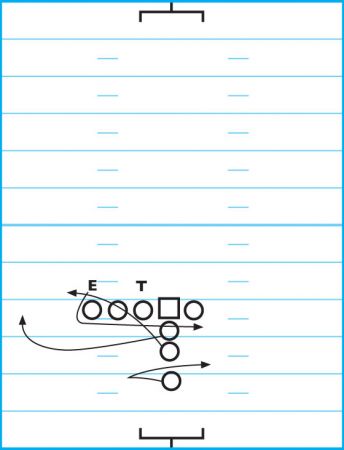
OUR TEAM EMPLOYS a stack 4-3 defense. As such, our defensive front plays an attacking “read-on-the-run style” where the defensive line reacts to schemes while making an upfield charge.
We instruct our linemen to react to these schemes much like most teams that run a stack 4-3. It’s how we react to a veer-release scheme, however, that is unique.
We categorize blocking schemes into three areas: single, combination and release schemes. There are specific blocks that are common to each area.
Single Combination Release
Schemes
Reach Scoop Arc
Cutoff Combo Veer
Base Double Pull influence
Hi-wall Down and fold
Pass set Down and pull
Taking On A Veer Scheme
A veer scheme is defined as any time an offensive lineman takes an inside release vs. an outside aligned (1-, 3-, 5- or 9-technique) defensive lineman. The definition includes a backside offensive tackle’s release to the second level on the play away.
We teach our defensive linemen to take off with a 6- to 8-inch power step, keying the gap V of the neck with a hand landmark of the breast plate of the offensive lineman he is lined up against. As the offensive lineman takes an inside release, part of the landmark will disappear. Because of the shoulder-to-shoulder outside alignment our team employs, our defensive linemen will only be able to get a forceful blow with the inside hand on the outside breast of the opposing lineman.
While taking his second step, he reaches for the inside hip pad of the offensive lineman, getting close, but not quite reaching it. This technique forces him to get his shoulders turned perpendicular to the line of scrimmage.
On his third step, he shoves the releasing offensive lineman inside, enabling the LB to get over the top of the down block. At the same time, he should eye up what is coming at him and react accordingly.
DIAGRAM 1:
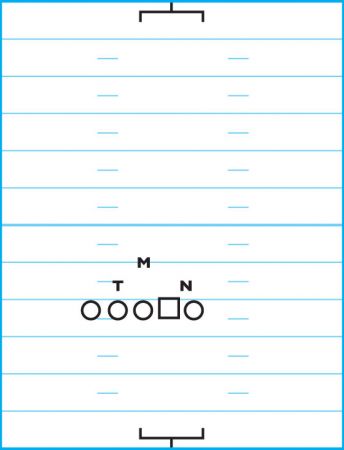
If the defensive lineman is a 3-technique, he should expect a trap or mid-line option. If he’s a 5- or 9-technique, he can expect a kick out or log by a guard, a fullback veer option or a play away.
DIAGRAM 2:
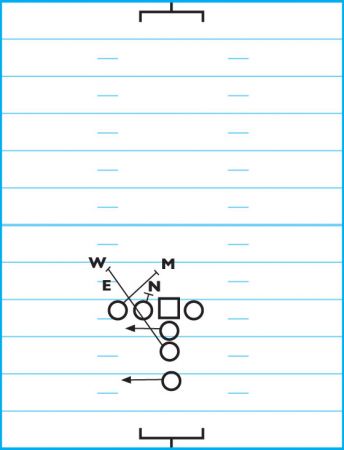
Against the veer option, the defensive end is responsible for dive plays. However, when we recognize that an option play is coming, we know that our initial inside presence gives the QB a pull read by squaring up to the LOS. When that happens, the 5-technique becomes an extra player on the QB with the capability of running to the pitch. If he sees that the ball is handed off, he must tackle the fullback.
Against good veer-option teams that run few gap-scheme plays, you can change up your defensive end technique to something we call “heavy,” which tells the DE to tighten his alignment. This tighter alignment allows you to get better hands on the veer-releasing tackle, which gives your LB greater protection. The DE must squeeze the tackle’s release while keeping his shoulder square to the LOS. This gives him a more realistic chance to become an extra player on the QB.
DIAGRAM 3: The end’s responsibility is to dive toward the QB. He will wrong arm and pry all kick-out blocks in the base technique.
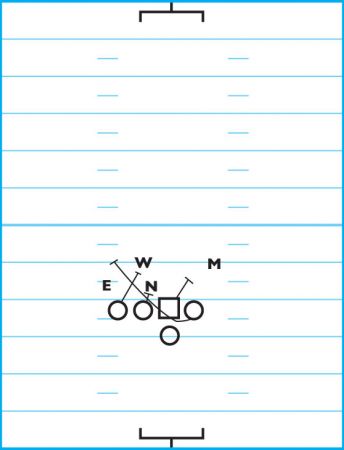
DIAGRAM 4: If the DE sees a log path by a guard, he must get outside of it. On any play away, the 5- or 9-technique chases behind the LOS and becomes a factor on the play. On plays away with wide flow, the DE checks for boot legs, then pursues.