When ‘Killer Red’ is called, any one of nine different players can rush the quarterback.
Over the past few years we have leaned heavily on one call on third and long situations. “Killer Red” has given up 2.0 yards per play over the last two seasons. We ran it 27 times last year and gave up three first downs (two of which were by penalty). In retrospect, we probably should have run Killer Red twice as many times. We run Killer Red out of a 3-3 look, but I have run variations over the years out of 4-3 and 3-4 alignments. It is edge pressure from both sides with two three techniques and a head up nose guard which can be called a bear front. The beauty of the call is its ability to adjust to offensive numbers both horizontally and vertically. By vertically, if the TE adds to the blocking surface up front, we automatically add to the rush surface.
It is assumed when the call is made that the two OLBs are coming on the blitz (10 personnel). Against a simple 2 x 2 set, it is just the two OLBs (Diagram 1) coming off the edge. 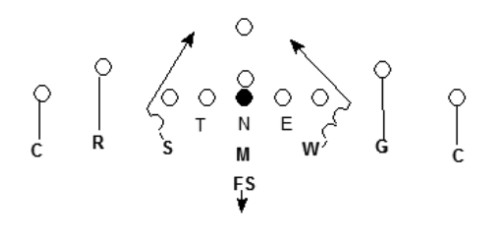
Against trips, it is essentially the same but we “rock” the safeties to cover (Diagram 2).
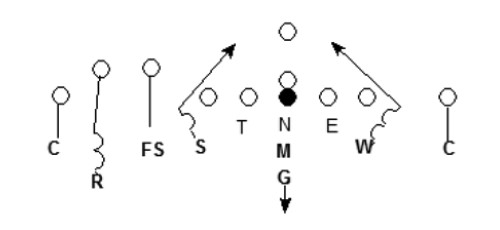
In this system, DBs only cover wide receivers and LBs only cover backs and TE’s with their hand on the ground. When heavier personnel is involved, we use the “Tora” system where LBs cover down all backs and TEs and safeties replace them off the edge. For example, if it is 2 x 2 with one TE, one side will be just like doubles, but the other side will make a “Tora” call
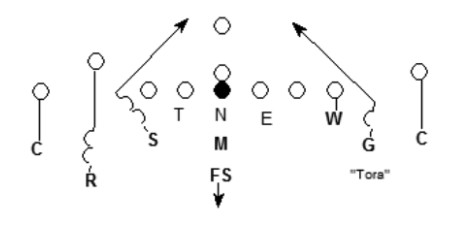
(Diagram 3).
• We could make a “Tora” call on both sides
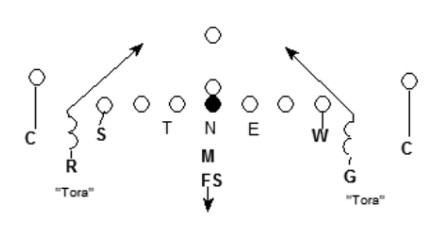
(Diagram 4).
• If there is a combination of Trips and a TE, then we will rock the safeties and make a “Tora” call
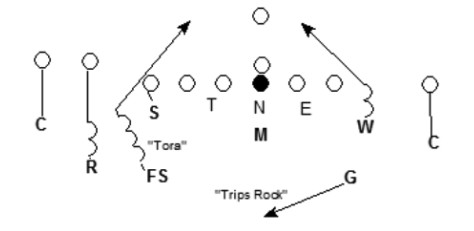
(Diagram 5).
• If it is trips away from a TE, we would go “corners over” and make a “Tora” call to the boundary
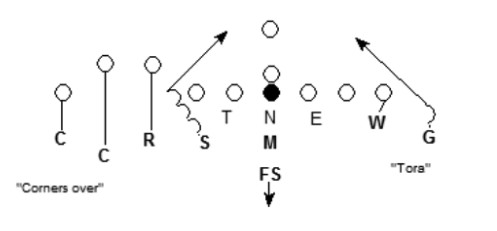
(Diagram 6).
• Two backs with no TE would still create a “Tora” situation
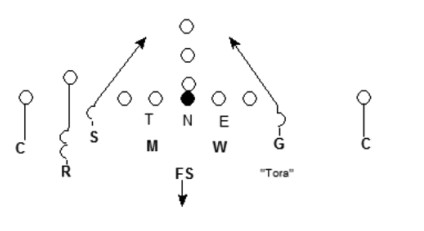
(Diagram 7).
• A pro formation would also invoke a double “Tora”
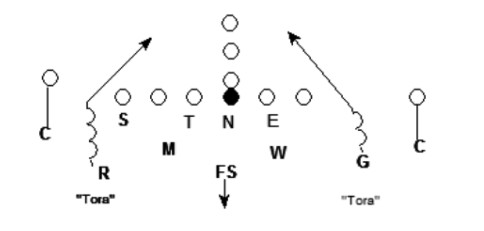
(Diagram 8).
Players love Killer Red because when that call is made, any of nine different players may get a chance to rush the passer. I include the Mike linebacker who is technically covering a back, but often gets to rush when the back stays in for protection.
About the Author: Carey Baker joined the Henderson State staff in the summer of 2010 and now serves as the defensive coordinator. At Tennessee, he lettered at fullback and began his coaching career at Southern Arkansas University. Baker has also coached at Southern Mississippi and Georgia Southern.